
West Indies vs Zimbabwe: 254/6 Super 8 Analysis & Lessons
West Indies vs Zimbabwe: deep Super 8 analysis of WI’s record 254/6 and a 107-run win, with phase tactics, matchups, and chase collapse.
West Indies vs Zimbabwe: How 254/6 Became the Biggest Total of T20 World Cup 2026
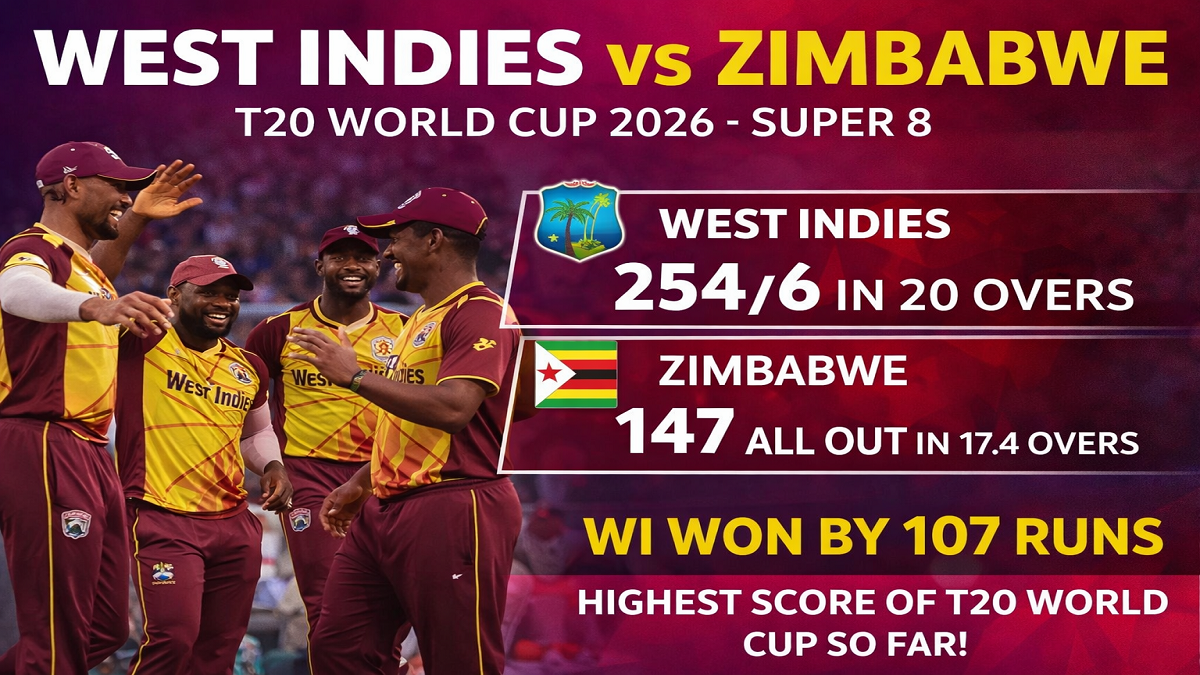
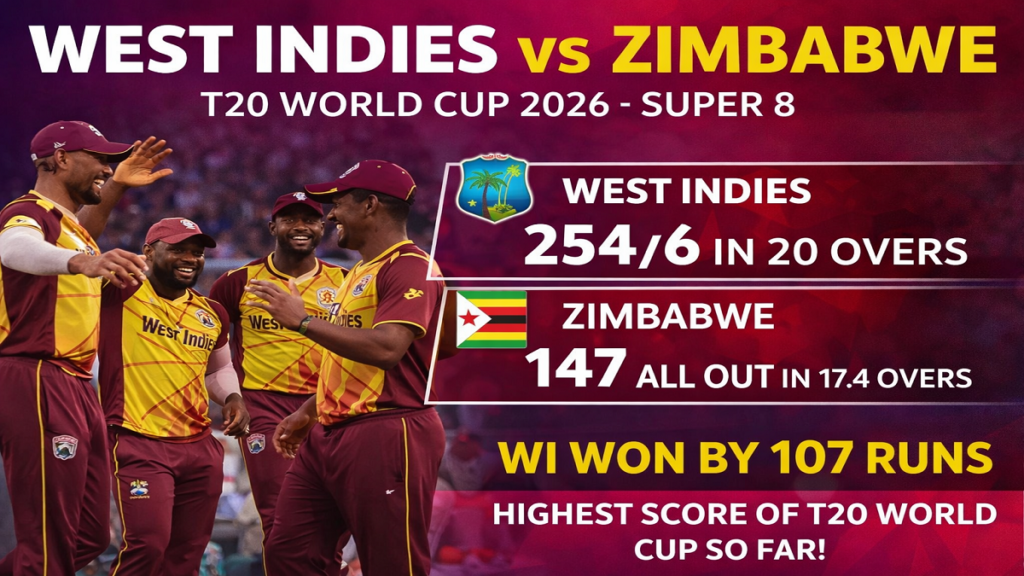
The Super 8 clash between West Indies and Zimbabwe in the T20 World Cup 2026 was far more than just another high-scoring match. It was a statement about modern T20 batting, about how pressure multiplies once a total crosses 230, and about how quickly a chase can collapse when the required rate removes patience from the equation. West Indies finished on 254/6 in 20 overs, which at that stage stood as the highest total of the tournament before Ireland later posted 235. Zimbabwe responded with 147 all out in 17.4 overs, and the 107-run margin reflected not only the size of the first innings but the complete control West Indies maintained from start to finish.
If you followed the result through the Live Scores section or checked the upcoming fixtures via the Schedule, the numbers alone were enough to draw attention. However, West Indies vs Zimbabwe deserves a deeper look because this match explains how extreme totals are built, how they are defended, and why they often feel decided long before the final wicket falls.
West Indies vs Zimbabwe Match Summary: 254/6 and Complete Control
In simple terms, West Indies controlled the match from start to finish. They scored 254/6 in 20 overs. Then they bowled Zimbabwe out for 147 in 17.4 overs. The 107-run victory gave them a big boost in net run rate. It also strengthened their position in the Super 8 stage. However, the numbers alone do not explain how the total became so massive. Nor do they show why Zimbabwe never found rhythm in the chase.
West Indies vs Zimbabwe was shaped by three interconnected factors: a controlled yet aggressive powerplay, middle-overs acceleration without stagnation, and fearless death-over finishing. On the bowling side, West Indies did not need extraordinary deliveries. They needed disciplined lengths and intelligent field placements that forced Zimbabwe into increasingly risky shots.
To understand why 254 was possible and why 255 became unrealistic, we need to break the game into phases.
Powerplay Analysis: Setting the Tone Without Losing Structure
The powerplay is often described as the launchpad of a T20 innings, but in extreme totals like 254, it is more accurate to call it the foundation. West Indies vs Zimbabwe likely began with clear intent, yet that intent was not reckless. The most important aspect of a big powerplay is not just scoring quickly; it is scoring quickly without triggering a collapse.
In modern T20 cricket, high-percentage powerplay scoring zones are straight down the ground and square through off side when width is offered. West Indies’ top order traditionally prefers attacking bowlers who miss length early. If Zimbabwe offered even marginally overpitched deliveries, they would have been punished. If short balls sat up, they would have been pulled hard. That early punishment forces captains to spread the field faster than planned.
Once the field spreads, the bowling side loses one of its primary wicket-taking tools: close catchers. Defensive fields are necessary to stop boundaries, yet they also make it harder to create edges that carry to slips or short covers. West Indies vs Zimbabwe likely turned at that moment. Once Zimbabwe shifted into containment mode, West Indies were free to choose which overs to attack instead of being forced into risk every ball.
Equally important is wicket preservation. In any attempt to reach 250, losing three wickets inside six overs changes everything. West Indies avoided that trap. Even if they lost one wicket, the presence of depth meant the run rate did not stall. A stable powerplay of 60 to 75 with minimal damage sets the platform for a huge score. Without that base, the middle overs become repair work rather than expansion.
Middle Overs Breakdown: The Real Engine of 254
The middle overs, usually from 7 to 15, are where many T20 innings slow down. Spinners come into the attack. The field spreads. Dot balls start to build pressure. In this match, though, that phase did not slow West Indies down. Instead of surviving, they kept the run rate moving and expanded the innings with control.
The key concept in middle overs is rotation. Boundaries are valuable, but consistent singles and twos are what prevent bowlers from building dot-ball pressure. Dot balls create urgency. Urgency creates forced shots. West Indies denied Zimbabwe that chain reaction by keeping the scoreboard moving even when boundaries were not immediate.
Another crucial factor is identifying the over to spike. In almost every 240-plus total, there is at least one over in the middle phase that swings the projected score significantly. That over might go for 18 to 22 runs and changes the captain’s approach. Once one bowler is exposed, field placements shift and bowling rotations become reactive rather than proactive.
West Indies vs Zimbabwe likely featured such a spike. It could have been against a spinner who missed length or a seamer who relied too heavily on predictable slower balls. Once that over landed, the innings would have moved from “big” to “dangerous.” A projection of 210 suddenly becomes 230, and 230 with five overs left becomes 250.
The most impressive aspect of extreme totals is not the sixes themselves but the absence of stagnation. If an innings never dips below eight or nine per over in the middle phase, the death overs begin from a position of strength. That is what appears to have happened here.
West Indies vs Zimbabwe Death Overs Masterclass: From 220 to 254
The death overs are where strong totals turn into statement totals. To move from 220 to 254 requires clarity, composure, and depth. West Indies vs Zimbabwe showed all three.
Death-over batting is less about improvisation and more about anticipation. Batters expect yorkers and slower balls. If the bowler misses by even a few inches, the ball disappears. A low full toss is driven for six. A short ball that lacks pace is pulled into the stands. Under pressure, bowlers struggle to maintain exact lengths, and that is where the batting side extracts maximum value.
Trading wickets for runs is also part of the equation. A team pushing for 250 cannot play conservatively in the final overs. Losing a wicket in pursuit of an extra 15 runs is acceptable when depth allows continuous aggression. West Indies’ lineup gave them that freedom. Even if a set batter fell, the next one could attack immediately.
Zimbabwe’s challenge in this phase would have been execution. At 200-plus on the board, every bowler feels the need to be perfect. Perfection under pressure is rare. That is why death overs so often define extreme totals.
West Indies vs Zimbabwe Bowling Analysis: Defending With Discipline
Defending 254 is a different type of challenge. While the total itself exerts pressure, the bowling side must still execute smartly. West Indies vs Zimbabwe did not require magic deliveries; it required a plan built around denying boundaries and letting the required rate amplify mistakes.
When a team is chasing 255, singles are not dangerous. Boundaries are. Therefore, protecting the boundary becomes the primary defensive tactic. Hard lengths into the pitch, wide lines to force hitting against the angle, and well-placed deep fielders all reduce clean striking options.
Dot-ball sequences become lethal in such chases. Two dots in an over at a required rate above 12 can feel like defeat. The batter feels compelled to attempt a big shot on the third or fourth ball. That is where wickets come from. West Indies likely relied on this pattern repeatedly.
Zimbabwe were bowled out for 147 in 17.4 overs, which indicates collapse rather than measured defeat. Collapses in large chases usually occur because batters are forced to attack against the field rather than with it. Once that pattern begins, wickets fall in clusters.
West Indies vs Zimbabwe Chase Analysis: Why 255 Was Always a Pressure Trap
A chase of 255 demands 12.75 per over from ball one. That is not just a number; it is a psychological constraint. In most T20 games, an over of 10 is solid. In this game, 10 was insufficient. Even 12 was barely adequate. That reality compresses decision-making.
Zimbabwe needed an explosive powerplay without losing wickets. If early wickets fell, the chase would lose structure. Without structure, batters begin swinging in isolation rather than building partnerships.
The middle overs then become a race against the required rate. If the rate climbs to 14 or 15, each over demands two boundaries. If those boundaries do not arrive, pressure compounds. Once the required rate touches 16 or 17, rational cricket gives way to probability. The probability of successful chase decreases sharply because boundary frequency becomes unsustainable.
West Indies vs Zimbabwe likely followed that trajectory. Zimbabwe may have started aggressively, but once wickets fell and the rate climbed, the chase entered desperation mode. Desperation produces false shots. False shots produce catches.
West Indies vs Zimbabwe Turning Point: The Moment the Chase Slipped
In high-scoring matches, the turning point is often subtle. It may not be a spectacular wicket; it may be a quiet over. In West Indies vs Zimbabwe, the turning point was likely when Zimbabwe realized they were falling behind the required rate despite attacking.
A typical scenario might have seen Zimbabwe at 70/3 after eight overs, needing 185 from 12. That equation is nearly 16 per over. At that stage, even a good over of 12 feels insufficient. The psychological impact of that gap is enormous.
Once that realization sets in, batters often premeditate earlier in the count. They swing at second balls, third balls, rather than building with singles first. That shift increases dismissal probability significantly.
West Indies vs Zimbabwe Tactical Lessons for Super 8
This match reinforces several tactical lessons relevant to the Super 8 stage and beyond. First, middle overs decide extreme totals. Powerplay fireworks alone cannot produce 254; sustained acceleration between overs 7 and 15 is essential.
Second, depth changes risk tolerance. A deep batting lineup allows fearless finishing. Without depth, batters hesitate. Hesitation slows totals and invites pressure.
Third, dot balls are as valuable as wickets when defending huge scores. Wickets often follow dot pressure. West Indies did not need extravagant spells; they needed consistent discipline.
Fourth, chasing 250-plus requires near-perfection. One quiet over can be tolerated. Two or three often cannot. Teams must accept that not every target is realistically chaseable without extraordinary conditions.
West Indies vs Zimbabwe and the Tournament Context
At the time of this match, West Indies’ 254/6 stood as the highest total of the T20 World Cup 2026 before Ireland later reached 235. That difference highlights the scale of the performance. It was not simply above par; it was above the tournament trend.
For team-specific context, readers can explore the West Indies page and the Zimbabwe page to compare squad performances across matches. Other West Indies performances, such as the controlled win covered in West Indies vs Italy – Shai Hope’s 75 Seals 42-Run Victory, show the team’s ability to win without extreme totals. Meanwhile, Zimbabwe’s resilience in Sri Lanka vs Zimbabwe – Zimbabwe Seal Epic Chase in Colombo demonstrates that they are capable under manageable chase conditions.
Official tournament updates and statistics remain available on the ICC website, while broader coverage can be found in the News section and in the T20 World Cup 2026 category.
Conclusion: West Indies vs Zimbabwe as a Super 8 Blueprint
West Indies vs Zimbabwe was more than a high-scoring spectacle. It was a blueprint for building and defending extreme totals. West Indies combined controlled aggression, middle-overs expansion, and fearless finishing to reach 254. Then they used disciplined bowling and intelligent field placements to turn 255 into a pressure trap.
Zimbabwe’s 147 all out reflects not just a batting failure but the reality of chasing beyond comfortable limits. The required rate removed patience, and the pressure created mistakes.
In Super 8 cricket, where margins are tight and momentum matters, performances like this reshape expectations. West Indies demonstrated that they can lift the scoring ceiling of the tournament and defend it with composure. That combination makes them one of the most dangerous sides in the competition.
Stay Tuned – Play Live Cricket
Follow ongoing match coverage through:
Disclaimer
This article is written for informational purposes based on match context and cricket analysis. For official statistics and verified tournament information, refer to the ICC website.