
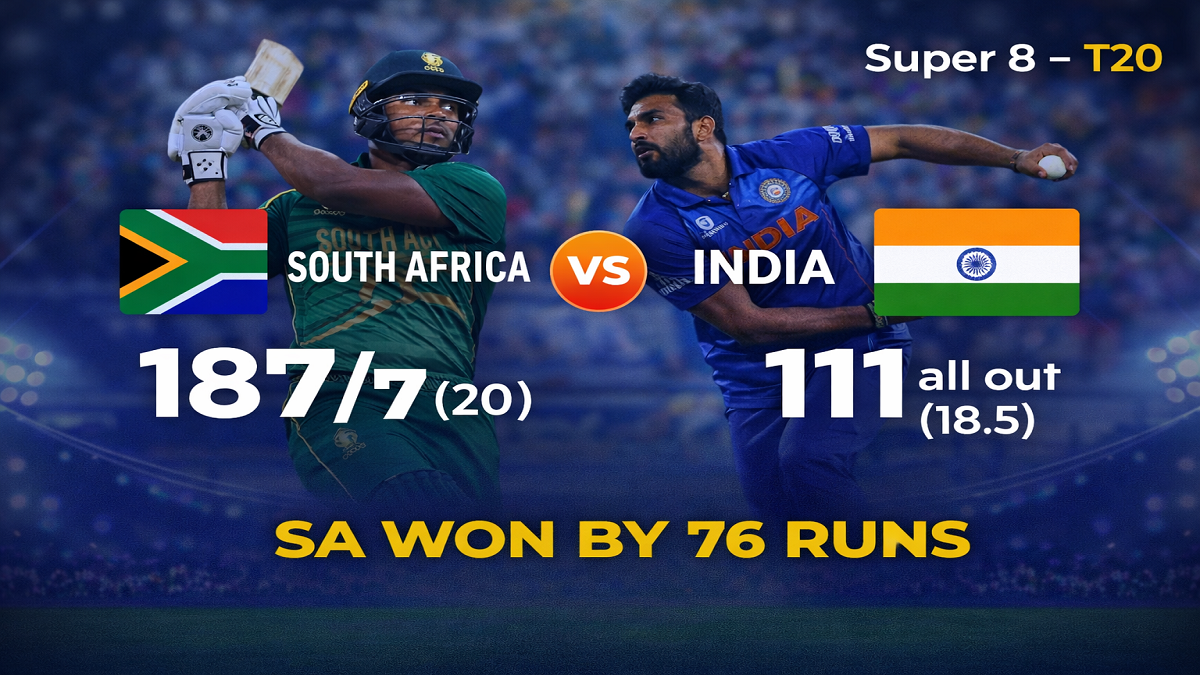
South Africa vs India: Super 8 Expert Analysis (187/7)
South Africa vs India Super 8 analysis: why SA’s 187/7 became a 76-run win, with phase-by-phase tactics, key matchups, and chase collapse.
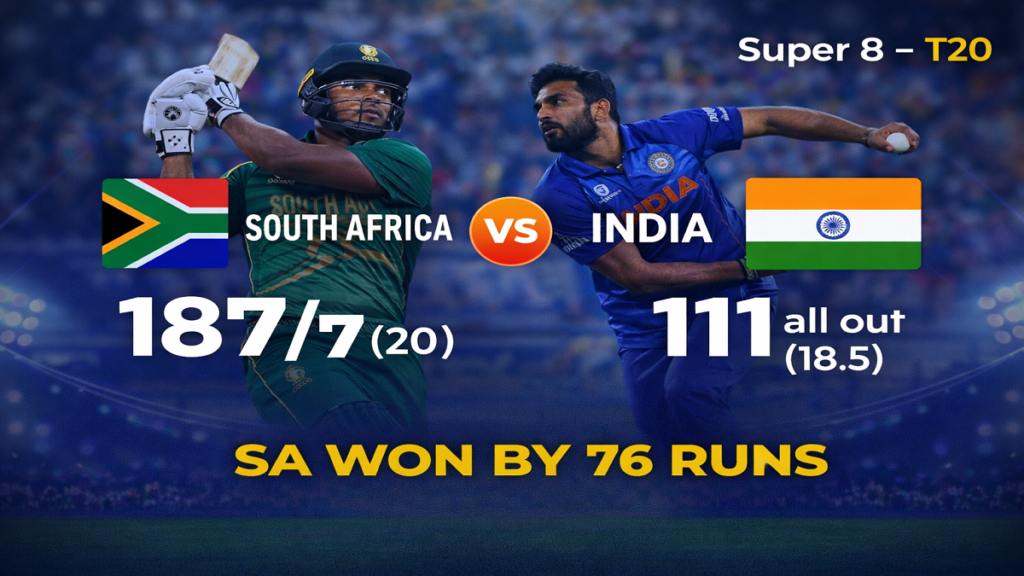
South Africa vs India Super 8 Match Analysis: Why 187/7 Became a 76-Run Statement Win
A 76-run win in a Super 8 game is not “just one bad day.” It’s usually a full tactical mismatch — one team controls the tempo with the bat, and then doubles down with relentless pressure while defending. That’s exactly what happened here.
South Africa posted 187/7 in 20 overs, a total that sits in the “pressure-plus” zone: not impossible to chase, but high enough to force the chasing side to keep winning every phase. India, however, never got close to that level of control. They were bowled out for 111 in 18.5 overs, meaning the chase didn’t merely fall short — it collapsed in slow motion, with the required rate rising and wickets falling in the exact pattern a disciplined bowling side wants.
This is a perfect pillar-style match for Play Live Cricket because it teaches the real currency of T20 cricket: phase wins, matchup hunting, and pressure stacking. Let’s break it down like a cricket analyst would — not only what happened, but why it happened.
England vs Sri Lanka: Expert Super 8 Analysis (146/9)
South Africa vs India: Match Snapshot
- South Africa: 187/7 (20.0 overs)
- India: 111 all out (18.5 overs)
- Result: South Africa won by 76 runs
At first glance, 187 is a strong total. However, what makes it truly dangerous is how it’s structured. In fact, the best T20 totals are built with multiple scoring gears — powerplay intent, middle-overs stability, and death-overs damage. South Africa did enough in each phase to ensure India had no breathing space in the chase.
South Africa vs India The Key Theme: South Africa Won the “Tempo War”
In T20, the scoreboard is only half the story. The other half is tempo — the ability to decide when the game speeds up and when it slows down.
- With the bat, South Africa ensured they had at least one batter (or partnership) controlling the innings at any given time.
- With the ball, they denied India easy starts and, consequently, forced boundary-hunting under pressure.
As a result, India were not just chasing runs; they were chasing momentum — and they never caught it.
South Africa’s Batting: How 187/7 Was Built (Phase-by-Phase)
South Africa vs India Phase 1: Powerplay (Overs 1–6) — Intent Without Chaos
A strong powerplay does not always mean maximum risk. Instead, it means maximum clarity. South Africa’s early plan likely included:
- taking advantage of field restrictions with “safe” boundary options (straight hits, hard-wired gaps)
- protecting wickets while still pushing the run rate
- forcing India to change lengths early (which creates loose balls later)
Even if South Africa didn’t go crazy in the first six overs, they likely achieved something equally valuable: a platform with intent.
Why it matters: if your powerplay is structured, the middle overs become a launchpad rather than a repair job.
South Africa vs India: The powerplay battle India needed (but didn’t win)
For India to keep 187 in check, they would need:
- 2 wickets in the powerplay, or
- a powerplay under ~45 while keeping boundaries minimal
If South Africa got ahead early — even slightly — it set the tone for the rest of the innings.
Pakistan vs New Zealand Abandoned: What It Means in Super 8
South Africa vs India Phase 2: Middle Overs (Overs 7–15) — The “Control + Spike” Model
This is usually where big totals are either built or wasted. In these overs, good teams do two things:
- Rotate strike consistently (avoid dot-ball pressure)
- Spike the innings with targeted boundary overs (one 14–18 run over changes the scoreboard)
South Africa’s 187/7 suggests they did not rely on one massive passage. Instead, they likely stacked several smaller wins:
- a couple of overs at 10–12
- steady 7–9 run overs in between
- and minimal “dead overs” (overs of 3–5 runs)
South Africa vs India: Why this is elite T20 batting
If you keep scoring at 8–9 in the middle overs without losing control, you walk into the death overs with wickets and momentum. Consequently, 170 becomes 185+ very quickly.
South Africa vs India Phase 3: Death Overs (Overs 16–20) — “Value Hitting” Over Wild Swinging
South Africa finished at 187/7, which often indicates:
- they found enough boundaries late
- yet also lost wickets trying to maximize
That is not necessarily a weakness. In fact, late wickets are acceptable if the trade-off is 15–25 extra runs. Moreover, in high-pressure Super 8 games, those extra runs become psychological weight in the chase.
South Africa’s ideal death-overs formula likely included:
- targeting specific bowlers (the weaker death option)
- looking for straight boundaries (highest percentage)
- using pace against pace (ramps, open-face, lap sweeps) if yorkers arrived
Ultimately, 187 wasn’t just a total — it was a statement of controlled aggression.
India’s Bowling: Where the Game Slipped
If you concede 187/7, you don’t automatically bowl “badly.” However, you usually lose key moments.
Here are the common bowling leaks that inflate totals into 185+:
1) One “release” over in the middle
Even a single over of 16–18 in overs 9–13 changes the match. It also forces captains to protect bowlers later, which weakens death options.
2) Missed execution at the death
If yorkers become low full tosses or slower balls become predictable, batters feast. Therefore, a decent 168 becomes 185+.
3) Dot balls not followed by wicket pressure
Dot balls create pressure only if they lead to wickets or boundary denial. If you bowl two dots and then leak a boundary ball, you’ve gifted the batter the best outcome: reset plus reward.
South Africa’s final total suggests they found those “soft points” — not everywhere, but enough.
The Chase: Why India Collapsed to 111 (18.5 Overs)
Chasing 188 requires two non-negotiables:
- A strong powerplay foundation
- One stable partnership that carries through the middle
India got neither. And once you lose both, the chase becomes a spiral: required rate climbs, shot selection narrows, and wickets fall in clusters.
South Africa vs India Phase 1: Powerplay Collapse — The Chase Loses Shape Early
Even if the required rate starts around 9.4, you can chase it if you begin well. However, if you lose early wickets, everything changes.
Early wickets do three things:
- force your middle order to arrive before the ball softens
- remove your best boundary hitters (or their freedom)
- and allow the bowling side to attack with aggressive fields
In other words, the chase loses its shape. Consequently, your batters stop playing “innings roles” and start playing survival.
South Africa vs India Phase 2: Middle Overs Squeeze — Dot Balls Became a Trap
Once India’s innings entered the middle overs, South Africa’s best weapon likely became the squeeze.
A squeeze is created by:
- hard lengths into the pitch (no easy drives)
- cutters/pace-off (no easy timing)
- boundary riders that turn “good hits” into singles
- and bowlers who hit plans ball after ball
The key statistic conceptually isn’t just wickets — it’s dot-ball percentage. If India faced too many dots, the required rate would jump from 9 to 10.5 to 12. Once that happens, batters begin manufacturing boundaries, which is exactly when edges, top-edges, and miscues appear.
Therefore, the collapse often looks like this:
- a wicket triggers a quiet phase
- a quiet phase triggers a risky over
- a risky over triggers another wicket
That chain reaction is how 111 all out happens.
South Africa vs India Phase 3: No Platform = Desperation Cricket
To chase 188, you generally want something like:
- 55–65/2 after 6, or
- 85–95/3 after 12–13
India were all out for 111 in 18.5, which strongly implies they never reached a credible platform. Instead, the innings likely kept “restarting” after every wicket.
And when you keep restarting a chase, you run out of overs before you run out of hope. Eventually, hope turns into low-percentage shots — and low-percentage shots end in catches.
South Africa vs India: The Turning Points That Decide Big Chases
In matches like this, there are usually 3–4 key turning points:
1) A wicket inside the first 12 balls
This is the fastest way to break chasing intent. It also gives the bowling side instant belief.
2) A double-wicket over in the middle
Clusters kill chases. A two-wicket over doesn’t just remove batters — it removes continuity.
3) A boundary drought (12–18 balls without a boundary)
This is the silent killer. The moment a batter feels he “must” hit one, he often hits out of shape.
4) A top-order wicket at the exact moment the chase needs acceleration
When the chase is wobbling, you need your best batter to control the tempo. If he falls right when the required rate spikes, the chase typically collapses.
South Africa’s 76-run margin suggests they hit at least two of these turning points perfectly.
Why South Africa’s Total Was “Bigger Than It Looks”
This is an important pillar concept for your readers:
A total becomes “bigger” when the bowling side can defend it in multiple ways.
South Africa likely had:
- at least one powerplay strike option
- at least one middle-overs squeeze bowler (often spin or cutters)
- and at least one death-overs execution bowler
Therefore, India couldn’t “target one phase” to win the chase. They had to win all phases, and that is extremely difficult under Super 8 pressure.
South Africa vs India: Tactical Masterclass
1) They protected the straight boundary
Most batters score fastest straight. So teams defend it by:
- bowling into the pitch
- mixing pace
- and setting long-on/long-off early
2) They forced India to hit to the bigger side
Captains often set fields so batters must hit into longer boundaries, especially when under pressure. Consequently, mistimed lofted shots become catches.
3) They Used Matchups Aggressively
In T20 cricket, captains do not simply bowl their “best bowler” at random. Instead, they deploy the most effective matchup for the situation. Smart bowling is about exploiting weaknesses, not just relying on reputation.
For example, when a batter struggles against away movement, the bowling side deliberately angles the ball across him. Similarly, if a player is uncomfortable against hard lengths into the pitch, the strategy shifts toward hitting that zone repeatedly. On the other hand, when a batter thrives on raw pace, bowlers cleverly take speed off the ball to disrupt timing.
Through these subtle adjustments, pressure steadily builds. As a result, the batter is forced into shots that carry higher risk than reward. Ultimately, this is how disciplined bowling attacks manufacture false strokes without needing unplayable deliveries.ng attacks create “false shots” without needing unplayable deliveries.
South Africa vs India: What India Can Learn From This Loss
1) Chases require one batter to bat deep
To chase 188, at least one top-order batter must be there late. Without that, finishing becomes guesswork.
2) Rotation is as valuable as boundaries
You cannot chase big totals with boundaries alone, because boundaries come and go. Rotation, however, keeps the required rate stable. When rotation dies, pressure doubles.
3) Don’t let the required rate touch 12+
Once the chase crosses that line, you stop playing cricket and start playing probability. And probability usually favors the bowling team.
What South Africa Can Take Forward (Why This Win Matters)
This wasn’t just a win — it was a message that South Africa can:
- build 180+ totals with structure
- absorb wickets without panic
- and defend with multiple bowling plans
In Super 8 and knockout cricket, that combination is what separates contenders from tourists.
South Africa vs India: Simple “Phase Scorecard” Summary
South Africa (187/7)
- Powerplay: intent + platform
- Middle overs: rotation + targeted spikes
- Death overs: value hitting to push beyond par
India (111 all out)
- Powerplay: early damage created chase pressure
- Middle overs: squeeze increased dot balls and forced risk
- End: no platform, desperation shots, collapse before 20 overs
South Africa vs India: FAQs
Is 187 always a winning total?
Not always. However, it becomes highly defendable when your bowling unit can win at least two phases — especially powerplay + middle overs.
Why do big chases collapse so quickly?
Because once the required rate rises, batters reduce options. Consequently, they attempt riskier shots more often, which increases dismissal probability.
What’s the biggest difference between strong and weak chasers?
Strong chasers control tempo through rotation and partnerships. Weak chasers chase boundaries, not the game.
Play Live Cricket
Stay tuned to Play Live Cricket for Super 8 match analysis, tactical breakdowns, and expert-level cricket opinion that goes beyond the scorecard. We cover how games are won in phases, how matchups shape momentum, and why certain totals become “bigger than they look” under pressure. Explore our live scores, match schedules, and team pages to follow every major T20 tournament with deeper insight.
Disclaimer
This analysis is based on match data, tactical observation, and cricket interpretation for informational purposes only. While we aim for accuracy, readers should verify official stats through authorized tournament sources. Play Live Cricket is not affiliated with any cricket board or tournament organizer unless stated. Predictions and opinions reflect analysis at the time of writing and are not guarantees of future outcomes.