South Africa Beat Pakistan in 1st Women’s T20I Thriller
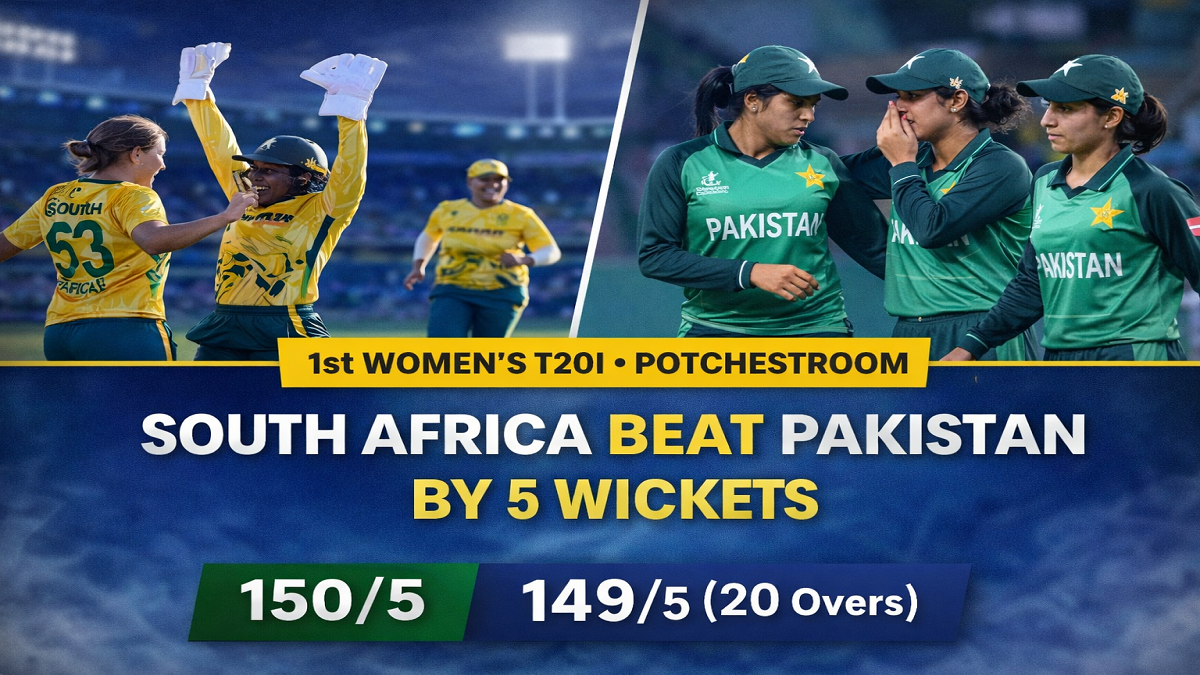
South Africa beat Pakistan by 5 wickets on the last ball at Potchefstroom as Wolvaardt hit 61 and Reyneke starred in a tense chase.
South Africa Beat Pakistan in Women’s T20 Series Opener After a Last-Ball Finish at Potchefstroom
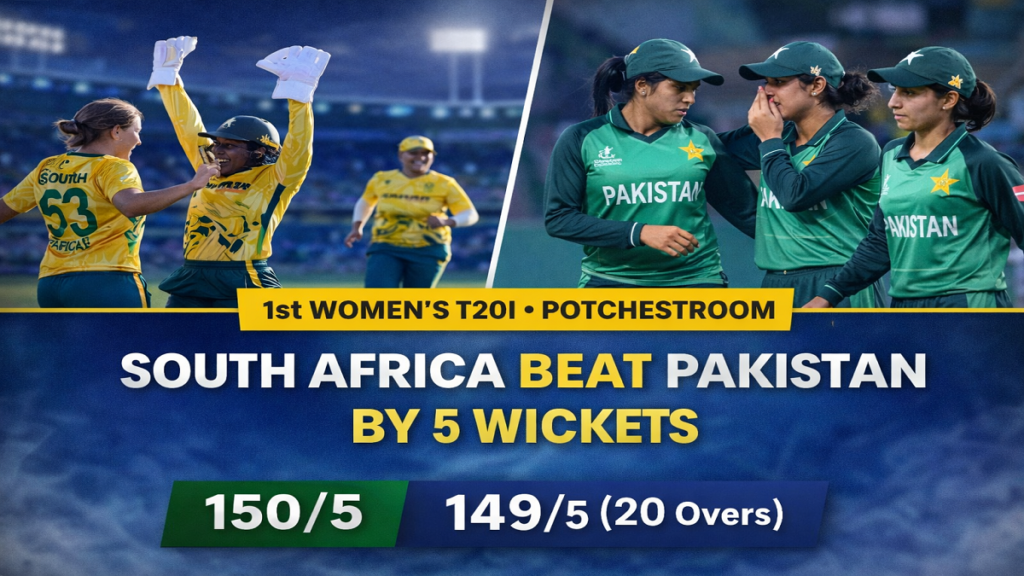
In the first match of the Women’s T20 series, South Africa overcame Pakistan with a nerve-holding chase that was decided on the very last delivery. At Senwes Park in Potchefstroom, Pakistan Women produced a competitive 180/9, driven by a powerful late surge from captain Sana Fatima. In reply, the hosts chased down the target with composure, finishing on 185/5 to win by five wickets with no balls to spare and move 1–0 ahead in the three-match contest.
This match had everything a T20 fan wants. There were early wickets, a collapse, a counter-attack, a nervy chase, and a finish that forced both teams to play under maximum pressure. Most importantly, it showed why women’s cricket is growing so fast: the tempo is high, the plans are bold, and the momentum can flip in a single over.
Below is the full match story in a detailed, easy-to-read, human-style breakdown for Play Live Cricket—with key moments, batting and bowling highlights, and what this result means for the rest of the series.
Match Result Summary: South Africa Beat Pakistan by 5 Wickets
Match: SA Women vs PAK Women, 1st Women’s T20I
Venue: Senwes Park, Potchefstroom
Date: 10 February 2026
Toss: Pakistan Women elected to bat
Pakistan Women: 180/9 (20 overs)
South Africa Women: 185/5 (20 overs)
Result: South Africa beat Pakistan by 5 wickets (0 balls remaining)
Player of the Match: Kayla Reyneke
South Africa Beat Pakistan Through Calm Chasing Under Pressure
South Africa beat Pakistan in a way that strong T20 teams often do: by refusing to panic, even when the chase gets tight. A 181 target is never simple, especially when wickets fall and the required rate climbs late. Yet South Africa kept enough control in the middle overs to stay alive, then held their nerve in the closing moments.
The chase had clear phases.
First, South Africa attacked the powerplay with intent. Then, they built a base through their experienced batters. After that, Pakistan pulled things back with timely wickets. Finally, South Africa found a late finisher who stayed brave when the margin became one ball.
That finishing presence mattered because this chase did not end with comfort. It ended with courage.
Pakistan Women’s Innings: Early Wickets, Then a Captain’s Counterpunch
Pakistan’s innings is a story of two halves.
On one side, Pakistan had trouble building partnerships early. On the other side, Pakistan still reached 180 because their captain produced an innings that changed the match’s shape.
Pakistan’s Total: 180/9 in 20 Overs
Pakistan Women finished on 180/9, which is a strong T20 total on most nights. However, the way they got there was unusual. They were under pressure early, and their recovery depended heavily on one massive late surge.
Pakistan’s batting card (key scores):
- Gul Feroza 13 (10)
- Muneeba Ali 16 (16)
- Natalia Pervaiz 20 (17)
- Sana Fatima (c) 90 (41)
- Nashra Sandhu 9 (7)
Extras: 9
The standout is obvious. Sana Fatima’s 90 off 41 balls was a match-turning knock, with boundary power that forced South Africa to defend under stress later.
South Africa Beat Pakistan’s Top Order Early With Key Breakthroughs
South Africa beat Pakistan’s early momentum by striking repeatedly in the first half of the innings. Pakistan lost wickets at moments when they needed stability, and that prevented a smooth buildup.
Pakistan were 16/1, then 25/3, and later slipped to 64/6. Those scoreboard moments matter because they show how often Pakistan had to restart. Every restart costs balls, and in T20 cricket, balls are gold.
Important early dismissals included:
- Gul Feroza bowled by Kayla Reyneke
- Ayesha Zafar caught off Ayanda Hlubi
- Sidra Ameen out for 0
- Aliya Riaz out for 0
At 64/6, many teams would struggle to even reach 140. That is why Pakistan’s final total is even more impressive, because the platform did not exist until the late overs.
Sana Fatima’s 90: The Innings That Nearly Won It
Sana Fatima played one of those innings that changes team belief instantly. Pakistan were deep in trouble, but she flipped the match using clean hitting and fearless decision-making.
She scored 90 off 41, striking at 219.51, with 9 fours and 7 sixes.
That power was not just “big hits.” It was smart T20 batting.
She picked her matchups smartly and attacked the bowlers she felt she could dominate. When the field came in, she used the shorter boundary options to keep the scoreboard moving. As a result, South Africa were pushed into protecting the ropes rather than attacking the stumps and building pressure.
Pakistan’s late acceleration is visible in the fall of wickets and timing:
- After 64/6, Pakistan reached 138/7 when Umm-e-Hani fell.
- Then Pakistan pushed through 150 and beyond, ending at 180/9.
In simple terms, Sana Fatima turned a struggling innings into a challenging total. Without her, Pakistan would have been well short of a winning score.
South Africa Beat Pakistan: South Africa’s Bowling
South Africa beat Pakistan partly because they had bowlers who created damage early, even if they conceded runs later.
Key Pakistan-Innings Bowling Figures
- Ayanda Hlubi: 3 overs, 41 runs, 3 wickets
- Kayla Reyneke: 4 overs, 13 runs, 2 wickets
- Nonkululeko Mlaba: 4 overs, 40 runs, 2 wickets
- Ayabonga Khaka: 4 overs, 49 runs, 1 wicket
The contrast is interesting.
Hlubi took 3 wickets but went for runs. That often happens in T20: attacking lengths bring wickets, but they can also leak boundaries.
Reyneke, however, produced the classic “winning” spell. She gave away only 13 runs in 4 overs and took 2 wickets. That control helps in two ways: it reduces total damage, and it increases pressure at the other end.
Also, in a match decided on the final ball, a tight spell like that becomes priceless.
South Africa Beat Pakistan: 185/5 and a Nervy Finish
South Africa beat Pakistan by setting the tone early in the chase and showing composure when the pressure peaked in the final overs. They did not allow the required rate to spiral, and when the match tightened, they responded with clarity instead of panic.
The chase revolved around three decisive contributions. Laura Wolvaardt blended stability with controlled aggression, shaping the innings while keeping the scoreboard active. Sune Luus injected momentum in the powerplay and carried that tempo into the early middle overs, ensuring the target never drifted out of reach. Finally, Kayla Reyneke held her nerve at the death, finishing the job under pressure and guiding South Africa across the line.
South Africa Women’s Total: 185/5 (20 Overs)
Key scores:
- Tazmin Brits 16 (14)
- Sune Luus 32 (20)
- Laura Wolvaardt (c) 61 (38)
- Dane van Niekerk 16 (17)
- Kayla Reyneke 29* (16)
The chase had moments where South Africa looked comfortable. Yet Pakistan kept dragging it back, which is why the ending became so tight.
Powerplay Story: South Africa Beat Pakistan’s Early Pressure With Fast Scoring
Chasing 181, the biggest mistake is starting slow. South Africa avoided that.
They reached 54/1 in the powerplay, which kept the required rate under control.
That early scoring matters because it gives freedom later. It also prevents bowlers from setting defensive fields too early. When the chase stays alive, pressure shifts to the bowling side.
Tazmin Brits fell for 16, but the base was already forming. Then Luus and Wolvaardt began shaping the chase with a mix of boundaries and smart singles.
South Africa Beat Pakistan: The Partnership That Set the Chase Up
South Africa beat Pakistan largely because their top order did enough before the late wobble.
Luus scored 32 off 20, striking at 160, and Wolvaardt scored 61 off 38, also at a high rate, with 8 fours and 1 six.
Their partnership pushed South Africa toward the match’s “winning zone,” where the target becomes less about the total and more about managing the last 5 overs.
Even when Luus fell at 87/2, Wolvaardt continued. That continuation is important in chases because it stops the innings from resetting completely.
Wolvaardt’s fifty came quickly, showing she wasn’t playing a slow anchor role. She was scoring at the pace the match demanded.
Pakistan’s Fightback With the Ball: Why the Chase Got Tight
If South Africa beat Pakistan, it was not because Pakistan rolled over. Pakistan kept finding moments.
Pakistan’s key wicket-takers:
- Nashra Sandhu: 4 overs, 27 runs, 2 wickets
- Humna Bilal: 4 overs, 32 runs, 1 wicket
- Ayesha Zafar: 3 overs, 24 runs, 1 wicket
Nashra Sandhu removing both Luus and Wolvaardt is huge. When your two main set batters are out, the chase becomes unstable again. That is exactly what Pakistan wanted.
Dane van Niekerk fell too, and then a run out removed Lara Goodall. Suddenly, South Africa were 147/5, and the match was wide open.
This is the key point: Pakistan gave themselves a real chance to defend 180.
South Africa Beat Pakistan Because Reyneke Finished Like a Specialist
When a chase becomes a final-over fight, you need someone who can handle the moment.
Kayla Reyneke did exactly that.
She stayed unbeaten on 29 off 16, with 3 sixes, and guided South Africa over the line.
Her innings mattered because the required rate late was uncomfortable. Also, Pakistan’s bowlers were not just bowling; they were trying to win a series opener under pressure. That pressure can create small errors—one extra ball, one misfield, one boundary option missed—and those details decide the game.
Reyneke’s approach was simple:
- back her swing,
- choose a clear scoring zone,
- and keep the target in sight.
It’s also why she earned Player of the Match in a game that included a 90 and a 61.
Key Turning Points That Explain How South Africa Beat Pakistan
1) Pakistan at 64/6, then Sana Fatima’s explosion
Pakistan were almost out of the contest. Sana Fatima dragged them back and forced South Africa to chase a serious total.
2) Reyneke’s economical spell
Conceding only 13 in 4 overs while taking 2 wickets is match-defining in a last-ball finish.
3) Wolvaardt’s controlled aggression
Her 61 ensured South Africa never fell too far behind the rate.
4) Sandhu removing Luus and Wolvaardt
That double impact turned a smooth chase into a tense finish.
5) Reyneke’s finishing under pressure
South Africa beat Pakistan because they won the final moments, not just the early overs.
What This Result Means in the Women’s T20 Series
This win gives South Africa early control of the series. A 1–0 lead matters because it reduces pressure for the next match and gives the team confidence in close finishes.
For Pakistan, this match still provides positives:
- Sana Fatima’s form is a major sign.
- Their bowling created real tension late.
- Their fielding and effort kept them in the contest.
But Pakistan will also want cleaner phases:
- avoid the early collapse,
- build one stable partnership,
- and finish with the same power they showed late.
For South Africa, the biggest positive is composure. Chasing 181 and winning on the last ball teaches a team how to stay calm in the toughest situations.
Quick Match Stats Recap
- Pakistan Women: 180/9 (20 overs)
- South Africa Women: 185/5 (20 overs)
- Sana Fatima: 90 (41)
- Laura Wolvaardt: 61 (38)
- Ayanda Hlubi: 3/41
- Kayla Reyneke: 2/13 and 29 (16)*
Play Live Cricket
Stay connected with Play Live Cricket for match summaries, series updates, and women’s cricket coverage with clean, reader-friendly analysis.
Disclaimer: This match report is based on publicly available score information and is written for news and informational purposes.