Sarfaraz Ahmed Career Analysis and Retirement
Sarfaraz Ahmed retires after a long Pakistan career. A full analysis of his ODI, T20, and Test cricket, captaincy, wicketkeeping, achievements, and legacy.
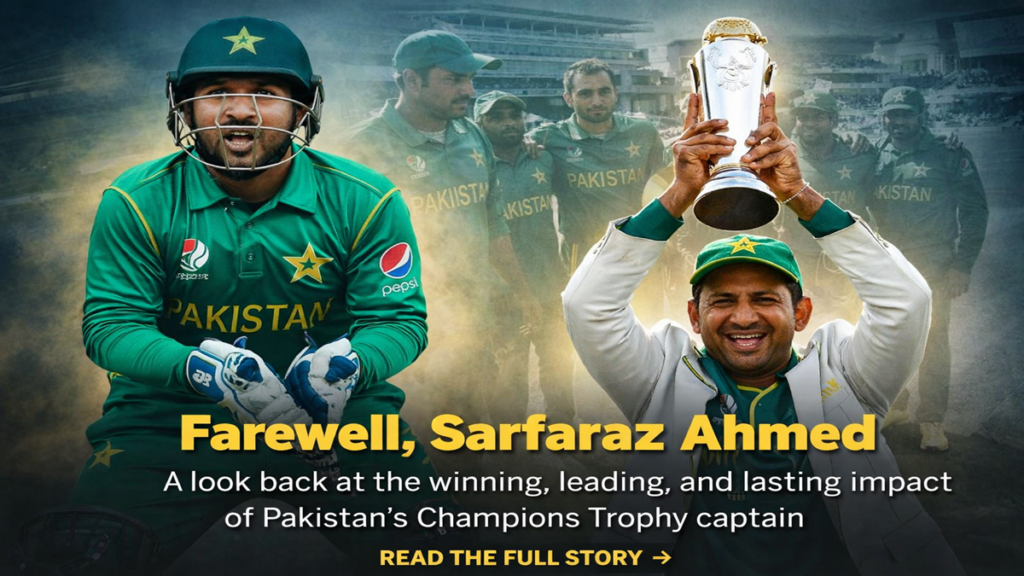
Sarfaraz Ahmed Career Analysis: Pakistan’s Fighter, Leader, and Big-Match Competitor
Sarfaraz Ahmed has retired from international cricket. That news closes one of the most memorable careers in modern Pakistan cricket. Some players leave behind huge numbers. Some leave behind famous images. Sarfaraz leaves both, but his legacy is bigger than stats and trophy photos.
He played in a time when Pakistan cricket often felt tense and unsettled. In that setting, Sarfaraz gave the team energy, urgency, and fight. He did not rely on style alone. He earned his place through toughness, cricket sense, and the will to stay involved when the game got hard.
That is why his retirement deserves more than a short farewell.
Sarfaraz played 54 Tests, 117 ODIs, and 61 T20Is for Pakistan. Across formats, he scored 6,164 runs, including six centuries and 35 fifties. As a wicketkeeper, he took 315 catches and made 56 stumpings. He also captained Pakistan in 100 international matches and led the side to the 2017 ICC Champions Trophy. Still, the numbers tell only part of his story.
To understand Sarfaraz Ahmed, you have to look at the full picture. His ODI batting, T20 captaincy, Test grit, and wicketkeeping all shaped his career. His influence in the dressing room mattered too. More than anything, he kept making himself useful in difficult moments. That was the theme of his career. He kept finding ways to matter.
Sarfaraz Ahmed and the Making of a Pakistan Cricketer
Sarfaraz did not build his reputation overnight. His cricket story had layers. He first became a major name when he captained Pakistan to the ICC Under-19 World Cup title in 2006. That early success told people two things. First, he had leadership instincts. Second, he knew how to handle tournament pressure. That second point stayed with him throughout his career.
Pakistan cricket has always valued talent, but talent alone does not win tight tournaments. Teams also need nerve, game awareness, and the ability to stay connected when pressure rises. Sarfaraz brought those qualities from a young age. He was never a distant cricketer. He was always inside the contest, reading the game, reacting to the mood, and trying to shift momentum.
His senior international career did not follow a perfect line. Opportunities came in phases, and security was rarely guaranteed. Selectors and fans often debated where he fit best. Still, he kept returning because he brought something valuable to every format. He scored hard runs, kept wicket with intent, and lifted the energy of the team. On top of that, he could lead. That mix made him valuable.
Sarfaraz was also a cricketer who looked completely real in a Pakistan shirt. He never felt packaged or polished artificially. His style came from intent and instinct. He looked like a player who cared deeply about every ball, and that emotional honesty helped him connect with supporters.
Bangladesh vs Pakistan 3rd ODI Match Analysis
Sarfaraz Ahmed in ODI Cricket
ODI cricket may be the format that explains Sarfaraz the batter most clearly. It gave him enough time to settle, enough space to read the game, and enough tactical depth for his cricket intelligence to stand out.
Sarfaraz was never a decorative middle-order batter. What made him effective was his reading of the game. He understood when Pakistan needed repair work, when the innings needed composure, and when the scoring tempo had to shift. That made him a very useful ODI player.
Sarfaraz often came in during unstable phases. Pakistan lost early wickets many times in his era, and that meant the middle order had to absorb pressure before thinking about acceleration. He handled that challenge well. He could rotate strike, run hard between the wickets, and stop the innings from freezing. On difficult days, those small actions had major value.
Sarfaraz Ahmed and ODI Middle-Overs Control
The middle overs in ODI cricket demand clarity. Batters cannot simply survive, and they cannot swing blindly either. They need to manage risk while keeping the scoreboard alive. Sarfaraz did that better than he is often given credit for.
Sarfaraz knew how to keep an innings alive without forcing it. He worked singles well, disrupted bowlers’ lengths, and stayed involved ball by ball. Boundaries were useful, but he did not depend on them every over. Touch, angles, and sharp decision-making were enough to guide Pakistan through difficult passages where many sides lose shape.
His ODI hundred at Lord’s against England in 2016 remains one of the most memorable signs of that quality. It was not just a statistical landmark. It showed that he could produce a serious innings on a major stage, in foreign conditions, against a strong opponent. He remains the only Pakistan wicketkeeper-batter to score an ODI century at Lord’s, and that achievement adds real weight to his fifty-over career.
Sarfaraz Ahmed Under ODI Pressure
Pressure often revealed his best side. The more vulnerable the innings looked, the more useful Sarfaraz often became. He was willing to fight for runs, survive difficult passages, and take on the unnoticed work that matters deeply inside a match, even if fans remember only the final score.
Pakistan cricket has produced many naturally gifted stroke-makers. Sarfaraz belonged to a different class of batter. He was an innings builder under pressure. He made untidy situations feel manageable. That role is not always glamorous, but ODI teams need it badly.
He also helped the team think. That is one of the underrated parts of his batting. While at the crease, he often seemed aware of field placements, over-by-over pressure, and the game state. He did not bat like a man chasing personal highlights. He batted like someone trying to solve a match. That is why his ODI contribution deserves genuine respect.
Sarfaraz Ahmed in T20 Cricket
T20 cricket changed quickly during Sarfaraz’s career. The format became more explosive, more aggressive, and more obsessed with power. Sarfaraz was never the most destructive batter in that environment, but he remained important because he gave Pakistan balance. That word matters here.
What made Sarfaraz especially useful was his adaptability. He could act as a stabiliser, serve as the link between the top order and the finishers, and lead as a wicketkeeper-captain who understood bowlers, managed match-ups well, and kept the group composed.
His T20 batting was not built on brute force. It was built on hustle, game sense, and the ability to keep innings moving. He could find gaps, pick moments, and prevent collapse. In an age when every batter gets judged only by boundary count, that kind of value can be missed. Still, tournament teams understand it better than highlight reels do.
Sarfaraz Ahmed and Pakistan’s T20 Shape
Pakistan’s T20I side under Sarfaraz had a clear identity. It trusted bowlers, protected pressure phases, and played with stronger tactical control than many Pakistan sides before it. That structure did not appear by accident. Sarfaraz helped build it.
He understood that T20 cricket is not just about big shots. It is also about field settings, bowling changes, over management, and team confidence. A captain has to stay close to all of that. Sarfaraz did. He stayed active, loud, and involved. His body language told the team that the game was alive on every ball.
Pakistan rose to No. 1 in T20I cricket during his leadership. The side also recorded a world-record streak of 11 consecutive T20I series wins and completed six clean sweeps. Those achievements say a lot about his captaincy. They show consistency, not luck.
Sarfaraz Ahmed as a T20 Captain
This is one of the most powerful parts of his legacy. Sarfaraz captained Pakistan’s T20 side with urgency and strong game awareness. He backed his bowlers, kept his fielders engaged, and understood the emotional flow of the format. Above all, he gave the team a stronger sense of unity. Pakistan can sometimes look like a side carrying too many separate ideas, but under Sarfaraz, the T20 team often played with the feel of one group following one plan. That cohesion mattered.
His own batting in T20Is was not always spectacular, but his leadership often improved the whole unit. That is why his T20 career cannot be judged only through personal strike-rate conversations. Pakistan became a stronger T20 side under him, and that remains one of the biggest arguments in his favour.
Sarfaraz Ahmed in Test Cricket
Test cricket is where Sarfaraz may still be underrated. Many fans remember him first as the captain who lifted the Champions Trophy or as a combative white-ball cricketer. Yet his red-ball career deserves more respect than it usually gets.
He was a stubborn Test batter.
That matters because Pakistan often needed stubbornness more than style. Sarfaraz came to the crease in difficult positions many times. The ball was still doing enough. The score was often under stress. Partnerships needed time and grit. In those moments, he could be very hard to remove.
He did not waste energy trying to look pretty. He focused on staying in the fight.
Sarfaraz Ahmed and the Value of Hard Test Runs
Not every key Test contribution comes in the form of a huge century. Sometimes a forty or sixty changes the match because it stops the collapse, frustrates bowlers, or pushes the total into safer territory. Sarfaraz played many innings in that spirit.
He was a useful batter with the tail, calm under pressure, and capable of shifting method with the demands of the innings. He could absorb pace, then counterattack spin to disturb the flow of the game. More importantly, he had the temperament to keep competing when the contest became untidy. That toughness made him valuable in conditions where Pakistan needed resilience.
His Test batting had an edge to it. He did not simply defend for survival. He tried to break a bowler’s rhythm when the time was right. A quick single, a smart sweep, or a sudden release shot could shift the tone of a session. That made him far more than just a defensive keeper-batter.
Sarfaraz Ahmed Behind the Stumps in Tests
Keeping wicket in Test cricket is a hard craft. The keeper has to stay mentally fresh across long sessions. He has to remain sharp after long, quiet spells. He must take the chance when it finally comes. Sarfaraz handled that challenge with serious commitment.
His Pakistan record of 10 catches in a Test match innings against South Africa in Johannesburg in 2019 stands as a major achievement. Records like that demand focus, sound judgment, and patience. They also reflect trust from bowlers, because a keeper only reaches those moments when the whole attack and fielding system works in rhythm.
Sarfaraz gave the role energy and presence. He kept his bowlers invested, stayed vocal through long spells, and remained switched on even when the game drifted. That sustained involvement is one of the key reasons his Test wicketkeeping still deserves real appreciation.
Wicketkeeping Analysis
No proper reading of Sarfaraz’s career is complete without serious attention to his wicketkeeping, because that was the base skill on which so much of his value rested.
A wicketkeeper does far more than collect edges and complete stumpings. He gives energy to the field, keeps bowlers emotionally invested, and reads the movement of the match from the closest possible position. Sarfaraz offered all of that. His keeping combined alert hands with a strong awareness of the game around him. He stayed present, vocal, and fully engaged. Pakistan benefited from that.
His tally of 315 catches and 56 stumpings across formats reflects not only quality, but durability as well. Numbers like those are built on years of concentration, physical effort, and reliability. They also show how effective he remained in varying conditions, against different types of bowling attacks, and across every major format.
Sarfaraz Ahmed’s Strengths as a Keeper
His biggest strength may have been how alive he looked behind the stumps. He did not keep wicket like a silent observer. He made the whole field feel active. Spinners, in particular, often benefit from that sort of keeper. Quick glove work, sharp anticipation, and constant communication create pressure on batters. Sarfaraz offered that package.
He was also a keeper who understood batters. Because he read the game well, he often sensed when a batter was pinned down or losing rhythm. That helped him as both a wicketkeeper and a captain. He could spot pressure before it fully showed on the scoreboard.
Sarfaraz Ahmed Captaincy Legacy
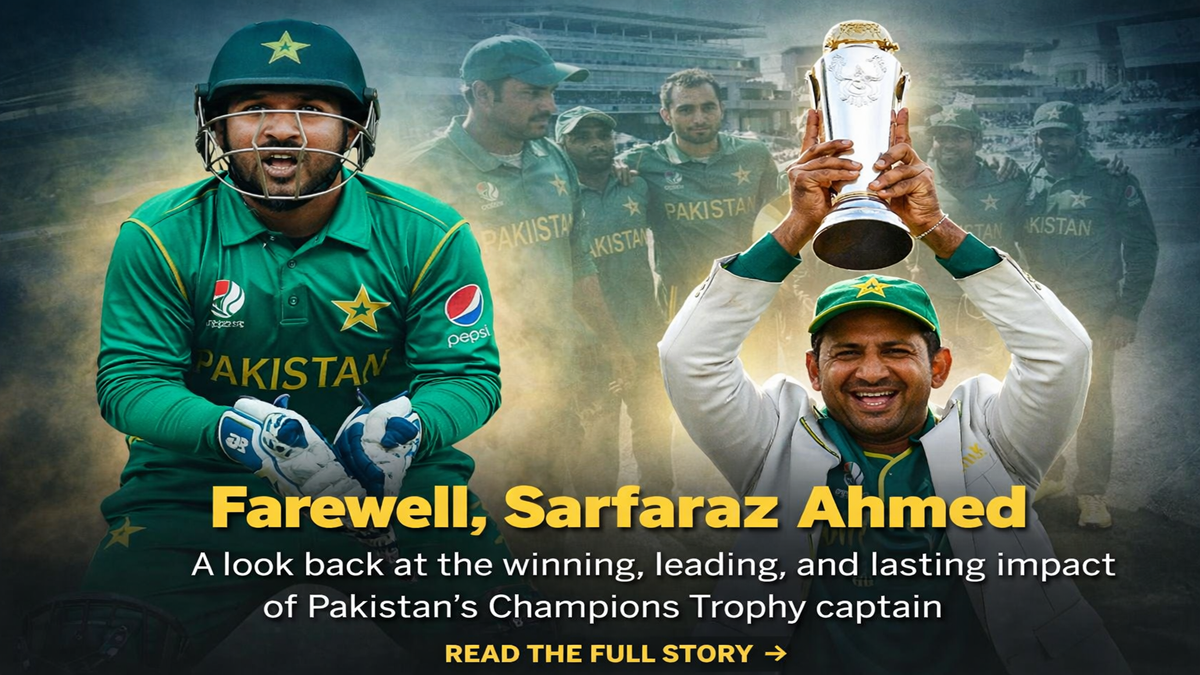
Captaincy will remain the biggest part of Sarfaraz’s legacy. He led Pakistan in 100 matches across formats, so his leadership was not a short trial. His time in charge brought big wins, tournament success and a stronger T20 identity. The main highlight was the 2017 ICC Champions Trophy.
That win changed how many people viewed him. Pakistan beat India by 180 runs in the final at The Oval. Sarfaraz became the first Pakistan captain to win the Champions Trophy. It was not only a famous result. It was also a strong statement of leadership. Pakistan went into the event without huge expectations, but came out as champions through belief, clarity, and courage.
Sarfaraz Ahmed and the Champions Trophy Legacy
The Champions Trophy win is still one of the biggest moments in Pakistan’s white-ball history. Sarfaraz lifting the trophy became a famous image because the victory had emotion, importance, and quality.
Pakistan also looked like a proper team in that tournament. The side played with clear direction and trusted its plans. In big moments, the players looked united. Sarfaraz deserves credit for that. He stayed involved, pushed standards, and kept the team switched on.
Sarfaraz Ahmed and the Players He Backed
A captain is also judged by the players he supports. During Sarfaraz’s era, several future stars moved ahead, including Babar Azam, Shaheen Shah Afridi, Hasan Ali, Imam-ul-Haq, Faheem Ashraf, Fakhar Zaman, and Shadab Khan. That matters because leadership is not only about tactics. It is also about trust. Sarfaraz backed these players at important moments.
No captain gets every call right, and Sarfaraz was no exception. At times, the pressure of leadership affected his own batting. At times, tactics could look reactive. Still, the bigger picture remains strong. He won globally, built a successful T20 side, and gave Pakistan one of its most memorable modern trophies. That is serious captaincy work.
Achievements and Career Highlights
Sarfaraz’s career includes many big achievements. Each one shows a different side of his value. He captained Pakistan to the ICC Under-19 World Cup in 2006. He later led the senior side to the 2017 ICC Champions Trophy. That made him the only Pakistan captain to win ICC titles at the junior and senior levels. It gave him a special place in national cricket history.
He also took Pakistan to the No. 1 T20I ranking. Under him, the team won 11 straight T20I series and completed six clean sweeps. He scored an ODI hundred at Lord’s. He also set a Pakistan record by taking 10 catches in a Test innings. In 2018, he received the Pride of Performance award. He became the youngest Pakistan captain to get that honour. These are not minor achievements. They define his career.
Sarfaraz retires as a trophy-winning captain, a dedicated wicketkeeper-batter, and an important figure in Pakistan’s modern white-ball story.
What Sarfaraz Ahmed’s Retirement Means for Pakistan Cricket
Retirement ends a career on paper, but it does not end a player’s influence. Sarfaraz played his last international match in 2023. Still, his formal retirement in 2026 feels important because it closes an era. He linked two generations of Pakistan cricket.
He came through before Pakistan’s current core was fully ready. Later, he helped guide some of those players into international cricket. He also represented qualities Pakistan still needs: role clarity, commitment, and honesty in competition. When Sarfaraz was at his best, the team knew what it would get from him. That kind of trust matters a lot.
This retirement should also make Pakistan cricket think. The game often celebrates flair before usefulness. Sarfaraz showed that usefulness can win major matches, too. A sharp keeper, a pressure batter, an active captain, and a leader who trusts young players can change a team. He did that for Pakistan.
Final Verdict
Sarfaraz Ahmed should be remembered as more than a trophy photo or a familiar voice behind the stumps. He was a tough cricketer who served Pakistan with fight, leadership, and commitment across all formats.
In ODI cricket, he gave Pakistan control in the middle order and calm in pressure moments. He also helped build one of the team’s strongest T20 sides. Test cricket showed his grit, patience, and active wicketkeeping. His leadership brought one of Pakistan’s biggest tournament wins. Behind the stumps, he stayed sharp and fully engaged.
Not every great career looks elegant. Some become important because they carry weight in big moments. Sarfaraz had that kind of career.
His retirement deserves respect for that reason. Pakistan cricket is losing a player who did not always receive full credit while he played. With time, though, his legacy has become clearer. He fought hard, led bravely, and remained useful in every format. That is a career worth honouring.
Play Live Cricket
Stay tuned at Play Live Cricket for more deep player analysis, Pakistan cricket features, match breakdowns, tactical insights, and long-form stories that go beyond headlines. We cover the game with detail, clarity, and proper cricket context for readers who want more than quick updates.
Disclaimer
This article is an editorial cricket analysis based on the official retirement announcement shared by the user and widely known career records. It is written for news analysis, fan insight, and historical cricket discussion.