
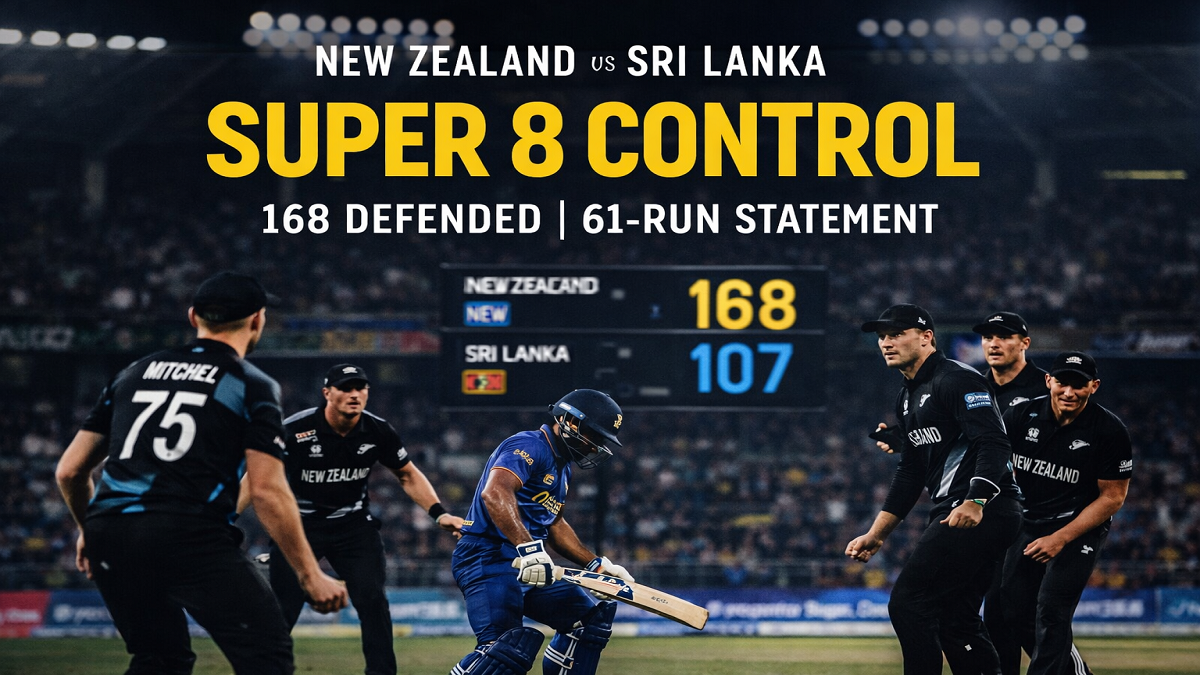
New Zealand vs Sri Lanka: Super 8 Dominance
New Zealand vs Sri Lanka battle in Super 8 as NZ defend 168 and win by 61 runs. Expert breakdown of strategy, pressure, and execution.
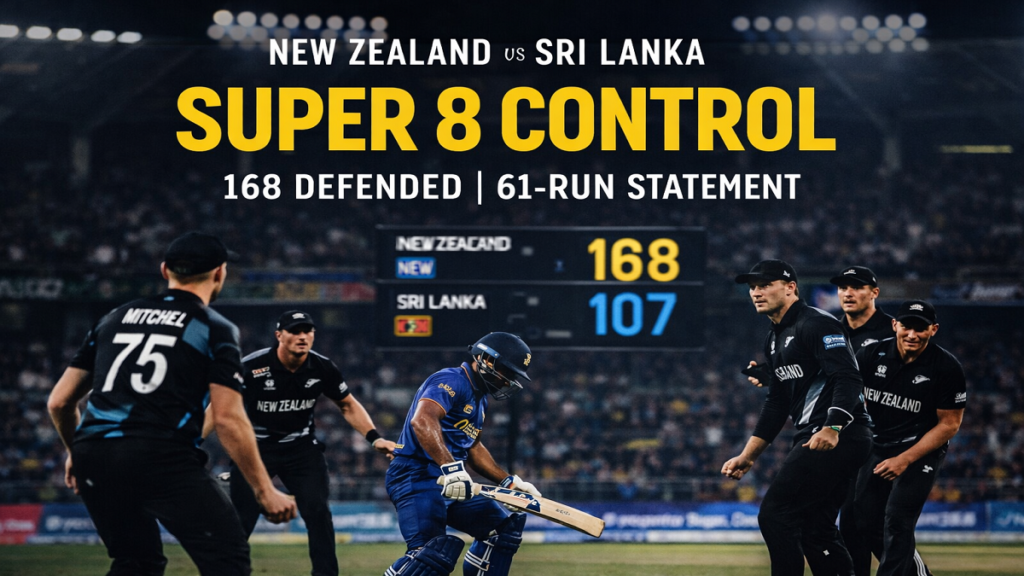
New Zealand vs Sri Lanka: Super 8 Dominance
The New Zealand vs Sri Lanka Super 8 contest looked straightforward on the scoreboard, yet it was a match shaped by structure rather than spectacle. New Zealand posted 168/7 and then held Sri Lanka to 107/8, sealing a 61-run win that felt decisive long before the final over. However, the real story sits deeper than the margin. This was a game where New Zealand managed tempo, controlled risk, and applied pressure in layers, while Sri Lanka Struggled to build a chase strong enough to handle the rising rate and smart fields.
Even in T20 cricket, where sixes often steal the headlines, Small details can decide a match. Field placements that block the best angles. Bowlers who hit the same hard length until batters doubt their options. Batters who do not panic when the powerplay is not explosive. These are the details that turn a defendable total into a commanding win. In Colombo, New Zealand leaned on those details, and the result was a chase that never truly found oxygen.
If you track live momentum swings regularly, you will recognize this pattern: the scoreboard pressure begins as a whisper, then becomes a steady hum, and finally turns into a roar that batters cannot silence. That is what happened here. Sri Lanka did not lose in one dramatic over. Instead, they drifted into a chase that demanded perfection at the end, and the match never allowed them to reach that end with resources intact.
For readers who follow match flow daily, you can also use Play Live Cricket’s Live Scores page to keep the same match-phase lens in real time. Meanwhile, the broader tournament context and group movement can be followed through the Schedule page.
Super 8 Cricket Is About Control, Not Just Firepower
Super 8 matches carry a different emotional weight. A league-stage win is valuable, but a Super 8 win can reshape qualification math, net run rate, and belief inside the dressing room. Because of that, teams play with sharper intent. Captains do not simply “try things” and hope they work. Instead, they lean into their strongest patterns.
New Zealand’s pattern in this match was clear from early on. They aimed to build a total that would feel larger than it looked. That approach matters because 168 is not automatically a match-winning score in modern T20. On the right pitch, it can be chased comfortably. Yet, if a bowling side can remove easy scoring lanes and keep batters off balance, 168 becomes a psychological trap. As a result, Sri Lanka ended up chasing a number that kept growing in their minds, even if it stayed fixed on the scoreboard.
Sri Lanka, on the other hand, needed a chase blueprint that recognized how New Zealand were going to bowl. That blueprint had to include a stable powerplay, a flexible middle overs plan against spin and defensive seam, and a clear method to target specific overs without risking collapse. Unfortunately, their chase never developed that structure. Instead, it became reactive. Reactive chases rarely work in tournaments.
New Zealand’s 168/7 Was Built in Phases, Not in Bursts
New Zealand’s innings did not rely on one massive partnership. Instead, it was a layered build. That kind of innings often looks “quiet” to casual viewers. Yet it is usually the most dangerous, because it avoids the collapse points that bowlers plan for.
A T20 innings is not one continuous story. It is a sequence of small battles. The powerplay is about getting ahead of the field. The middle overs are about refusing stagnation. The death overs are about converting position into a total. New Zealand were not perfect in every moment, but the overall shape of their innings stayed healthy.
New Zealand vs Sri Lanka: Powerplay Useful Runs Without Panic
In the first six overs, New Zealand’s main aim was to avoid early damage while still keeping the run rate alive. They were selective with risk, and that selection is what made their innings stable. When batters take early risks, they often give bowlers a window into their intent. Once bowlers sense desperation, they attack it. New Zealand denied Sri Lanka that read.
Instead, New Zealand focused on scoring zones that keep risk low: using pace to guide balls into gaps, working square boundaries when the ball sat on a back-of-length, and stealing singles that keep the scoreboard moving. Consequently, they did not need a flurry of sixes to feel in control. They simply needed to avoid a quiet powerplay.
That subtle difference matters. A “quiet” powerplay does not mean fewer boundaries alone. It means a higher dot-ball percentage and fewer controlled singles. New Zealand avoided that trap. Therefore, even if the powerplay was not explosive, it was productive enough to set up the innings.
New Zealand vs Sri Lanka: Middle Overs The Phase That Protected the Total
Overs 7 to 15 decide more T20 matches than most fans admit. In this window, captains search for choke points. Spinners attempt to slow momentum. Fields stretch. Batters have to choose between patience and ambition. New Zealand navigated this phase with a simple principle: keep scoring without offering cheap wickets.
Rather than swinging for the sake of momentum, New Zealand rotated strike consistently. They turned ones into twos when the deep fielders were slightly square. They used the sweep and late cut selectively, which forced fielders to defend multiple angles. As a result, Sri Lanka could not lock them down with one field.
Meanwhile, the batters avoided the most dangerous mistake in middle overs: trying to “break” the over with a low-percentage hit. That urge often leads to soft dismissals at long-on, deep midwicket, or extra cover. New Zealand’s innings did not escape wickets completely, yet their approach prevented a cluster. That was crucial, because a cluster would have kept the final total below 160. Instead, they stayed on track for the high 160s.
Death Overs: Turning Position Into 168
Once the innings moved into the final five overs, New Zealand shifted from consolidation to conversion. At that stage, the objective was simple: maximize value from each delivery without surrendering control. In T20 cricket, the death overs rarely demand chaos; instead, they reward clarity and precision.
Sri Lanka attempted to defend this phase with yorkers, wide angles, and slower variations into the surface. However, New Zealand adapted intelligently. Straighter boundaries were targeted whenever pace entered the slot. When the field spread to defend aerial routes, the batters responded by keeping the ball along the ground and piercing gaps square of the wicket. Subtle crease movement further disrupted the bowlers’ length, especially when yorkers missed by a fraction.
As a result, what might have been a 155-type finish gradually stretched to 168. That additional 10 to 12 runs proved decisive later, because the chase never recovered from the scoreboard pressure that followed.
New Zealand vs Sri Lanka: Rachin Ravindra’s Match Influence Was About Timing
Rachin Ravindra was named Player of the Match, and his impact can be explained beyond the headline numbers. His innings of 32 off 22 carried a specific value: it kept the innings in rhythm. In tournament cricket, rhythm is not entertainment. It is survival.
An innings can collapse even when wickets have not fallen quickly. Collapse begins when batters stop trusting singles, stop trusting soft hands, and start chasing boundaries too early. Ravindra’s approach prevented that drift. He scored at a rate that did not force the next batter into immediate aggression. Therefore, he acted as a stabilizer while still pushing the run rate forward.
With the ball, his contribution added another layer. In a chase, part-time or support overs are often targeted. Sri Lanka could not truly target him because New Zealand’s field and lines reduced access to easy boundaries. Consequently, the chase faced pressure from multiple angles, not just the frontline bowlers.
Mitchell Santner and the Art of “Quiet Choking”
Mitchell Santner’s match value lies in something modern T20 teams obsess over: controlling the middle overs without losing wicket-taking threat. Santner is often effective because he makes batters feel like they need to manufacture shots. Manufactured shots create mistakes.
He does not rely on one big turner. Instead, he relies on small changes: pace off the pitch, trajectory, and subtle drift. In Colombo, his bowling likely asked a repeated question: “Where is your safe boundary?”
When batters cannot find a safe boundary, they either accept singles and fall behind the rate, or they attempt riskier strokes into protected pockets. Sri Lanka fell into that trap. As a result, they faced a chase where every over felt slightly heavier than the last.
Santner’s impact also links to field strategy. Captains can set aggressive fields for him because he rarely gifts freebies. That freedom allows a team to hunt mistakes rather than defend boundaries. Therefore, Santner’s role was not merely economical. It was structural.
The Chase: Why Sri Lanka Never Truly Arrived
A chase of 169 can succeed if the chasing side wins one of two battles: the powerplay battle or the middle overs acceleration battle. Sri Lanka did not win either. That is why the chase never stabilized.
Powerplay: Early Damage Creates Long-Term Pressure
The powerplay is not only about runs. It is about clarity. If a batting side loses early wickets, the chase becomes foggy. Who attacks? Who anchors? Which bowlers do you target?
Sri Lanka’s early phase did not provide clean answers. Wickets reduced freedom. Dot balls increased anxiety. Meanwhile, New Zealand’s bowlers likely hit disciplined lengths that made boundary hitting uncomfortable.
Once that happens, the required rate rises quietly. A required rate that climbs quietly is more dangerous than one that spikes suddenly, because it tricks batters into believing they still have time. Eventually, the chase reaches a point where it needs two big overs back-to-back. That is where collapses happen.
New Zealand vs Sri Lanka: Middle Overs When the Chase Became Reactive
The middle overs were the true turning point. Sri Lanka needed a controlled surge. That does not mean reckless hitting. It means selecting one bowler or one matchup and attacking with clarity, while still keeping wicket protection.
However, New Zealand’s bowling combinations likely removed that clarity. Seamers used hard length and change-ups. Spinners controlled pace. Fielders stayed in catching positions for mis-hits. Consequently, Sri Lanka’s attempts to “get ahead” often looked like forced hits rather than planned ones.
When you watch chases closely, you can tell when a team is reacting. The footwork becomes half-committed. The bat swing becomes bigger. The shot selection becomes one-dimensional. Sri Lanka’s scoreline suggests they never found a period of comfortable scoring. That means every boundary carried extra weight, and every dot ball felt like two.
New Zealand vs Sri Lanka: Late Overs When the Match Was Already Gone
By the closing phase, the chase had already slipped beyond recovery. Strategy gave way to damage control, and the required rate demanded near-perfect execution. At that stage, batters no longer built partnerships. Instead, they searched for immediate impact. Although T20 cricket occasionally produces dramatic finishes, disciplined bowling and intelligent fields usually shut that door.
New Zealand controlled the death overs with clarity. Bowlers delivered wide yorkers to deny leg-side access and push batters outside their comfort zone. They mixed pace deliberately and drove slower balls into the surface to disrupt timing. Rather than offering predictable lengths, the attack changed angles and speed to create hesitation before every stroke.
Fielders supported that intent. The captain protected the straight boundary and removed the safest scoring arc. Larger pockets became the only option, forcing batters to attempt ambitious strokes against the wind. Under that pressure, clean connection rarely came.
As a result, Sri Lanka failed to produce the consecutive high-scoring overs required to revive momentum. The target of 169 did not explode out of reach in one moment. Instead, New Zealand’s execution pushed it further away with every disciplined over.
New Zealand vs Sri Lanka: New Zealand’s Bowling Plan Worked Because It Had Layers
A great bowling performance is not just about taking wickets. It is about keeping the chase emotionally uncomfortable. New Zealand achieved that by bowling in layers.
First, they applied early discipline to reduce Sri Lanka’s free strokes. Then, they used spin and variation to compress the middle. Finally, they executed the death overs without panic. That sequence is how teams defend totals in the 160–175 range consistently.
The “layer” concept matters because one successful phase can still be undone by another. A strong powerplay means little if the middle overs leak 70. A strong middle overs means little if the death overs leak 50. New Zealand avoided those leaks. Therefore, the chase never had a recovery route.
New Zealand vs Sri Lanka: Match Momentum and the Psychology of Required Rate
Momentum is often misunderstood. Fans describe it as energy or rhythm. Players see it differently. For them, momentum combines numbers and emotion. In a chase, the required rate controls the mood. It is not just a number on the screen. When the rate stays steady or drops, batters feel relaxed. They trust singles. They pick their boundaries.
A slow rise creates hidden pressure. At first, the change looks small. However, the gap grows quietly. Soon, every dot ball feels heavier. A sharp rise changes everything. Urgency replaces patience. Shot selection becomes rushed. Risk increases. Mistakes follow.
Because of this, strong bowling sides do not chase magic overs. Instead, they build pressure one ball at a time. Tight lines, smart fields, and small victories create long-term control. Eventually, the scoreboard reflects that control. By then, the chase already feels out of reach.
New Zealand vs Sri Lanka: Why 168 Was More Than “Enough” in This Match
On paper, 168 looks competitive. In this game, it became more than enough. The difference came from how New Zealand defended it. Batters rely on certain scoring zones under pressure. Some prefer straight hits down the ground. Others depend on square boundaries. Many look for the inside-out option over extra cover. When those zones disappear, the chase becomes harder.
New Zealand removed those comfort areas early. The captain protected key boundaries. Bowlers stayed away from slot lengths. Instead, they attacked tight channels and forced batters to hit to longer pockets. As a result, Sri Lanka could not score freely. Every boundary required risk. Every over increased pressure. The collapse to 107/8 did not happen because 168 was huge. It happened because New Zealand controlled every scoring option.
New Zealand vs Sri Lanka: What Sri Lanka Needed, and What They Did Not Get
Sri Lanka required one batter to anchor the chase and keep the required rate stable. That role does not demand fireworks. Instead, it relies on strike rotation, smart boundary choice, and calm decision-making under pressure.
At the same time, the lineup needed a second batter to attack selected overs without losing balance. When both roles function together, a chase stays alive. However, early disruption weakens the structure. Once both anchors disappear, the innings loses shape and risk increases rapidly.
That scenario unfolded in this match. Dot balls built pressure. Wickets removed stability. Consequently, each new batter arrived with less time and fewer options. The required rate climbed, and the chase never rebuilt its foundation.
New Zealand vs Sri Lanka: Tournament Value The Net Run Rate Punch
A 61-run win in Super 8 cricket means more than two points. It boosts net run rate. That boost can decide a semifinal place. In tight groups, teams often finish level. Because of that, margin matters.
New Zealand understood this clearly. After gaining control, the bowlers kept the pressure high. Fielders stayed alert. Each over followed a clear plan. No phase drifted. That focus separates strong teams from hopeful ones.
For fans tracking the bigger tournament build, you can follow the Play Live Cricket T20 World Cup 2026 Mega Hub for team paths, format context, and phase-based tournament reading.
New Zealand vs Sri Lanka: Tactical Lessons from New Zealand vs Sri Lanka
This match offers several evergreen lessons for how modern T20 cricket is actually won. Discipline can defeat power. Teams often fear the big hitters more than the quiet controllers. Yet, disciplined bowling and smart fields can make big hitting feel impossible.
Middle overs still decide chases. When a chase loses its middle overs shape, the death overs become a desperate sprint. Desperate sprints rarely finish. Defendable totals are created by risk management. New Zealand’s innings was not extreme. It was stable. Stability gave them options with the ball.
Pressure is built by dot balls, not just wickets. Wickets are visible. Dot balls are silent. Silent pressure often wins matches. These lessons remain useful beyond one match. They are the same principles that separate title-winning sides from highlight-reel sides.
Where This Post Fits on Play Live Cricket
This piece is best placed under your Match Analysis category.
It also supports your broader authority build across T20 World Cup 2026, because it teaches readers how Super 8 matches are won, not just what happened.
If you want to strengthen your internal structure further, you can also connect it to your Predictions and Match Schedule sections to keep readers moving across the site:
- Predictions: https://playlivecricket.com/category/predictions/
- Match Schedule: https://playlivecricket.com/category/match-schedule/
Stay Connected with Play Live Cricket
Cricket evolves fast, and T20 evolves fastest. For live momentum, fixtures, and more deep-match reading, stay connected with Play Live Cricket. Follow live action on Live Scores, track fixtures on the Schedule page, and explore more deep dives in Match Analysis.
Disclaimer
This article is published for educational and informational purposes. Match statistics, awards, and playing conditions may vary by official tournament records and updates. For verified score details and official match documentation, refer to the tournament’s official sources.