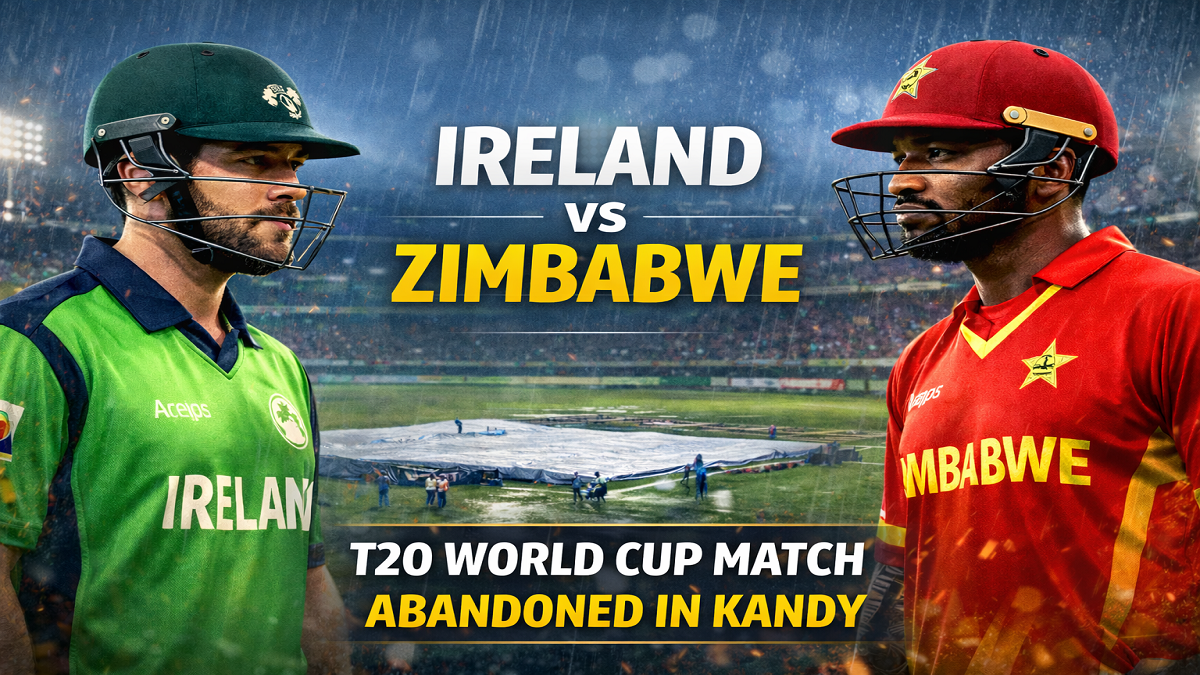
Ireland vs Zimbabwe T20 World Cup Match Abandoned in Kandy
Ireland vs Zimbabwe T20 World Cup match in Kandy was abandoned without a ball bowled due to rain. Points shared, Group B race tightens, full report.
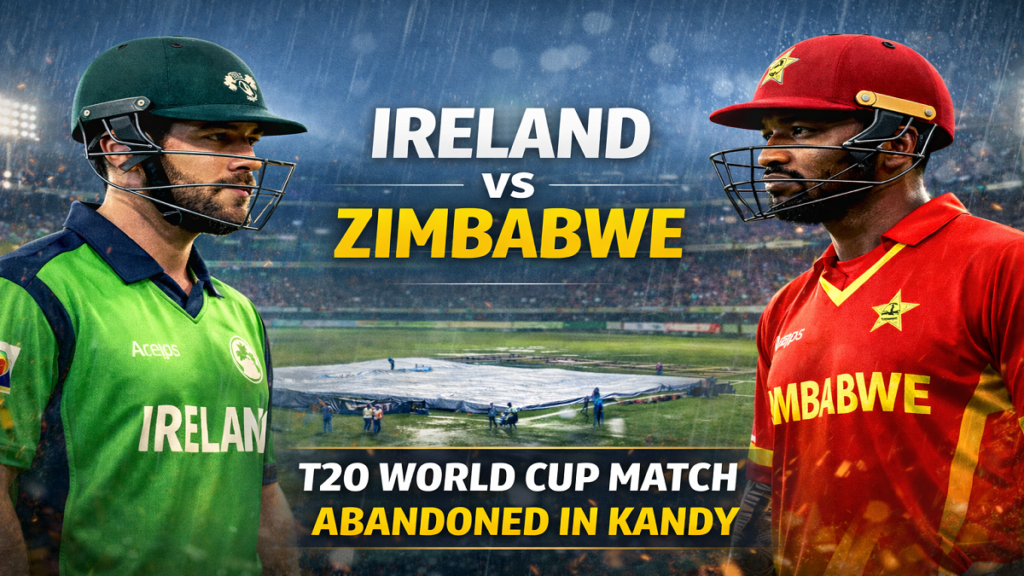
Ireland vs Zimbabwe T20 Abandoned in Kandy Without a Ball Bowled
The Ireland vs Zimbabwe T20 fixture at the ICC Men’s T20 World Cup 2026 had all the ingredients to become a proper Group B pressure game. It was the kind of match that doesn’t always get the loudest headlines before it starts, but often ends up being a turning point once the group table begins to squeeze. Ireland and Zimbabwe are both teams that live in that competitive middle band of international T20 cricket—good enough to beat anyone on the right day, disciplined enough to punish mistakes, and hungry enough to treat every group match like a final.
But cricket, especially in a global tournament, doesn’t always belong to the teams. Sometimes it belongs to the sky.
In Kandy, rain refused to step aside. The outfield never dried enough. The umpires kept inspecting. The covers stayed on. Fans waited for a reduction, a toss, any sign that the day would move forward. Yet every new shower reset the clock. Eventually the match was abandoned without a ball bowled, and with it went 40 overs of opportunity—overs that could have shaped points, net run rate, confidence, and the story of Group B.
The scoreboard will record it as a simple line: abandoned, no play, one point each. The tournament reality is more complicated. Because in a tight group, “no result” is still a result.
Ireland vs Zimbabwe: Why This Match Mattered So Much
Supporters inside the stadium cling to hope because live sport thrives on uncertainty, and until an official announcement is made, possibility still exists. From the stands, fans cannot see radar screens or forecast models; they only see the covers stretching across the square and the ground staff moving with purpose. Every inspection by the umpires feels like a moment where the day could suddenly change. When the covers are rolled back even slightly, a ripple of optimism spreads through the crowd. Conversations restart. Phones come out. People begin calculating revised over counts in their heads.
The waiting becomes part of the experience. Spectators watch small details closely—the intensity of the drizzle, the direction of the wind, the body language of officials walking across the outfield. If the rain lightens for even a few minutes, cheers sometimes rise as though a wicket has fallen. Hope resets quickly in stadiums because fans invest emotionally long before the first ball is bowled. They have traveled, planned their day, worn team colors, and built expectations around the contest. That emotional commitment makes it difficult to accept that play may never begin.
Ground staff working tirelessly offers another layer of belief. Each sweep of the squeegee, each movement of equipment, signals effort and intent. Supporters interpret that effort as progress. As long as people are working on the field, the match feels alive. Only when the final announcement arrives does reality settle in, replacing anticipation with quiet disappointment.
Ireland vs Zimbabwe: What Happened in Kandy
From early in the day, conditions in Kandy didn’t look promising. Tournament venues can handle a lot—covers, drainage, ground staff, drying equipment—but there are limits. When rain comes in waves and the sky keeps reloading, every inspection becomes a repeat of the previous one. The problem isn’t only the pitch. The outfield is the real battle. A damp outfield creates two major issues:
First, it becomes unsafe. Fielders sprinting after the ball can slip. Bowlers approaching the crease can lose footing. Even simple movements—turns, dives, slides—carry greater injury risk. In a World Cup, no team wants to lose a key player because the grass held water.
Second, it affects fairness. If one part of the outfield is wetter than another, the ball slows down unevenly. That changes boundary value. It changes how batters can place shots. It changes how bowlers can grip the ball. Cricket is hard enough without adding random external advantages.
The officials kept monitoring the situation, but the necessary window never arrived. Eventually, once the time passed for starting even a short contest, the match was called off. No toss happened, which confirms the match never reached a playable threshold.
For fans, it’s the worst version of a rain day: not even a five-over sprint to rescue something. For teams, it’s a strange day where you do the full mental preparation of match day and get none of the match.
Ireland vs Zimbabwe: Points Shared, But Momentum Lost
A shared point does keep both teams alive. It avoids the pain of a defeat. Yet it also cancels the chance to build momentum.
Momentum in T20 cricket goes far beyond raw emotion. It develops through rhythm at the crease and consistency with the ball. Teams build it by learning from each passage of play and adjusting quickly to conditions. Clarity in roles strengthens that rhythm, while confident decision-making under pressure allows players to trust their instincts. Together, these elements create the kind of forward movement that separates settled sides from uncertain ones.
Teams often use group matches to lock down combinations—who opens, who bowls the 19th over, which spinner matches which batter, what the best batting order looks like on slower surfaces. When you don’t play at all, those questions don’t get answers.
So both Ireland and Zimbabwe come out of this match with the same practical problem: they must move on without the information they expected to collect.
That matters because tournament pressure grows. The first match you play feels like a beginning. The third match feels like a judgement. By the later group games, you start feeling that every over carries your whole campaign.
A washout delays that feeling in a weird way. It gives you a point, but it also pushes more pressure into fewer remaining games.
Ireland vs Zimbabwe: How This Washout Can Change Group B
Group tables in T20 World Cups often split into two patterns:
- a team runs away early with points and net run rate
- everyone stays tightly packed, and the last round decides everything
An abandoned fixture often strengthens the second scenario by tightening the standings. Instead of allowing one side to create early distance, the points table becomes more compact and competitive. With no clear gap forming, teams remain within reach of each other. As a result, qualification stays uncertain for longer, and the pressure stretches deeper into the group stage. That sounds exciting for neutral fans. For teams, it can be stressful.
If Ireland and Zimbabwe had played and one team had won, the group would gain shape. Now the group stays fluid. That means more teams will enter the final matches with realistic qualification hopes, which increases intensity and reduces predictability.
Also, abandoned matches often affect strategy. Teams who lose a full match sometimes shift toward aggressive net run rate planning later. That can influence toss decisions, chase decisions, and bowling usage. You may see teams push harder for fast chases or bigger totals because they know they missed a match’s worth of net run rate potential.
Ireland vs Zimbabwe: Ireland’s Perspective
Ireland have a long history of being competitive in global events, especially when conditions suit their bowling discipline and their batters commit to smart shot selection. In many T20 games, Ireland’s path to victory looks like this: keep the powerplay controlled, take one or two early wickets, choke the middle overs, and then finish with calm death bowling.
If Kandy had offered a slightly helpful surface—some grip, a bit of movement, slower pace—Ireland could have leaned into their strengths. Even if the pitch was flat, Ireland’s best days often come from being structured and patient, not from trying to out-hit opponents without a plan.
From Ireland’s perspective, the frustration lies in the loss of control. The team never had the opportunity to push for a win or even experience a setback and respond with intent. Instead of testing their plans under pressure, they were left waiting without resolution. The campaign pauses without progress, leaving them in a holding pattern rather than moving forward with clarity.
The one point is not useless. It’s still a point. But World Cups are not about comfort points. They are about converting chances into wins, and Ireland lost a full chance.
Now, Ireland’s job becomes clearer and harder at the same time: they must earn their separation elsewhere. They must find two points in another match that may be tougher, and they must do it with enough margin to stay safe on net run rate if the group becomes crowded.
Ireland vs Zimbabwe: Zimbabwe’s Perspective
Zimbabwe will read the washout in their own way. Zimbabwe have grown into a team that takes pride in structure: clear roles, controlled overs, and the belief that they can beat similar-level opponents through better execution. A match like this is often where Zimbabwe can make a statement, because it’s not about surviving a giant; it’s about outplaying a peer.
So Zimbabwe will feel the same disappointment: the match was an opportunity to earn two points against a direct competitor. It was a chance to build belief within the group.
At the same time, Zimbabwe may also view the shared point as a small cushion. In tight groups, avoiding a loss can matter, especially if you still have matches where you expect to be competitive.
But this is the main truth: Zimbabwe didn’t get to show what they planned. They now carry preparation forward without the match experience they expected to gain.
Ireland vs Zimbabwe: Net Run Rate
Net run rate becomes important because it often decides qualification when teams tie on points. The key problem with an abandoned match is that it reduces the number of matches you can use to influence net run rate.
If you play four group matches, you have four opportunities to build margin. If one match is washed out, you now have three. That means each remaining match carries more net run rate weight.
This can change how teams approach situations later.
A team chasing 150 might normally take the safe route and win in 19 overs to avoid risk. But if net run rate becomes urgent, they might push harder to win in 16 overs. That increases the chance of a collapse. It’s a trade-off.
Similarly, a team batting first might normally aim for 165, but if they feel net run rate pressure, they may push for 190, which can expose them to losing wickets and ending lower than they should.
So while this match was abandoned without action, it still plants a seed that can influence later decisions.
Ireland vs Zimbabwe: What This Match Could Have Looked Like If Rain Allowed Play
Even without a toss, we can reasonably say Kandy conditions under heavy cloud and moisture usually bring one theme: early help for bowlers, especially those who bowl full, hit the seam, and keep the ball on a challenging length.
Had Ireland taken the field first, their approach likely would have centered on maximizing the new ball. Early pressure through tight lines and attacking lengths could have pushed Zimbabwe into a rebuilding phase. From there, Ireland would have aimed to control the middle overs with disciplined fields, cutting off easy singles and forcing batters to take calculated risks.
If Zimbabwe had bowled first, they might have aimed to restrict Ireland’s early scoring and force them into riskier shots against a damp ball that doesn’t always come on the bat cleanly.
If the match was reduced, it could have become a different game entirely. Reduced-overs cricket is about immediate clarity. You don’t “build.” You strike. You don’t “wait.” You exploit. That often benefits the team with better power hitters and clearer match-ups.
But all of that remains hypothetical. The only reality that stands is: no contest took place, and that absence will shape what comes next.
Ireland vs Zimbabwe: The Psychological Side of a Washout
People often assume a washout gives players rest. In one sense, yes—no one had to bat or bowl. But a match day is more than physical output. It’s mental loading.
On a match day, players shift into a different mental space from the moment they wake up. Meals follow a routine, conversations revolve around tactics, and warm-ups are designed to sharpen both body and mind for the pressure ahead. Everything builds toward that first ball. When the contest never begins, the energy that was carefully prepared has nowhere to go. Instead of feeling refreshed, players can feel restless, carrying a sense of unfinished business into the next fixture.
For teams, the challenge is to reset without losing sharpness. You can’t treat the next match like a continuation of this one, because nothing happened. But you also can’t let your intensity drop.
A strong coaching group focuses on maintaining balance during disruptions like this. They prioritize proper recovery so players don’t carry unnecessary fatigue into the next match. At the same time, they ensure enough focused skill work to keep timing sharp and instincts fresh. Clear communication also becomes essential, reducing uncertainty and reinforcing roles so the squad stays mentally settled despite the interruption.
This is where professional tournament management matters. The team that handles disrupted schedules better often performs better later.
What Ireland Needs to Do Now
After collecting one point, Ireland’s next steps should focus on control and margin.
Ireland need wins, but they also need to think about the quality of those wins. In a tight group, a narrow win is still valuable, yet a dominant win can be the difference between qualifying and missing out on net run rate. Ireland’s priorities likely include:
Strong powerplay bowling discipline, because early wickets make middle overs easier and reduce death-over pressure. Stable top-order batting, because chasing under pressure becomes harder if you lose wickets early and chase rates climb too fast.
Calm finishing, because T20 games often swing in the final four overs. Ireland must avoid late panic that damages net run rate even in a win. Smart fielding intensity, because in tournament cricket, one dropped catch or one misfield can turn a controlled 155 chase into a messy 19.5 over finish.
The washout doesn’t change Ireland’s identity. It changes their margin for error.
What Zimbabwe Needs to Do Now
Zimbabwe will likely focus on similar themes: consistency and clarity. Zimbabwe’s best results usually come when their innings has shape: A steady start, not necessarily explosive, but stable enough to keep options open. A middle phase where they rotate strike and protect wickets, setting up a final five overs that can be attacked.
Bowling discipline that prevents easy boundaries, especially in the middle overs, forcing opponents to take risks.
Zimbabwe’s immediate priorities likely include: Top-order stability, because early collapses turn a strong plan into survival cricket. Middle-overs control with ball, because T20 games are often won or lost between overs 7 and 15 when teams either build pressure or release it. Better finishing decisions, because the last overs can decide not just wins, but net run rate.
Zimbabwe will want to use upcoming matches to reclaim the opportunity that rain stole from them here.
Ireland vs Zimbabwe: The Fan Experience
From a supporter’s perspective, an abandoned match without a ball bowled is uniquely disappointing. If you get a shortened contest, at least you get drama. If you get a late start, at least you get closure. But a full washout creates a long day of waiting with no payoff.
Supporters inside the stadium often hold on to hope because they don’t have the full picture of what’s coming next. Each inspection feels like a possible turning point. Every movement of the covers sparks fresh optimism. As ground staff continue their work, fans read it as a positive sign, convincing themselves that the rain might finally ease and the match will somehow find a window to begin.
When the announcement arrives, the disappointment feels heavier because the emotional build-up had nowhere to go. That is the human side of rain in cricket. It doesn’t just remove a match; it removes an experience.
Ireland vs Zimbabwe: What This Result Means Going Forward
The official outcome is simple: Ireland and Zimbabwe each take one point. The tournament meaning is deeper: Group B stays tight, and later matches carry more pressure. Net run rate becomes more influential because both teams lost an opportunity to create a big margin. Momentum is delayed, and both teams must generate their own energy for the next fixture.
Qualification scenarios remain open, which means teams may play with increased urgency earlier than expected. In many World Cups, one abandoned match becomes the moment teams look back on later and say, “That’s where the group became dangerous.”
Conclusion: No Cricket, But Not No Story
The Ireland vs Zimbabwe T20 match in Kandy didn’t produce a scorecard worth analysing, but it still created consequences worth understanding.
World Cup tournaments are short and unforgiving. They reward teams who take chances when they appear. Rain removed a chance from both Ireland and Zimbabwe, and now both sides must find their advantage elsewhere.
They move on with one point each, but also with the knowledge that they lost a full match’s opportunity to shape their campaign on their own terms. That shifts pressure forward. It makes upcoming games more intense. It keeps Group B unpredictable.
For Ireland and Zimbabwe, the message is clear: the tournament doesn’t pause for bad weather. The next match will arrive with the same demands, and the teams that respond fastest will be the teams still standing when the group closes.
Play Live Cricket
Stay tuned on Play Live Cricket for daily T20 World Cup updates, match reports, points table impact, and clear qualification scenarios.
Disclaimer
This article is for informational and news reporting purposes only. Play Live Cricket is not affiliated with the ICC, participating teams, or official broadcasters.