India Will Win T20 World Cup 2026: Prediction & Reasons
India will win T20 World Cup 2026 based on squad depth, key match-winners, smart tactics, and conditions analysis that favour their winning blueprint.
India Will Win T20 World Cup 2026: Performance-Based Prediction
If you want a prediction that can rank, it must do two things at once: satisfy cricket fans with real match logic and satisfy Google with structure, intent, and clarity. This article is built exactly for that—no hype-only claims, no vague statements, and no filler. The prediction is simple: India will win T20 World Cup 2026. The reasons are not emotional. They are performance-based, role-based, and conditions-based—because that is how T20 tournaments are actually won.
T20 World Cups punish teams that rely on one superstar or one style. A side might look unbeatable on paper and still lose because one powerplay collapse, one bad match-up, or one off day in death overs flips everything. That is why the most reliable way to predict a champion is to study what consistently wins in modern T20 cricket: depth, flexibility, middle-overs control, and end-overs execution. India fit that model better than anyone when the tournament is played on South Asian conditions where spin control, smart hitting, and calm chases become the biggest separators.
This is not saying India will win every match. It is saying India are the most complete team to win the trophy across a long tournament where you must win in multiple ways.
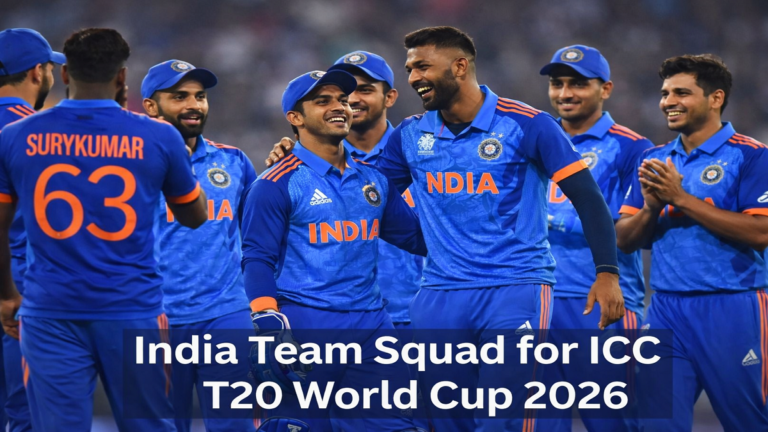
India vs Netherlands: Dube’s 66 Sets Up 17 Runs victory
India Will Win T20 World Cup 2026: The Core Prediction
The headline prediction—India will win T20 World Cup 2026—stands on four pillars that usually decide trophies: squad balance, bowling control in the middle overs, finishing power, and pressure-handling in knockouts. India do not need perfect starts every match because their structure protects them from one early wicket or one quiet powerplay. They can chase 170 with control, defend 150 with discipline, and win ugly when a pitch slows down. That “win in different ways” ability is the strongest sign of a future champion.
Most teams enter a T20 World Cup with one main plan. India can enter with three and switch between them without changing identity. That is why the prediction has weight.
Why India Will Win T20 World Cup 2026 Based on Performance
A performance-based prediction does not mean guessing totals. It means evaluating repeatable skills that survive pressure. In T20, repeatable skills are not only six-hitting. They include strike rotation against spin, boundary options to long sides, defensive bowling without freebies, and fielding standards that save 10–15 runs across a match. India consistently tick these boxes because their squad is built with roles, not just names.
India’s batting is not designed around one anchor and one hitter. It is designed around multiple “match states.” If they lose two wickets early, they can rebuild without falling behind. If they start fast, they can convert a 55/1 powerplay into 190 instead of settling for 170. If the pitch grips, they can play for ones and twos, keep wickets in hand, and take the game deep. These are tournament-winning patterns because knockouts rarely allow perfect conditions.
On the bowling side, India’s biggest advantage is control across phases. In a T20 World Cup, you must control the opponent at least in one phase every match. Some teams do it only in powerplay. Some do it only at the death. Champions usually do it in the middle overs because that is where teams either build a platform or lose momentum. India’s bowling resources allow them to apply that squeeze consistently.
India Will Win T20 World Cup 2026 in India and Sri Lanka Conditions
South Asian conditions tend to reward teams that understand pace-off bowling, spin angles, and smart batting against turn. In these venues, totals are not always the full story; timing matters more than raw power, and match-ups matter more than reputation. India’s players grow up playing these surfaces, but more importantly, India’s squad construction matches these conditions.
When the ball grips, batters who can access gaps become more valuable than batters who only swing straight. India’s lineup typically includes players who can manipulate fields, play sweeps and cuts, and keep the scoreboard moving without panic. That is how you win games where 160 feels like 190 because the pitch gets slower.
In Sri Lanka-style surfaces, the middle overs can decide everything. If a team loses control between overs 7–15, the match usually ends there. India’s spin options and smart pace variations give them a major advantage because they can defend with control rather than chasing wickets with risk. That matters in knockout cricket, where one over of 20 can destroy a semi-final.
India Will Win T20 World Cup 2026 Because They Win the Middle Overs
The middle overs are the most misunderstood phase in T20. Fans often focus on powerplay boundaries and death-over sixes, but tournaments are usually decided by the quiet overs where pressure builds. A team that wins overs 7–15 forces opponents into low-percentage shots. That is when wickets fall, and that is when chases get stuck.
India are strong here for two reasons: batting depth that keeps strike rotation alive, and bowling variety that prevents easy match-ups for the opponent. When India bat, they can keep the run rate healthy without gambling. When India bowl, they can use different types of spin and pace to break rhythm.
This is one of the strongest reasons the prediction India will win T20 World Cup 2026 is realistic. Middle-overs strength travels across venues and survives pressure.
India vs Pakistan: India win by 61 runs in Colombo
India Will Win T20 World Cup 2026 With Death Overs Advantage
Death overs decide titles because they compress the match into 24 balls. The best teams either score 45–60 in the last five overs or defend that phase with discipline. India’s advantage is not only one death bowler; it is a full death-overs plan.
A strong death plan has three parts: wicket-taking options, boundary prevention, and composure under pressure. India’s bowlers typically offer a mix of yorkers, hard lengths, slower balls, and wide lines that make hitting less predictable. When that plan works, opponents do not just score fewer runs—they lose momentum. That momentum loss changes the chase psychology and forces risky shots earlier.
On the batting side, India’s finishing strength is not limited to one player. Tournament winners often have two or three players who can close innings. That reduces dependence and makes India harder to game-plan against. A rival captain might save an over for the 19th, but if India have two finishers at the crease, that advantage disappears.
India Will Win T20 World Cup 2026 Because of Squad Depth and Role Clarity
Squad depth is not a buzzword. It is the real difference between a finalist and a champion. Over a long tournament, someone will be out of form, someone will have a minor injury, and someone will have a poor match at the wrong time. Teams with shallow benches panic and shuffle roles. Teams with deep squads replace like-for-like and keep the plan intact.
India’s depth allows them to maintain role clarity even when they rotate players. Role clarity means each batter knows whether they are building, accelerating, or finishing. It means each bowler knows which phase they own. It means the captain can react to the match without guessing.
This matters for ranking too, because readers trust analysis that explains “how” rather than only “who.” That is why this section is essential if you want to rank top positions for prediction searches.
India Hammer Namibia by 93 Runs in Delhi Thriller
India Will Win T20 World Cup 2026: Key Match-Winner Profiles
A prediction article must identify match-winner profiles without turning into a long list. In T20 World Cups, the match-winner profiles that matter most are: powerplay aggressor, middle-overs controller, finisher, wicket-taker in the middle, and death-overs closer. India usually carry options in every profile.
India’s top order can set the tone early, but the more important advantage is the middle order’s ability to absorb pressure. When top-order teams lose early wickets, they often collapse because the next batters play too many dot balls. India’s middle order often carries players who can score against spin without taking reckless risks. That allows India to reach par totals even on tricky pitches.
With the ball, India’s wicket-takers are not only “new ball” specialists. They typically have bowlers who can take wickets when batters try to accelerate in the middle overs. Those wickets matter more than powerplay wickets in knockouts because they break set batters and force new players to start under pressure.
If your website audience wants one clear message, it is this: India are built to control the match, not just to survive it.
India Will Win T20 World Cup 2026: The Winning Blueprint Match by Match
A ranking prediction article becomes stronger when it explains a repeatable blueprint. Here is the blueprint that fits India’s strengths and South Asian conditions.
India’s ideal powerplay approach is controlled aggression. They target one boundary option per over rather than attempting two every over, because losing three wickets early is the fastest way to lose a knockout. A stable powerplay does not always mean 60. On slower pitches, a 45/1 powerplay can be better than 60/3 because it sets up middle-overs control and a strong finish.
In the middle overs, India’s blueprint is to keep the run rate alive through rotation and selective hitting. The key is not to “wait for the death.” Teams that wait often find the pitch gets slower, bowlers get smarter, and 60 needed off the last five becomes impossible. India’s best version keeps scoring pressure on the fielding side so the opponent cannot relax.
At the death, India’s blueprint is to finish with intent while protecting strike. They look for boundary balls, but they also value running between wickets because that is what wins close games when the boundary option disappears. That mix—power plus running—wins tournaments.
With the ball, India’s blueprint is to attack early if the pitch allows, but always save the best control for the middle overs. If they can choke overs 7–15, the death overs become easier because the batting side feels forced to take risks. India’s death plan then closes the game.
This blueprint is why the prediction India will win T20 World Cup 2026 is not just a headline. It is a tactical fit.
India Beat USA by 29 Runs at Wankhede | Play Live Cricket
India Will Win T20 World Cup 2026: Biggest Threats and How India Can Handle Them
A good prediction article must be honest about threats. Otherwise, it reads like fan talk and loses trust. Here are the main threats India face and why they are still the most likely champions.
The first threat is a high-quality pace attack on a fresh surface. If India lose early wickets to swing or steep bounce, they can be forced into a rebuild. The solution is role discipline: one batter anchors without fear, the others rotate and hit only the right balls. India’s depth supports that approach.
The second threat is a world-class spin attack on slow pitches. Teams that cannot rotate against spin often lose because dot balls create panic. India’s advantage is having multiple players who can score against spin with sweeps, late cuts, and down-the-ground options. Even a small edge in spin scoring wins matches in India and Sri Lanka.
The third threat is one bad knockout day. T20 always has randomness. The best way to reduce randomness is to have more ways to win. India have more ways to win than most teams, so even though a bad day is possible, their probability across the tournament remains higher.
Final Prediction
Prediction articles should not end with a dramatic line; they should end with a clear conclusion that matches the evidence. Based on squad balance, phase control, conditions suitability, and match-winner profiles, the performance-based prediction is:
India will win T20 World Cup 2026.
Not because they are perfect, but because they are built to win more situations than any other team in this tournament. Champions do not need everything to go right. They need structure when things go wrong. India have that structure.
Play Live Cricket
Stay tuned to Play Live Cricket for complete coverage of the T20 World Cup 2026, including match previews, performance-based predictions, live score updates, tactical breakdowns, and post-match analysis. We focus on deep cricket insights rather than surface-level reactions, so you get clear explanations of why teams win, how strategies evolve, and which players truly influence the tournament. From powerplay trends to middle-overs match-ups and death-over execution, our coverage is designed for serious cricket fans who want more than just headlines. Follow Play Live Cricket for regular updates as the road to the T20 World Cup 2026 unfolds.
Disclaimer
This article is a performance-based prediction and reflects analytical opinions based on current squad balance, recent form, and tournament conditions. Cricket is unpredictable, and outcomes may differ due to injuries, form fluctuations, pitch behavior, or match-day circumstances. Play Live Cricket does not guarantee results and encourages readers to view predictions as informed analysis rather than confirmed outcomes.
FAQs
Will India win the T20 World Cup 2026?
India are one of the strongest contenders because they combine depth, middle-overs control, and strong finishing—three traits that usually win T20 World Cups.
Why do people say India will win T20 World Cup 2026?
Because India’s squad balance suits South Asian conditions, and they have match-winners across batting, spin, and death bowling.
What is the biggest reason India can win in 2026?
Middle-overs control. Teams that dominate overs 7–15 usually reach finals, and India’s bowling and batting resources suit that phase.