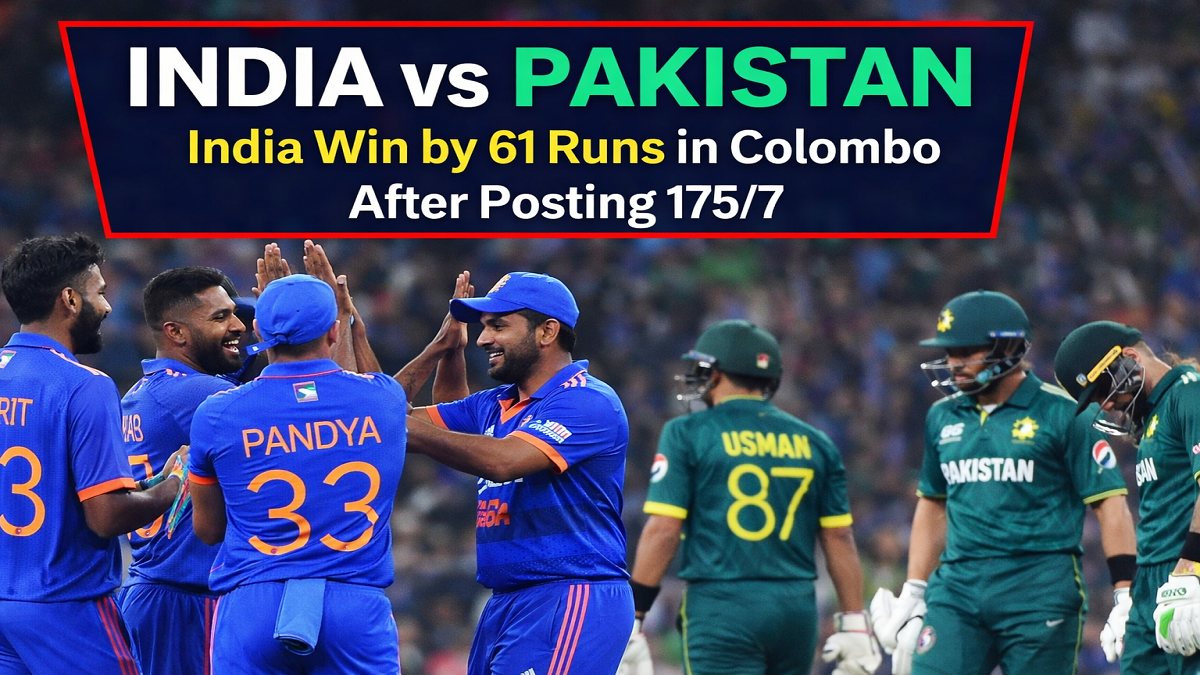
India vs Pakistan: India win by 61 runs in Colombo
India vs Pakistan: India posted 175/7, then bowled Pakistan out for 114 in 18 overs to complete a commanding 61-run win in Colombo (Group A).
India vs Pakistan: India Dominate in Colombo with 61-Run Win After Posting 175/7
Noise always follows this fixture. So does pressure. Yet the matches that become truly one-sided usually follow a simple pattern: one team stays calm, while the other team starts chasing the game too early. That was the story in Colombo.
In this India vs Pakistan clash at the R. Premadasa Stadium, India put up 175/7 and defended it with ruthless control, bowling Pakistan out for 114 in 18 overs. The result was a 61-run victory that reshaped the mood of Group A and underlined how quickly a chase can collapse when early wickets and dot balls squeeze the air out of an innings.
India’s performance had a clear shape. From the start, intent was visible in their approach. During the middle overs, discipline kept the innings steady. Later, valuable runs in the death overs pushed the total beyond the comfort zone. When Pakistan began their chase, India responded with early pace, controlled spin through the middle, and tight boundary protection until the end.
Pakistan, meanwhile, never found a stable partnership. The required rate rose. The shots got bigger. The margins got smaller. And once India had them at the edge, the chase became a trap rather than a pursuit.
India vs Pakistan Match Context: Why This Game Felt Different
World Cup group matches are not only about points. They are also about how you win. A close win keeps you alive. A heavy win lifts your net run rate, builds momentum, and sends a message to the rest of the group.
This India vs Pakistan match carried that extra weight. The margin was huge. The performance was complete. And the result helped push India toward the next stage while leaving Pakistan with serious pressure on their remaining games.
Even the atmosphere around the fixture felt tense. Reports noted frosty pre-match scenes, including the captains not shaking hands at the toss. That detail didn’t decide the match, but it reflected the intensity that always sits beneath this rivalry.
India vs Pakistan Score Summary: The Numbers That Define the Night
India finished their 20 overs on 175/7. Pakistan were then dismissed for 114 in 18 overs, falling 61 runs short of the target.
The headline numbers also carried individual highlights. Ishan Kishan was named Player of the Match after a powerful 77 off 40 balls, while Pakistan’s Saim Ayub led the bowling with 3/25 in India’s innings. In the chase, Usman Khan top-scored for Pakistan with 44, but the resistance ended once India kept striking at key moments.
India vs Pakistan Pitch and Conditions: Why 175 Played Like a Bigger Total
Colombo can reward smart batting, but it punishes impatience. The surface often slows a touch in the middle overs, spinners can find grip, and the big dimensions force batters to think twice before committing to aerial shots.
The ground size matters. Ahead of the match, reporting highlighted that square boundaries can be around the mid-70m range, while straight and longer pockets can stretch into the mid-to-high 80s. Those numbers change how batters calculate risk. A shot that looks safe at one venue becomes a catch at another.
That is why India’s 175 carried extra value. It demanded discipline in the chase from ball one. Once Pakistan lost that discipline, the target began to feel heavier than it looked on paper.
India vs Pakistan: How India Built 175/7
Great T20 innings rarely come from nonstop slogging. They come from understanding phases. The best sides know when to attack, when to rotate, and when to protect wickets.
India’s innings followed that script. It wasn’t perfect. Wickets fell. Periods slowed. Yet the total kept moving because India never let the innings lose structure.
India vs Pakistan: Powerplay
India’s early approach was decisive, but not reckless. They looked to score, yet they resisted the rivalry trap of trying to win the match inside two overs.
This was also the phase where Kishan’s impact was felt most strongly. His 77 off 40 gave India a top-order surge and forced Pakistan into defensive decisions earlier than they would have liked.
Even when boundaries came, India made sure singles stayed part of the plan. That detail matters. Singles keep the run rate honest without handing the bowling side free wickets.
India vs Pakistan: Middle Overs
Middle overs are where totals either grow or die.
Bowling teams typically squeeze here with spin, slower balls, and boundary riders. The goal is to create dots. Dots create frustration. Frustration creates wickets.
India avoided that spiral through smart rotation. Instead of forcing big shots, the batters kept the strike moving and worked the ball into open spaces. Quick singles and well-judged twos replaced risky swings when boundaries were not available. Although this approach may not appear flashy, it builds stability. As a result, the innings remained balanced and the death overs became an opportunity to accelerate rather than a desperate attempt to recover.
Pakistan did find moments of control in this period. Saim Ayub’s spell was one of the reasons India did not explode past 190. Yet the key point is that India stayed functional even when the scoring slowed.
Death Overs: Enough Late Runs to Cross the Pressure Line
A score around 160 can feel chaseable. A score around 175 begins to demand perfection.
India’s late push, even with wickets falling, took them to that pressure line. The final total of 175/7 forced Pakistan to chase at close to nine an over from the start. That is not impossible, but it becomes dangerous if you lose early wickets or get stuck against spin.
India did not need a 210. They needed a total that could be defended with discipline. They got it.
Pakistan’s Chase: Why 176 Became Unreachable
Chasing 176 demands a clear plan from the first over. Early stability is essential, because it prevents panic and keeps the required rate under control. In addition, at least one strong partnership must anchor the innings. Just as importantly, steady rotation is needed so that dot balls do not pile up and create unnecessary pressure.
Pakistan never assembled those pieces.
India vs Pakistan: Early Collapse
The most damaging thing in a chase isn’t one wicket. It’s losing multiple wickets before the innings has found rhythm.
According to match reporting, Pakistan were reduced to 13/3 in two overs, with India’s quicks striking early and setting the tone. When that happens, a chase stops being a chase and becomes damage control.
From that point, the required rate is only part of the problem. The bigger problem is psychological. New batters arrive under pressure. They want to “fix” the situation quickly. That desire leads to bigger shots earlier than needed.
Dot Balls: The Quiet Force That Creates Panic
Dot balls don’t look dramatic on highlights. Yet they destroy chases.
One dot ball raises the required rate. Two dots increase frustration. A cluster of dots creates a situation where a batter feels forced to attack the next ball, even if the next ball is good.
India’s bowling strategy applied constant pressure. Rather than gifting width, they attacked disciplined lines and lengths. At the same time, boundary options were heavily protected. Although singles were available, they were limited to safe areas. As a result, Pakistan could not reset the chase with one explosive over.
When you can’t reset, you start gambling. Gambling is where wickets arrive.
The Partnership Problem: No Base, No Finish
A chase of 176 usually needs at least one partnership that crosses 40, plus another that holds the innings together through the middle. Partnerships do two things. They add runs, and they calm minds.
Pakistan couldn’t build that calm.
Usman Khan did provide resistance with 44, but without support, his innings became a lone stand rather than a platform. Once he fell, the chase lost its final thread. Reporting noted his dismissal as a decisive moment, with India’s control tightening again immediately after.
Pakistan were eventually dismissed for 114. The match didn’t drift to a close finish. It ended early because the chase ran out of wickets.
How India Controlled the Defense: Pressure, Plans, and Timing
Defending 175 is not about one magic over. It is about repeated small wins.
India did three things particularly well.
They Attacked Early with Pace
Early breakthroughs transform the shape of a chase. Once wickets fall, captains can deploy favorable match-ups with confidence. In addition, spinners are free to attack with aggressive field settings. Consequently, the chasing side is pushed into taking risks earlier than they intended.
India’s early strikes ensured Pakistan never settled. That is the foundation of the collapse.
They Bowled into the Hard Areas
The “hard area” is usually a good length around off-stump, with minimal width. It forces batters to manufacture scoring options. Manufacturing often creates mis-hits.
India stayed disciplined in those channels, which made Pakistan’s boundary options rare. When boundaries are rare, singles alone can’t keep up with a rising required rate.
They Protected the Boundary and Accepted Controlled Singles
This is a modern T20 truth: you don’t stop every run. You decide which runs are allowed.
India’s field settings and lines suggested a clear plan: protect fours, make sixes difficult, and accept singles that don’t change the equation. That plan becomes even stronger when the required rate is high, because singles don’t relieve pressure the way boundaries do.
Pakistan needed one or two explosive overs to bring the chase back to life. India denied that oxygen.
Key Turning Points in India vs Pakistan
This match had moments that shifted the game without needing a single “one-ball miracle.”
Turning Point 1: Kishan’s Momentum at the Top
India’s innings gained early speed through Ishan Kishan’s attacking batting. His 77 off 40 was not just a top score. It set the tone and built the base that allowed India to keep pushing later.
Turning Point 2: Pakistan 13/3 in Two Overs
Chases don’t often survive that start against a disciplined attack. Those wickets forced Pakistan into a rescue mindset far too early.
Turning Point 3: Usman Khan Falls and the Chase Ends
Usman’s 44 offered Pakistan a brief line of hope, but without partnerships it couldn’t evolve into a real chase. Once he fell, India’s win became inevitable.
Tactical Takeaways for India
India will take more than two points from this performance.
They will take proof that they can post a defendable total under pressure, even if they don’t produce a flawless 20 overs. They will also take confidence from how their bowling attack executed plans with discipline rather than relying on chaos.
This kind of win travels well in tournament cricket. It isn’t dependent on one pitch or one superstar moment. It is built on structure.
Kishan’s form is another major positive. A top-order batter playing with freedom and intent changes the entire shape of a T20 side.
Tactical Takeaways for Pakistan
Pakistan’s biggest lesson is also simple: a chase is won through structure, not emotion.
The chase required stability. Early wickets removed stability. Dot balls increased pressure. Lack of partnerships removed calm. Then the innings became a series of forced decisions.
For Pakistan to recover in the tournament, they need to improve three areas quickly.
They need rotation to return as a default habit, not an optional tactic. They need partnerships that last long enough to reset the required rate. And they need the middle overs to become a phase of control instead of a phase of panic.
This defeat also leaves a net run rate scar. In groups, that can return later when teams finish level on points.
What This Result Means for Group A
A 61-run victory is more than just another result. It sends a clear statement to the rest of the group.
Such a margin strengthens India’s position and builds valuable momentum. At the same time, it places Pakistan under greater pressure in the standings. Reports after the match suggested that India moved closer to qualification, while Pakistan’s path became more complicated.
Group-stage tournaments are often decided by fine margins. On this occasion, the margin was anything but small.
Final Verdict: India Won the Match by Controlling Pressure
This India vs Pakistan match was decided by composure.
India built 175 with phases, anchored by Kishan’s power and supported by a stable approach that didn’t collapse when wickets fell. Then they defended with discipline, striking early and squeezing hard.
Pakistan, in contrast, chased without a platform. Once early wickets and dot balls combined, the chase turned into a trap. The innings ended at 114, and the match ended early.
Result: India 175/7 beat Pakistan 114 all out (18 overs) by 61 runs.
Play Live Cricket
Stay tuned with Play Live Cricket for more T20 World Cup match reports, cricket news updates, points table impact, and deep match analysis. We cover every big moment, and we explain the story behind the score.
Disclaimer
This article is published for news and analysis purposes. Scores and match details are based on publicly available match updates and reporting available at the time of writing.