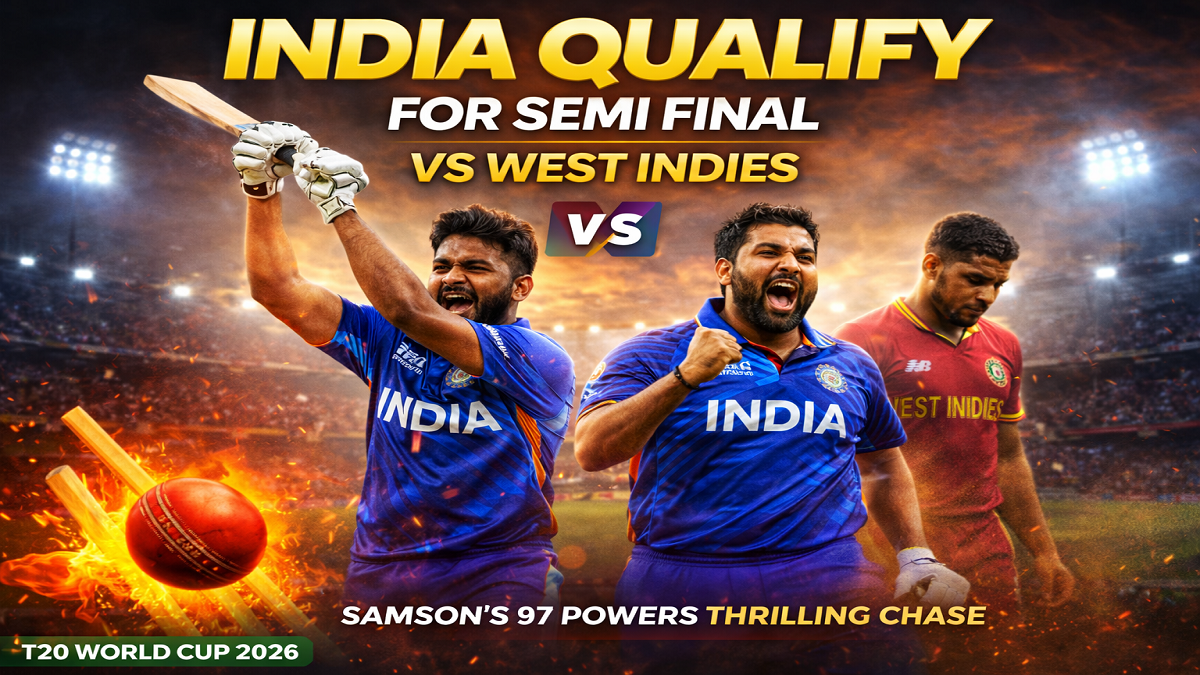
India Qualify for Semi Final vs West Indies
India Qualify for Semi Final after beating West Indies in a 196 chase—Samson’s 97 and calm finishing seal a 5-wicket win at Eden Gardens.
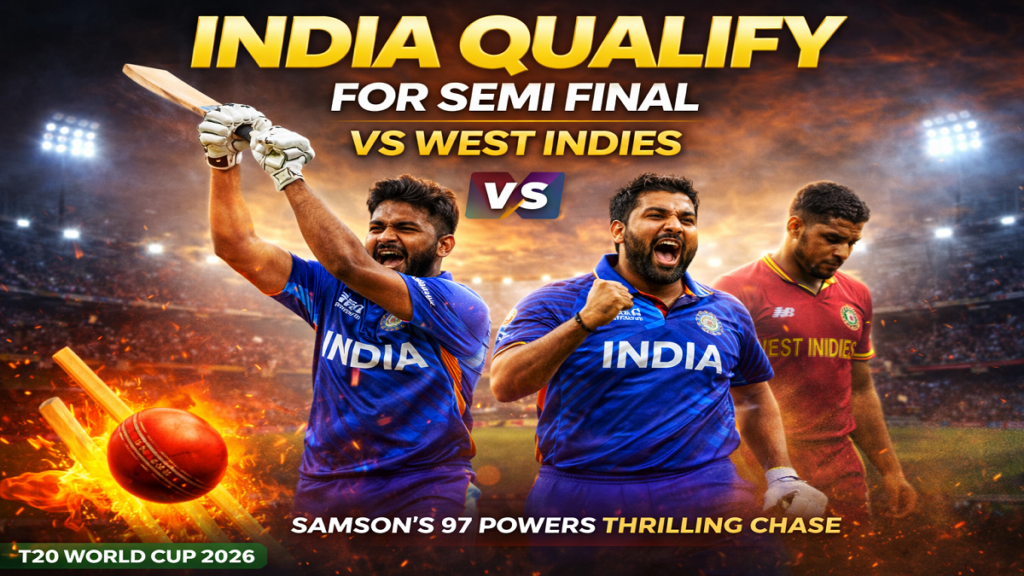
India Qualify for Semi Final vs West Indies: Full Expert Match Analysis (T20 World Cup 2026)
A chase of 196 is never “routine,” even on a good surface. It’s the kind of total that forces every batting unit to answer uncomfortable questions: can you score fast without losing shape, can you keep the required rate from becoming a monster, and can you finish under pressure when the bowling side starts throwing every matchup and variation at you? India answered all three, and that’s why India Qualify for the semi final with a win that feels like more than two points.
West Indies did a lot right to reach 195/4. They preserved wickets, accelerated late, and pushed the game into a scoring zone that normally creates panic. But India’s chase wasn’t built on panic. It was built on tempo management. The difference was not merely boundaries; it was the absence of stall overs. India refused to let the match drift into that familiar chase storyline where dot balls pile up, a batter swings at the wrong bowler, and the equation explodes. Instead, India kept the chase breathing—every over had a purpose, every partnership had a job, and every risk felt calculated rather than desperate.
At the center of it was Sanju Samson’s 97 off 50—an innings that didn’t just score runs, it controlled the match’s emotional temperature. This was not a “hit everything” knock. It was a chase architect’s innings: manipulating fields, choosing the right bowlers to target, and keeping strike rotation alive so West Indies couldn’t build pressure through dots. When India Qualify from games like this, it sends a message to the rest of the tournament: India can win the big ones in more than one way.
Match Context That Matters: Why This Win Feels Like a Knockout Dress Rehearsal
Big chases are won well before the last over. They’re won in the middle overs when the bowling side tries to make you blink. That’s why this match felt like a semi final rehearsal. West Indies had a defendable total, a new ball they could swing through the air, and the ability to use pace-off and hard lengths in the middle. They also had the psychological advantage that comes with a 190+ scoreboard: one mistake from the chasing team and the required rate becomes frightening.
India never let that “fear equation” take over. Even when wickets fell, India’s chase never became reckless. The important detail is not only that they got home, but how they got home—finishing at 19.2 overs means they didn’t scrape the line at the last ball. They remained in control of the chase length, which is often the best sign of a top T20 side.
And crucially, this was a qualification game in spirit and consequence. India Qualify because they won under pressure in a high-scoring contest—exactly the kind of contest that decides tournaments.
West Indies 195/4: A Total Built on Wicket Preservation and Late Over Acceleration
To understand why India’s chase was special, you first have to respect what West Indies produced. 195/4 is not “a couple of cameos.” It typically implies an innings that kept wickets in hand and accelerated through the back end. It means the batting unit avoided the most common T20 trap: losing 3–4 wickets in the middle, which forces survival mode at the death.
West Indies’ structure suggests they built a platform and then used late overs to convert. Even if the exact over-by-over is not in front of us, the shape of 195/4 in modern T20 is usually the same: a steady start, controlled middle, and a finishing surge. Roston Chase’s 40 off 25 indicates a role that combines stability with enough pace to avoid stalling. That’s a valuable type of innings because it prevents the bowling side from cashing in with dot-ball pressure.
When West Indies score 195 with only four wickets down, the defense normally has options. You can attack with close catchers early, because you can afford a few boundaries; you can also defend later with fielders in the ring because wickets are required to break momentum. But that only works if you actually create momentum breaks. Against India, the breaks didn’t last.
Why 195 Was Chaseable Here: The Venue, the Surface, and the “190+ Psychology”
Eden Gardens can produce high totals when the pitch is true and the outfield is quick. But even on a good pitch, a 190+ chase is still psychologically heavy. What usually decides it is not the pitch alone but the “pressure rhythm.” Chasing teams often lose their way in two moments: first, when the powerplay doesn’t explode; second, when the middle overs slow down.
India avoided both problems. They didn’t need a 70+ powerplay to chase 196; they simply needed to avoid a slow start and prevent early wickets from forcing a rebuild. If you keep wickets and keep the required rate stable, the chase stays within reach. That’s the subtle difference between a chase that feels impossible and a chase that feels “manageable if we play our cricket.” This is where India Qualify becomes more than a line in the points table. It becomes evidence that India can manage the mental game of a big chase.
India’s Chase Blueprint: Keep the Rate Flat, Keep Wickets, Trigger Boundaries in Bursts
In 196 chases, the most efficient plan is rarely “hit every over.” It’s “hit two overs out of four” while rotating strike in the other two. That pattern keeps the run rate healthy without inflating risk. The chasing team wants to prevent the bowling side from stacking dots; the bowling side wants to create a chain of quiet deliveries that forces a mistake.
India’s chase strongly reflects the smarter blueprint. The final score suggests India maintained enough scoring tempo that the required rate didn’t balloon, and they still had enough wickets to finish. Finishing in 19.2 implies India did not allow West Indies to drag them into a last-over lottery. That’s what elite teams do. They don’t just chase targets; they control the chase length.
Sanju Samson’s 97 off 50: The Difference Between “Power” and “Chase Control”
Sanju Samson’s innings is the headline because it was the engine. But the important part is how it functioned. A 97 off 50 can come from pure power. It can also come from a mixture of strike rotation, boundary selection, and matchup hunting. In a chase of 196, the second type is far more reliable because it reduces volatility.
Samson’s innings reads like a chase that stayed one step ahead. He likely kept scoring options open in multiple areas: using gaps square, picking up singles early in overs to avoid dot pressure, and then choosing one or two balls per over to attack. That’s not flashy analysis—it’s the core skill. In big chases, the batter who can still score 8–9 an over without taking high-risk swings is gold.
A key reason chases collapse is the “boundary famine.” Teams go three overs with only one boundary, panic, and then lose wickets trying to compensate. Samson’s value was that he prevented famine. Even when West Indies tightened, he could still access boundaries or keep the run rate ticking with twos and singles. That’s why the chase never looked like it needed a miracle at the end. When India Qualify after a chase like this, it’s because someone played a masterclass in managing risk.
The Hidden Skill: Strike Rotation Under Pressure
T20 fans often reduce chases to sixes. But in reality, chases are often decided by singles. Not because singles are worth more than boundaries, but because singles remove pressure. They prevent dots. And dots are the currency the bowling side uses to buy wickets.
India’s chase suggests the dot-ball percentage stayed under control. That’s normally the first sign of a successful chase: even if you’re not hitting 12 an over, you’re not stuck. You’re making bowlers feel like nothing is safe—if they miss length, it’s a boundary; if they hit length, it’s still a single and the over keeps moving.
West Indies, to defend 195, needed a period of suffocation. A two-over squeeze. A chain of dots that forces the batter to take on the longer boundary. It doesn’t appear they sustained that squeeze long enough.
West Indies Bowling: Why Taking Wickets Wasn’t Enough
Jason Holder’s 2/38 is a strong return on a night where runs flowed. But defending 195 is not only about taking wickets; it’s about taking wickets at the right time and against the right batter. If a set batter stays in—especially someone like Samson in that rhythm—then two wickets don’t always “change the chase.” They can even be absorbed if the run rate is already under control.
West Indies needed one of two things: either remove Samson early, or isolate him by creating dot pressure at the other end. If the set batter keeps strike and keeps scoring, the chase remains stable even after wickets. That’s exactly why high chases often depend on dismissing the anchor or the controller, not just “any” wicket.
The match outcome suggests India kept enough batting depth or composure that the wickets did not derail them. The chase stayed structured, not emotional.
Bumrah’s 2/36: The Best Kind of Spell in a 390+ Run Match
On a night where West Indies scored 195, any bowler going for under 9 an over is doing something valuable. Bumrah’s 2/36 isn’t about being “economical” in a traditional sense; it’s about preventing West Indies from crossing the psychological barrier of 200+. There is a massive difference between defending 195 and defending 210. At 195, the chasing side can still plan the chase in phases without needing a death-over explosion. At 210, even a good chase needs a couple of extraordinary overs. If Bumrah’s spell kept West Indies slightly in check—taking wickets and preventing one huge over—then that spell indirectly made the chase more realistic.
In tournaments, these are the spells that win trophies. Not always the ones that look pretty on a slow pitch, but the ones that keep totals from becoming out of reach.
India Qualify: Middle Overs Where India Won the Match Without Anyone Noticing
Powerplays get highlights. Death overs get headlines. Middle overs win tournaments. In a chase like this, the middle overs are the battlefield where West Indies would have tried to choke India with slower balls, hard lengths, and fielders in the ring. The chasing team’s job is to keep momentum alive while not losing wickets in clusters.
India’s final-over comfort suggests they achieved a key middle-overs goal: they did not allow the required rate to climb above comfort. That likely happened because Samson (and whoever partnered him) kept working singles and picking the right bowlers to attack. This creates a subtle but devastating effect: the bowling captain runs out of “safe overs.” When every bowler is being targeted somewhere, you can’t hide anyone. The chasing team then gets to choose which matchup to hunt. That’s how big chases become manageable: the chasing team ends up controlling the bowling changes.
Death Overs: Finishing Early Is a Statement of Control
India finished in 19.2. That is crucial. It tells you the chase was not a last-ball scramble. It tells you India didn’t need a “perfect last over.” Instead, they likely entered the final phase needing an achievable equation—something like 40 off 24 or 30 off 18—rather than 55 off 24.
When you enter the last five overs with wickets in hand and a reasonable equation, the batting side can play percentage cricket: take twos, pick the shorter boundary, wait for the bowler’s error, and never let dots accumulate. That’s usually the hallmark of a chase guided by a set batter. This is why India Qualify with confidence; the finishing wasn’t frantic. It was planned.
Turning Points: The Moments That Changed the Game’s Direction
A match like this usually flips on a few critical sequences, even if the scoreboard looks smooth. One likely turning point was the phase where West Indies tried to apply brakes and India responded with a boundary burst rather than panic. Another turning point was the late overs where India didn’t let the required rate spike. And the biggest turning point was simply Samson staying deep into the chase. When a batter carries form into the death overs, the bowling side is forced to bowl to a set player under extreme pressure—often the worst scenario for defenders.
West Indies might have hoped for one big over of dot pressure and a wicket. India didn’t give them that.
India Qualify: What India Must Carry Into the Semi Final
When a team wins a chase like this, it reveals what can work in knockout games. First, India’s batting showed it can chase without a perfect start. That matters, because semi finals often come with nerves and early movement. Second, India showed it can keep the chase calm through the middle overs, which is the phase where most teams collapse. Third, India proved it has a batter who can control tempo in high chases—something you need when pitches get slower and bowling gets smarter.
But India should also note that conceding 195/4 means there were periods where West Indies found rhythm. Against semi final opposition, India’s bowling will need more wicket-taking options in the middle overs and a tighter plan to the set batters. The good news is: qualification games give you pressure practice. And India Qualify after learning and winning simultaneously.
Tactical Lessons: What West Indies Must Fix After Scoring 195 and Losing
If you score 195 in a tournament game and still lose, the review isn’t “we didn’t score enough.” It’s “we didn’t defend smart enough.” West Indies’ biggest missing piece appears to be sustained pressure. In a chase of 196, you cannot rely only on wicket-taking. You need at least one two-over choke, preferably against the set batter, where you trade some singles for dot balls and force a risk.
West Indies might also examine their matchup use. If Samson was controlling the chase, did they throw their best matchup at him early enough? Did they protect his scoring areas? Did they bowl to the longer boundary with discipline? These are the small details that decide tournaments. On this night, India executed those details better with the bat.
India Qualify: What This Result Means for the Tournament
This wasn’t just a win. It was a “tournament-signature” chase. When a side chases 196 and finishes with balls remaining, it changes how opponents plan. They stop thinking, “We need 185 to challenge India,” and start thinking, “We need 205 and early wickets.” That mental shift is powerful.
Also, the performance sends a clear message: India Qualify not by scraping through low-scoring games, but by proving they can win a high-pressure shootout. In semi finals, where totals can be big and nerves bigger, that experience is priceless.
Conclusion: India Qualify Because They Controlled the Match, Not Just the Score
Cricket often gets simplified into totals and results. But the difference between a team that wins a tournament and a team that exits early is usually about control—control of tempo, control of pressure, control of the chase narrative.
India’s chase had that control. West Indies fought hard and produced a strong batting performance, but India’s response was smarter and calmer. Sanju Samson’s 97 was the innings that made the chase feel possible from start to finish. Bumrah’s spell ensured West Indies didn’t push the score into the 200+ danger zone. And India’s finishing in 19.2 overs confirmed that this wasn’t survival; it was execution.
That’s why India Qualify for the semi final—because they played like a team that understands what wins big matches.
Play Live Cricket
Stay tuned with Play Live Cricket for more tactical match breakdowns, phase analysis, and World Cup strategy coverage
Disclaimer: This article provides analysis for educational and informational purposes based on publicly available match information.