India Beat England Semi-Final, Reach T20 World Cup Final
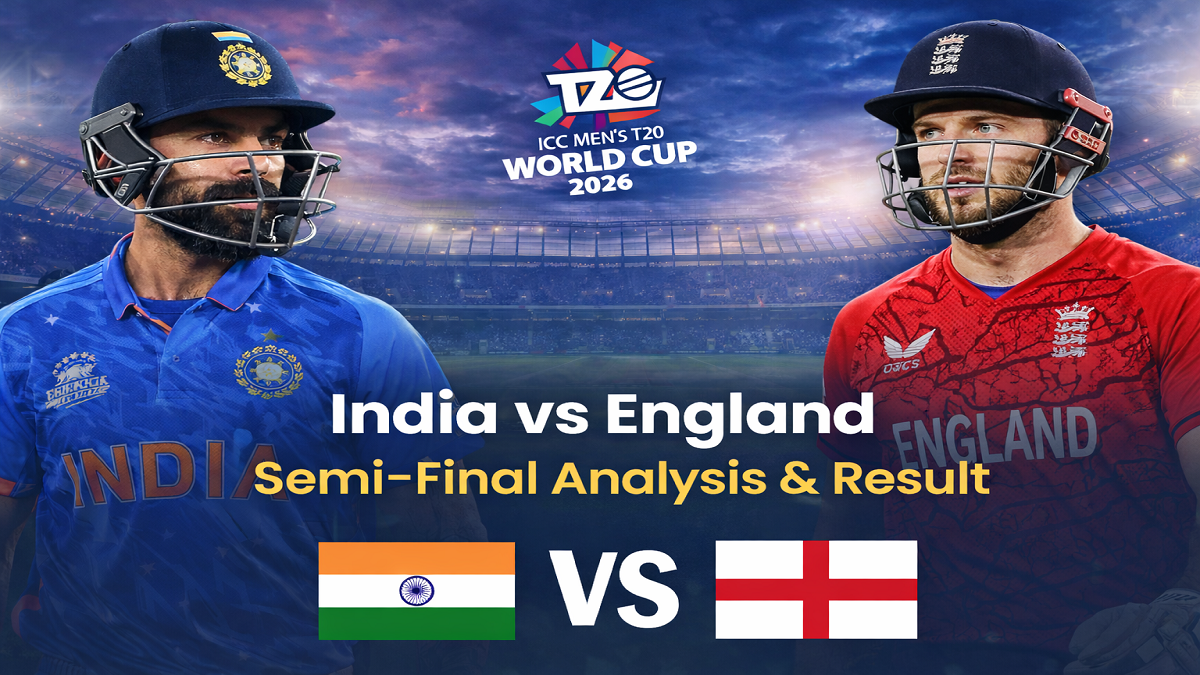
India beat England semi-final to reach the T20 World Cup final after a thrilling 7-run win. Read the full match report, key moments, and player highlights.
India Beat England Semi-Final, Reach T20 World Cup Final
India beat England semi-final and booked a place in the ICC Men’s T20 World Cup 2026 final after surviving a stunning late chase at Wankhede Stadium. The scoreline looks simple. India made 253/7, England replied with 246/7, and India won by seven runs. But this match did not feel simple at any stage. It moved like a storm. Every over changed the mood. Every boundary pushed the pressure back onto the other team. And every mistake carried extra weight because the margins were so thin.
This semi-final became a reminder of what knockout cricket demands. Teams must show brave batting and sharp decision-making. Clean fielding also plays a crucial role in pressure matches. Bowlers need calm execution during the death overs. England did many things well, but they lost a few key moments. India did not play a perfect game either. However, India handled the biggest moments better. That is why India beat England semi-final and reached the final.
If you are tracking the full tournament story, you can follow all knockouts and key turning points in your T20 World Cup 2026 Match Analysis hub.
Wankhede conditions shaped the contest from ball one
Wankhede often rewards intent. The outfield stays quick, and the boundary line always looks inviting. The surface usually offers true bounce, which makes timing easier for batters. On nights like this, bowlers feel as if they are working inside a small room. Even a slight mistake in length can disappear for six. A fuller delivery invites a powerful drive. A short ball often disappears with a pull shot. That is why teams chase big totals at this venue more often than people expect.
England chose to field first. They hoped the new ball would move. They also expected the pitch to slow later. That plan did not land. India found value in the powerplay. England then searched for control through spin and variations, but India kept scoring. Once India crossed the 240 mark, England still believed they could chase. They backed their batting depth. They almost proved it right.
Still, Wankhede also creates a second truth. On a flat pitch, fielding becomes a weapon. One drop can add twenty runs. One lazy stop can add six. One slow pick-up can turn one into two. That is exactly what happened in this semi-final. England dropped Sanju Samson at a key moment, and the match never looked the same after that.
India’s powerplay intent forced England into defensive cricket early
India started with clear purpose. They did not wait for the pitch to “tell” them anything. They treated the surface as a road from the first over. Abhishek Sharma attacked the pace early and looked for boundaries in the gaps. Although his innings was short, his impact was important. The aggressive start set the tone for India’s batting approach. Early boundaries also forced England’s fast bowlers to adjust their lengths quickly.
India lost Abhishek inside the powerplay, yet the momentum remained strong. Sanju Samson arrived at the crease and kept the scoring rate high. Rather than rushing, Samson played with control and clarity. Smart strike rotation and well-timed boundaries kept the pressure on England’s bowlers. That balance matters in knockout matches. When one batter attacks and the other rotates strike, bowlers often struggle to regain control. England felt that pressure very early in the semi-final.
India finished the powerplay at a strong rate. They also kept wickets in hand. That combination matters more than any single number. In a semi-final, you want to attack early. At the same time, you want enough depth to finish like a train. India built that base in the first six overs.
For context on how India have used the powerplay all tournament, India Squad & T20 World Cup 2026 Updates.
Samson and Kishan took control in the middle overs
Many teams score quickly during the powerplay, but fewer maintain that pace between overs 7 and 14. This phase usually allows bowlers to regain control. Spinners enter the attack, field settings change, and batters often lose rhythm.
India avoided that problem. The partnership between Sanju Samson and Ishan Kishan played a major role in why India beat England semi-final. Kishan attacked with clean power and quick hands, preventing England from settling. When bowlers missed their line, he punished them with boundaries. Quick running between the wickets also kept the scoreboard moving.
Samson controlled the tempo in a different way. Smart strike rotation ensured constant pressure on England’s bowlers. Whenever mistakes appeared, Samson attacked. England soon spread the field to stop boundaries, which allowed India to collect easy singles and twos. That steady scoring gradually removed England’s control in the middle overs.
England tried to use Adil Rashid to break the rhythm. Rashid still matters in T20 cricket because he forces batters to take risks. But on this night, India did not fear those risks. They took calculated chances. That is a key difference between normal T20 games and knockouts. In knockouts, batters often play “safe” against a world-class spinner. India did not. They backed their range. That decision kept the run rate above ten even in the so-called control phase.
The dropped catch on Sanju Samson changed the match’s shape
This semi-final had several turning points, but the most important moment came from England’s fielding. England dropped Sanju Samson at a crucial stage of the innings. In league matches, dropped catches often hurt. In knockout games, they can completely change the direction of the match. A missed chance does more than save a batter. It forces bowlers to restart their plans against a set player. Captains must adjust their fields, and the pressure shifts back onto the fielding side. That single mistake gave India a major advantage.
Samson used the opportunity brilliantly. Instead of slowing down, he increased the pressure on England’s bowlers. Confident shot selection allowed him to score freely across the field. Strong footwork against spin also helped him dominate the middle overs. Strike rotation became another key factor. By turning the strike regularly, Samson prevented England from building pressure through dot balls. The innings gained momentum quickly, and India pushed toward a match-winning total.
This is not guesswork. The final margin was seven runs. That drop mattered. T20 World Cup 2026 Highlights & Tactical Insights.
India Beat England Semi-Final: Samson’s 89 was not just hitting — it was control
Sanju Samson scored 89 off 42 balls. That number tells one story, but the deeper story lies in how the innings developed. Rather than hoping for lucky shots, Samson read the match situation and adjusted his approach against England’s bowling attack.
Early singles and quick twos helped him settle at the crease. Close observation of England’s new-ball strategy allowed him to identify scoring areas. Once the patterns became clear, Samson began targeting specific matchups. Full deliveries invited confident drives through the off side, while shorter balls disappeared with powerful pulls. Slower deliveries brought patience before attack, and strong footwork against spin created more scoring opportunities.
That last part mattered most. When a batter steps down the pitch, the spinner loses control. The spinner then bowls wider. Once the spinner goes wider, the batter can sweep or cut. The spinner then tries straighter lines. Once the spinner goes straighter, the batter can hit down the ground. That is how great batters create options. Samson created options all innings.
So when people ask why India beat England semi-final, you can point to Samson’s innings. It forced England to defend. It also allowed India’s later hitters to play with complete freedom.
England’s bowling plan lacked one clear “control” phase
On this surface, teams do not need miracles from their bowlers. They need one thing: a short control window. That window can come from swing. It can come from a tight spinner. It can come from a slow-ball plan. But it must appear somewhere. England never found that window. They tried pace early. India attacked. They tried spin. India attacked. They tried variations at the death. India still scored fast.
Jofra Archer bowled with pace, but the pitch did not help. Sam Curran mixed cutters and slower balls, yet the ball still came on. Adil Rashid took wickets, but India kept scoring off him. That is the core issue. England took wickets, but they still leaked runs.
In a match where both teams score freely, the side that leaks fewer boundary balls usually wins. England leaked too many “easy” balls. They bowled too many deliveries that sat up. They also missed yorker length more often than India did. England T20 World Cup 2026 Squad & Match Reports.
India Beat England Semi-Final: India’s finishing phase lifted the total from big to brutal
India’s total was already strong by the 14th over. But they did not settle for strong. They pushed for brutal. After Samson, India kept swinging with smart intent. Shivam Dube played a key role. He hits power cleanly, so bowlers cannot miss in his arc. Hardik Pandya then added a sharp late surge. Tilak Varma also played a cameo that mattered because it increased the final total by the kind of runs that decide matches.
This is where the Samson drop again matters. If England take that catch, India may still score big. Yet India might score 235 instead of 253. At Wankhede, that difference changes how the chase feels. It changes the mental pressure. It changes the risk England must take in the final five overs. Because India beat England semi-final by seven runs, every “extra” run mattered.
England’s chase needed a perfect start, but India forced early damage
To chase 254, England needed the top order to stay. They also needed early boundaries. They did get boundaries, but they lost key wickets too soon. Philip Salt fell early. That wicket hurt England because Salt often provides powerplay momentum. When Salt goes, England lose one of their fastest starters.
Jos Buttler tried to build the chase, but India did not allow him to own the tempo. India’s bowlers kept moving lines. They also used smart pace changes. Then India removed Buttler. England lost another anchor. Soon after, Harry Brook also fell.
At that stage, England still had hitters. Yet the chase had a new problem. England now needed one monster innings. They also needed support. That is a hard ask in a semi-final. But Jacob Bethell nearly delivered the impossible.
Jacob Bethell played an innings that nearly stole the semi-final
Jacob Bethell’s 105 off 48 balls was outstanding. The innings relied on fearless stroke play rather than cautious batting. Confident shot selection allowed Bethell to attack England’s bowlers from the start. Instead of waiting for mistakes, he forced bowlers to defend the boundary. Spin bowling also suffered under pressure. Powerful hits over the top and clever placement into gaps created constant scoring opportunities. Quick hands and confident footwork expanded his range of shots, making it extremely difficult for India’s bowlers to control the middle overs.
For a long stretch, Bethell turned the chase into a serious threat. The required run rate remained high, yet England kept pace with the target. The crowd sensed the tension, and India suddenly felt the pressure. India responded with calm decision-making. Rather than experimenting with random bowling changes, the captain trusted Jasprit Bumrah to deliver control overs. Hardik Pandya maintained pressure at the other end while the fielding unit stayed alert for opportunities.nThat opportunity eventually arrived through a crucial run-out.
India Beat England Semi-Final: The run-out ended England’s best path to victory
England’s best path was simple. Bethell needed to bat deep. Another batter needed to stay with him. Together they could keep the required rate in reach. Then Bethell ran out. India created the run-out through sharp work in the ring and clean work behind the stumps. This dismissal did not just remove 105 runs. It removed England’s calm.
Once Bethell left, England had to go for too much too soon. They needed sixes almost every over. That plan can work for a few balls, but it rarely works for five overs in a row. It brings risk. It brings mistakes. So even though England kept swinging late, the chase lost shape. That is where India beat England semi-final in the real sense. India found the one moment that broke England’s best plan.
Bumrah’s spell gave India the difference they needed
This semi-final produced huge scores, and most bowlers conceded runs freely. Yet one bowler still stood out: Jasprit Bumrah. The conditions offered little help, but Bumrah relied on skill rather than the pitch. Smart pace variations, accurate lines, and perfectly executed yorkers allowed him to control crucial overs. Even on a night filled with boundaries, Bumrah created valuable quiet moments that slowed England’s momentum.
High-scoring T20 chases often come down to two overs. When one bowler delivers a pair of tight overs, the chasing side feels forced to attack someone else. Extra risk then brings mistakes, which can lead to wickets or run-outs. That pressure helped India defend their total. By controlling those key overs, Bumrah played a major role in why India beat England semi-final and secured a place in the T20 World Cup final.
India Beat England Semi-Final: England’s key weak points in this semi-final
England will feel pain because they scored 246 and still lost. However, when you look closely, the reasons appear clearly. England’s first weak point was fielding under pressure. The dropped catch of Samson changed the match. In knockouts, teams must finish chances. England did not. That single mistake likely added a big chunk to India’s total.
England’s second weak point was death bowling execution. England tried yorkers and slower balls, but they missed often. When they missed, India hit boundaries. India’s late runs turned a chase into a mountain. England’s third weak point was early wicket loss in the chase. In a 250+ chase, the top order must provide a platform. England lost Salt early. They then lost Buttler. They then lost Brook. That forced Bethell to play the role of two batters at once. It also forced England to chase in a more chaotic way later.
England’s fourth weak point was control planning. They never found a phase where they stopped India’s flow. They took wickets, but they did not stop the runs. India kept scoring above ten per over. That is not sustainable for a bowling side in a semi-final. These points matter because they do not depend on luck. They depend on execution. England will review them hard before their next tournament.
What India did better than England in the biggest moments
India did three things better, and those three things often decide knockouts. First, India used the powerplay well. They attacked early and still kept enough wickets in hand. Second, India kept the run rate alive during the middle overs. Samson and Kishan did not let England’s spinners settle. That stopped England from creating a control phase.
Third, India held their nerve at the death. Even when England swung late, India still defended. India also created the key run-out that removed Bethell. That run-out changed everything. This is why India beat England semi-final and reached the final. India did not win because they looked better on paper. They won because they handled pressure better inside the match.
India Beat England Semi-Final: What this win means for India’s tournament story
This win does more than send India into a final. It also shows how India can win in different ways. In some matches, India win through bowling. In this match, they won through batting power and clutch moments.
This also boosts India’s confidence before the final. Knockout wins build belief. They also reduce fear. India will now feel that they can defend even when the pitch offers little help.
New Zealand vs India Final Preview and Prediction
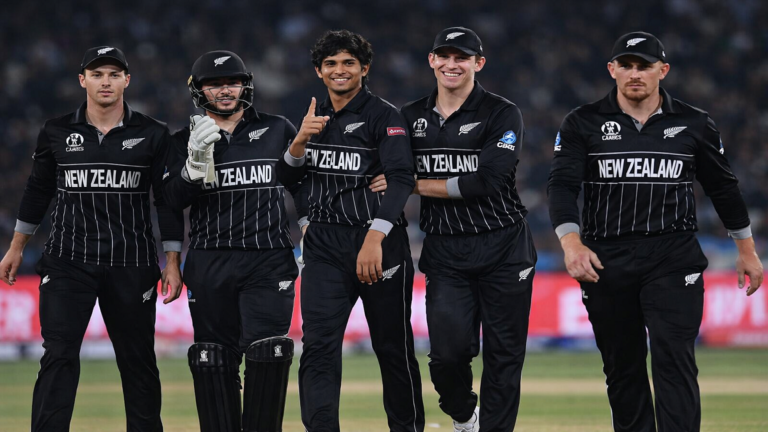
New Zealand and India will meet in the ICC Men’s T20 World Cup 2026 final after impressive performances in the semi-finals. India beat England semi-final in a dramatic high-scoring game, while New Zealand reached the final through a disciplined and balanced performance.
Both teams have shown strong form during the tournament, but their playing styles are quite different. India rely on aggressive batting and explosive middle-order hitters, while New Zealand focus more on stability, smart bowling plans, and excellent fielding.
This contrast in styles could make the final extremely competitive. The team that adapts faster to the pitch conditions and handles pressure better will likely lift the trophy. T20 World Cup 2026 match analysis on Play Live Cricket.
India’s Strength Heading Into the Final
India enter the final with strong momentum. Their batting lineup has produced big totals throughout the tournament, and the semi-final against England showed how dangerous they can be when their top order starts well. Sanju Samson’s aggressive batting in the semi-final demonstrated India’s ability to dominate bowling attacks during the middle overs. India also benefit from having several powerful finishers who can score quickly in the final overs.
Another key advantage for India is their bowling attack. Jasprit Bumrah continues to lead the pace unit with exceptional control during the death overs. His ability to deliver accurate yorkers often prevents opposition teams from finishing strongly. India’s balance between aggressive batting and disciplined bowling makes them one of the most dangerous teams in the tournament.
New Zealand’s Tactical Discipline
New Zealand approach big matches differently. Instead of relying on explosive batting, they usually focus on partnerships and calculated shot selection. Their bowlers also play an important role in controlling the tempo of matches. New Zealand’s attack often uses clever variations and tight lines to restrict scoring during the middle overs.
Fielding has always been another major strength for New Zealand. They rarely miss chances, and their quick ground fielding can save crucial runs. In high-pressure matches such as a World Cup final, these small advantages can become decisive. This disciplined approach has helped New Zealand reach several ICC tournament finals in recent years.
Key Battle: India’s Batting vs New Zealand’s Bowling
The most interesting contest in the final could be India’s batting lineup against New Zealand’s bowling attack. If India’s top order attacks successfully in the powerplay, they could build another large total similar to their semi-final performance. However, New Zealand will try to slow the scoring rate during the middle overs by using tight bowling lines and strategic field placements.
The outcome may depend heavily on how both teams handle the middle phase of the innings. If India maintain a run rate above ten runs per over during this period, they will likely put New Zealand under pressure. However, if New Zealand manage to take early wickets and restrict boundaries, the final could become a closely contested match.
Final Prediction
Both teams deserve their place in the final. India bring explosive batting and match-winning bowlers, while New Zealand bring tactical discipline and excellent fielding. Based on recent performances, India appear to hold a slight advantage. Their batting lineup has shown the ability to produce very high totals, and their bowling attack includes players capable of controlling the final overs.
Prediction: India enter the final as slight favorites, but New Zealand’s disciplined style means the match could remain competitive until the final moments.
India Beat England Semi-Final: Final thoughts
This semi-final will stay in memory because it revealed both the brilliance and the chaos of T20 cricket in a single night. Fearless batting and elite power hitting dominated the scoreboard. At the same time, the match showed how small moments can completely shift a knockout contest. A dropped catch can change momentum, a single run-out can flip a chase, and one disciplined bowler can still create control even on a batting-friendly pitch.
Most importantly, the night ended with India beat England semi-final and secured a place in the T20 World Cup final. India earned that position through Sanju Samson’s brilliance, strong pressure management, and better execution in the moments that often decide championship matches.
Play Live Cricket
Stay tuned with Play Live Cricket for more tactical match breakdowns, phase analysis, and World Cup strategy coverage
Disclaimer: This article provides analysis for educational and informational purposes based on publicly available match information.