England vs Sri Lanka: Expert Super 8 Analysis (146/9)
England vs Sri Lanka Super 8 analysis: how England’s 146/9 became a 51-run win, with phase-by-phase tactics, matchups, and key turning points.
England vs Sri Lanka Super 8 Match Analysis: How 146/9 Turned Into a 51-Run Win
A scoreline can lie in T20 cricket. At first glance, when a team posts 146/9, you instinctively think, “That’s chaseable.” However, this England vs Sri Lanka Super 8 game proved the opposite. Although 146 may look like a modest total on paper, England’s 146/9 (20 overs) became a mountain because of how it was constructed, how it was defended, and, most importantly, how Sri Lanka’s chase collapsed under sustained pressure to 95 all out in 16.4 overs. Therefore, the 51-run margin was not simply about one bad over or one brilliant spell; rather, it was the result of a complete tactical execution across all phases.
Moreover, this is exactly the kind of match that should serve as a pillar reference on Play Live Cricket because it clearly demonstrates what T20 cricket is truly about: phase control, matchups, tempo management, and scoreboard pressure. In fact, while casual viewers often focus only on boundaries and wickets, the deeper story lies in how momentum shifts across different stages of the game. Consequently, to fully understand this result, we must analyze not just what happened, but why it happened — and how England turned a seemingly average total into a commanding victory.
England vs Sri Lanka: Match Snapshot
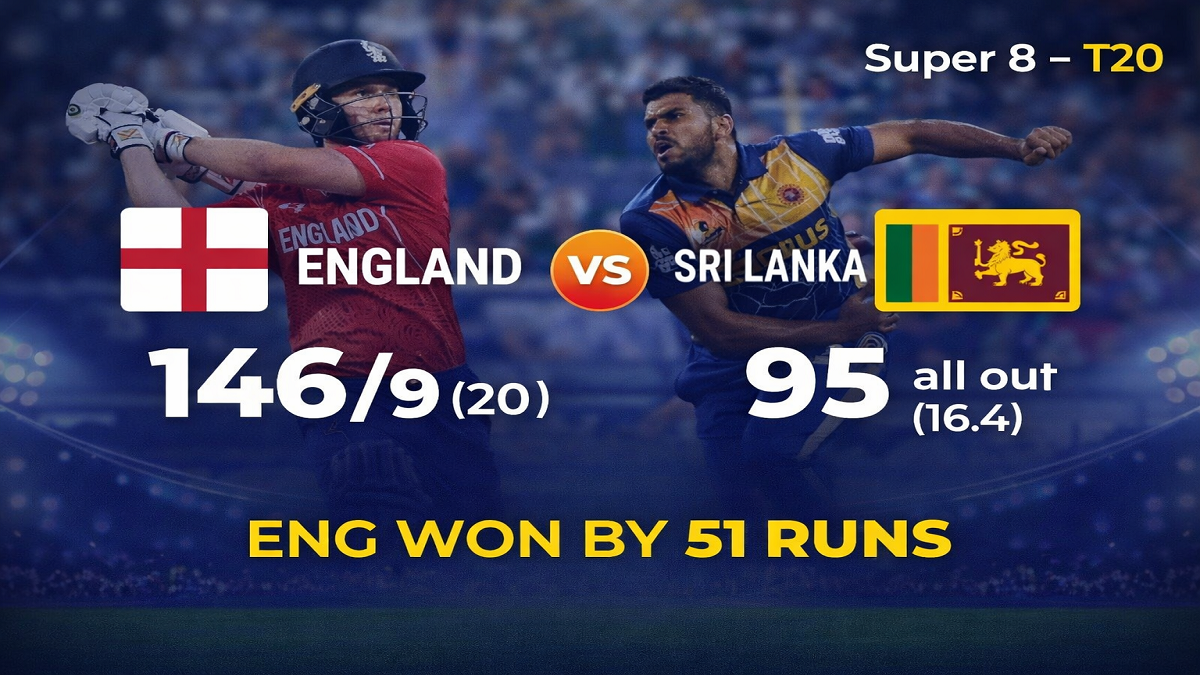
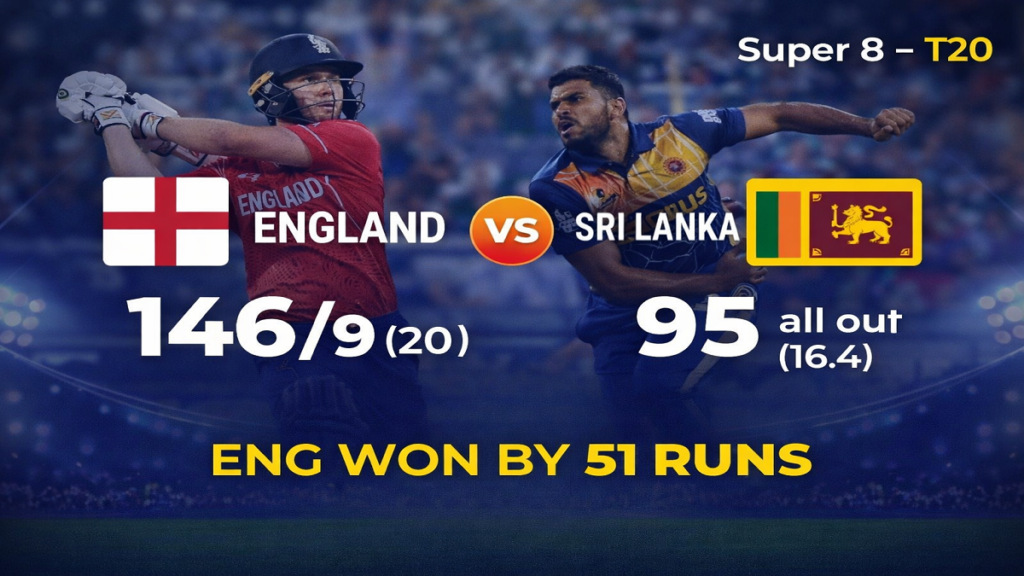
- England: 146/9 (20.0 overs)
- Sri Lanka: 95 all out (16.4 overs)
- Result: England won by 51 runs
At first glance, 146 does not look like a giant total. However, T20 cricket is rarely decided by first impressions. On paper, the target appeared manageable; in contrast, in real match conditions, it became a calculated scoreboard trap. In fact, totals like 146 often look gettable until the chasing side realizes that the pursuit requires constant momentum, clean strike rotation, and timely boundaries.
Moreover, when early wickets fall, that required momentum becomes difficult to sustain. As a result, the pressure steadily builds, the run rate climbs, and batters are forced into low-percentage shots. Consequently, what seemed like a modest chase quickly transforms into a tactical battle. That is precisely what happened here, because England’s bowling plan systematically denied Sri Lanka any rhythm. Therefore, 146 was not just a number — it was a strategically defendable total executed with discipline and clarity.
England vs Sri Lanka The Key Theme: England Won the “Pressure Game”
In T20 cricket, every match is actually two matches happening at the same time. On the surface, there are runs and wickets — the visible scoreboard battle. However, beneath that lies the real contest: pressure. That pressure is created through dot balls, smart field placements, calculated matchups, and, most importantly, the timing of wickets.
In this game, England completely dominated the second contest. While the scoreboard shows Sri Lanka were bowled out for 95 in 16.4 overs, the deeper story is that the required rate was never truly under control. From the very beginning, England ensured that the chase felt heavier than the numbers suggested.
Sri Lanka needed 147 in 20 overs, which translates to a required run rate of 7.35 from ball one. At first glance, that rate is not intimidating. In fact, in modern T20 cricket, teams regularly chase at eight or nine per over. However, the key condition is a stable start. If you begin well, 7.35 remains manageable. Conversely, if you lose early wickets and struggle against disciplined spin or hard lengths, that manageable rate quickly rises to nine or ten per over.
Once the required rate crosses that psychological boundary, the entire chase changes. Instead of building partnerships, batters begin forcing boundaries. Instead of rotating strike, they attempt risky aerial shots. Consequently, percentage cricket disappears and desperation cricket begins. At that stage, hope replaces structure.
Therefore, England’s defense was not built on magic deliveries alone. Rather, it was constructed around sustained pressure. They forced Sri Lanka into low-percentage shots, cut off easy singles, and ensured that every over felt like a small battle. As a result, the chase never developed rhythm — and without rhythm, even a modest target becomes a mountain.
England vs Sri Lanka: Reading the Pitch and Conditions
You can usually tell what type of surface it was from two clues:
- England finished 146/9 (not 175+), meaning strokeplay wasn’t effortless.
- Sri Lanka were dismissed for 95 in 16.4 overs, meaning batting got harder — either due to grip, variable pace, or quality bowling exploiting conditions.
This suggests a surface where:
- Timing wasn’t consistent
- Hard lengths were effective
- Spin or cutters held slightly
- And the “best” scoring method was smart risk, not pure hitting
On such pitches, the team that adapts faster wins. England adapted better in both innings.
England Batting: Why 146/9 Was Still a Winning Total
Phase 1 (Overs 1–6): The Powerplay Wasn’t About Maximum Runs
In modern T20, teams often try to smash 55–65 in the powerplay. But conditions don’t always allow that. When a pitch doesn’t play true, the best powerplay is sometimes:
- 38–45 runs
- 1 wicket max
- strong base for overs 7–15
England didn’t end with a huge total, which tells us they likely faced:
- disciplined new-ball bowling
- tight lines
- slower ball grip
- boundary protection that forced singles
Even if England didn’t “win” the powerplay with runs, they likely tried to win it with structure — keeping enough wickets so the innings could still finish strong.
The Big Problem England Faced: Wickets Fell Through the Middle
146/9 means they lost wickets at regular intervals. That can happen in two common ways:
- Sri Lanka used matchups well (right ball to right batter)
- England tried to force boundary shots when singles weren’t flowing
But here’s the part casual viewers miss:
In T20, 146/9 can be strong if…
- the batters still got to 140+
- despite losing wickets
- because it usually means they kept pushing the scoring instead of collapsing to 120
A collapse total looks like 118/9. A “scrappy but competitive” total looks like 146/9 — and that’s exactly what England produced.
Phase 2 (Overs 7–15): The “Squeeze” Period
This is where most T20 matches are won. Overs 7–15 are not about sixes every over. They are about:
- boundary every 8–10 balls
- minimal dots
- keeping wickets so you can explode late
When England kept losing wickets, the most valuable skill became strike rotation under pressure. On tricky surfaces, the team that still runs hard and finds singles can add 20–25 runs to a total without hitting extra boundaries.
If England reached 146 even with 9 wickets down, it strongly suggests:
- they ran well
- they found occasional boundaries
- and they avoided the “dead overs” where nothing happens
Phase 3 (Overs 16–20): Why England’s Finish Still Worked
England finished with 146. That likely means their death overs were not a huge explosion — but they probably did enough to push a par score into a defendable one.
A crucial concept:
“Par” is not one number — it changes with bowling strength
On a surface that offers anything, a disciplined bowling side can defend 145 if they have:
- variety at the death (yorkers, cutters, hard lengths)
- good fielding
- clear plans for top batters
England clearly had that.
Sri Lanka’s Bowling: What They Did Right (and What They Left Open)
Even though England reached 146, Sri Lanka did some things correctly:
1) They Kept Taking Wickets
If you take 9 wickets, you are doing something right. The issue was not wickets — the issue was control of scoring patterns.
2) The Missed Opportunity: Turning Wickets Into Dot-Ball Pressure
The best T20 bowling doesn’t only take wickets. It creates sequences like:
- dot, dot, single
- dot, wicket, dot
- single, dot, dot
If England kept reaching 140+ despite losing wickets, Sri Lanka probably allowed:
- too many “release balls” (a short ball sitting up, a wide half-volley, a predictable slower ball)
- or too many easy singles that kept England moving
At this level, one soft over changes everything. England didn’t need many — just one or two to get to 146 instead of 132.
England vs Sri Lanka: Why Sri Lanka Fell Apart (95 all out in 16.4)
Chasing 147, Sri Lanka had to bat with intent. But intent without stability becomes panic.
Sri Lanka were dismissed in 16.4 overs, meaning they didn’t even use all 120 balls. That tells you this wasn’t just “falling short.” It was a full collapse.
Let’s break the chase into the same phases.
Phase 1 (Overs 1–6): Early Wickets = Required Rate Explosion
If you lose 2 wickets early, your chase plan changes instantly:
- Your best boundary hitters are either gone or forced to rebuild
- Your middle order arrives earlier than planned
- And the required rate starts climbing because powerplay overs are the easiest time to score
Even if Sri Lanka had something like 35/2 after 6, the chase becomes tough, because 112 needed off 84 is still manageable, but only if wickets remain. If it became 28/3 or 30/3, the match starts slipping.
England’s new-ball success likely came from:
- hard lengths into the pitch
- forcing cross-bat shots
- smart fields (a deep square, a third man, a sweeper early)
- and using angles (over the wicket into the body, or around the wicket to cramp)
England vs Sri Lanka: The psychological impact:
When you’re chasing 147 and you’re two down early, you start thinking:
“We just need one big over.”
That’s the trap. Teams hunt a big over, play forced shots, and lose more wickets.
Phase 2 (Overs 7–15): England’s Real Win — The Middle Overs Choke
This is where the match was decided.
In a controlled chase, Sri Lanka would aim for:
- 55–65 runs between overs 7 and 15
- while losing 1 wicket max
But being all out for 95 means England likely forced:
- clusters of wickets
- and long periods with no boundaries
England vs Sri Lanka: How do teams create a middle-overs choke?
There are four common tools:
1) Spin into the pitch with defensive fields
A deep midwicket, a long-on, and a sweeper cover can turn big hits into singles.
2) Pace-off deliveries and cutters
If the ball grips, slower balls become extremely hard to hit straight.
3) Bowling to the longer boundary
Smart captains set fields so batters must hit into the bigger side.
4) Matchups — specific bowlers to specific batters
If a batter struggles against away-spin or hard lengths, you feed that weakness.
England almost certainly used at least two of these methods together.
Phase 3 (Overs 16–20): Sri Lanka Didn’t Reach a “Hitting Platform”
Most successful chases have a platform like:
- 85/3 after 14
- or 95/4 after 15
Then you need 50 off 30, which is doable.
Sri Lanka didn’t build that platform. Once wickets fell and the required rate climbed, the end became inevitable.
Also note: if you’re all out in 16.4 overs, it means the final phase wasn’t a calculated assault — it was a desperate one.
England vs Sri Lanka: The Turning Points That Likely Broke the Chase
Even without a full ball-by-ball, matches like this usually swing on a few moments:
1) A wicket in the first two overs
It sets the tone. It tells the batting side the pitch isn’t simple.
2) A “double wicket” over
T20 collapses often happen when one over takes 2 wickets. It forces new batters to start against pressure.
3) A boundary drought (12–18 balls without a boundary)
That’s when batters try something risky and nick off or hit to the deep.
4) A run-out chance or sharp catch
Fielding is pressure. Even one brilliant stop can turn a 2 into a 1, and those small moments push batters into mistakes.
England’s win margin suggests they were excellent in the field too.
England vs Sri Lanka: Why England’s Score Was Enough
Here’s the expert truth:
146 isn’t just a number — it’s a context total
On a surface where the ball doesn’t come nicely, 146 forces the chasing team to be perfect in rotation + boundary timing.
If Sri Lanka failed in rotation (too many dots), the boundary requirement rises. When the boundary requirement rises, batters swing harder. When batters swing harder, wickets fall. That’s the domino effect.
England created that effect deliberately.
England vs Sri Lanka: Tactical Lessons for Sri Lanka (What They Must Fix)
If Sri Lanka want to compete in Super 8-level matches, these are the big fixes:
1) Powerplay intent must be smart, not reckless
Intent doesn’t mean swinging at everything. It means:
- targeting specific bowlers
- choosing specific zones
- and protecting your best batters from high-risk shots early
2) Middle-over rotation is non-negotiable
Against disciplined fields, you must have batters who can:
- play late
- use soft hands
- manipulate gaps
- run hard
One-dimensional hitting doesn’t work when the pitch grips.
3) Avoid “panic overs”
When you’re behind, you don’t need 20 in one over. You need two overs of 10 and fewer dots. Great chases are built by reducing dot balls, not by hitting miracle sixes.
4) Batting order flexibility
If the innings is wobbling, promote a batter who can rotate and calm things down, not just a hitter.
Tactical Lessons for England (Why This Win Matters)
For England, this match is a blueprint win.
1) They defended with clarity
They didn’t need magic. They needed:
- good lengths
- patience
- and pressure fields
2) They didn’t chase an unrealistic batting total
Even though they lost wickets, they kept pushing to a competitive score rather than collapsing into “safe batting.”
3) Big teams win ugly
Championship sides win the matches where nothing looks smooth. 146/9 isn’t pretty — but it’s winning cricket when defended correctly.
England vs Sri Lanka: What This Match Means in Super 8 Context
Super 8 matches are not group games. They are pressure games.
- You don’t just beat teams with talent
- You beat them with planning and execution
England looked like the side with:
- clearer plans
- better adaptability
- and stronger control of phases
Sri Lanka looked like a side that got stuck between two approaches:
- rebuild slowly (but required rate climbs)
- attack early (but wickets fall)
When you hesitate between styles, T20 punishes you.
England vs Sri Lanka: A Simple “Phase Scorecard” Summary
England Innings (146/9)
- Powerplay: likely controlled start, avoid huge damage
- Middle overs: wickets fell but runs kept moving
- Death overs: enough finishing runs to reach defendable par
Sri Lanka Chase (95 all out)
- Powerplay: early wickets created pressure
- Middle overs: boundary drought + dot balls
- End: desperation shots, collapse before 20 overs
This is why the margin became 51 runs even though the target was only 147.
England vs Sri Lanka: FAQs
Was 146/9 a good score?
On a flat pitch, it’s average. On a pitch offering grip or uneven pace, it can be above par — especially with strong bowling and fielding.
Why did Sri Lanka collapse so badly?
Because chasing requires rhythm. Early wickets + dot-ball pressure removed rhythm, and the required rate forced low-percentage hitting.
What’s the biggest difference between winning and losing T20 teams?
Winning teams control the middle overs — with both bat and ball. That phase decides most matches.
Final Verdict: England vs Sri Lanka
This England vs Sri Lanka Super 8 match is a perfect example of T20 control cricket.
England didn’t post a massive total. They posted a defendable total with a plan. Then they defended it by squeezing the chase, forcing dots, taking wickets at the right moments, and never letting Sri Lanka find momentum.
Sri Lanka didn’t lose because they lacked talent. They lost because in pressure matches, talent must be backed by:
- rotation plans
- matchup awareness
- and calm decision-making under rising required rates
If you want one sentence that explains this match:
England made 146 feel like 170 by controlling the chase from the first over.
Play Live Cricket
Stay tuned to Play Live Cricket for in-depth match analysis, tactical breakdowns, performance-based predictions, and expert cricket insights from every major tournament. We go beyond the scorecard to explain the real story behind each result phase control, matchups, momentum shifts, and pressure moments that decide big games. Whether it’s Super 8 clashes, knockout thrillers, or emerging team performances, our goal is to give you clear, expert-level cricket understanding with structured analysis and data-backed opinions. Bookmark Play Live Cricket, explore our team pages, live score updates, and match schedules, and never miss a key moment from the world of T20 cricket.
Disclaimer
The analysis published on Play Live Cricket is based on match data, tactical observation, and expert cricket interpretation. All opinions expressed are independent cricket views intended for informational and educational purposes only. While we strive for accuracy in scores, statistics, and match details, readers are encouraged to verify official figures through governing cricket bodies or tournament authorities. Play Live Cricket is not affiliated with any official cricket board, tournament organizer, or team unless explicitly stated. Any predictions or performance-based opinions reflect analytical judgment at the time of writing and are not guarantees of future results.