Pakistan vs New Zealand Abandoned: What It Means in Super 8
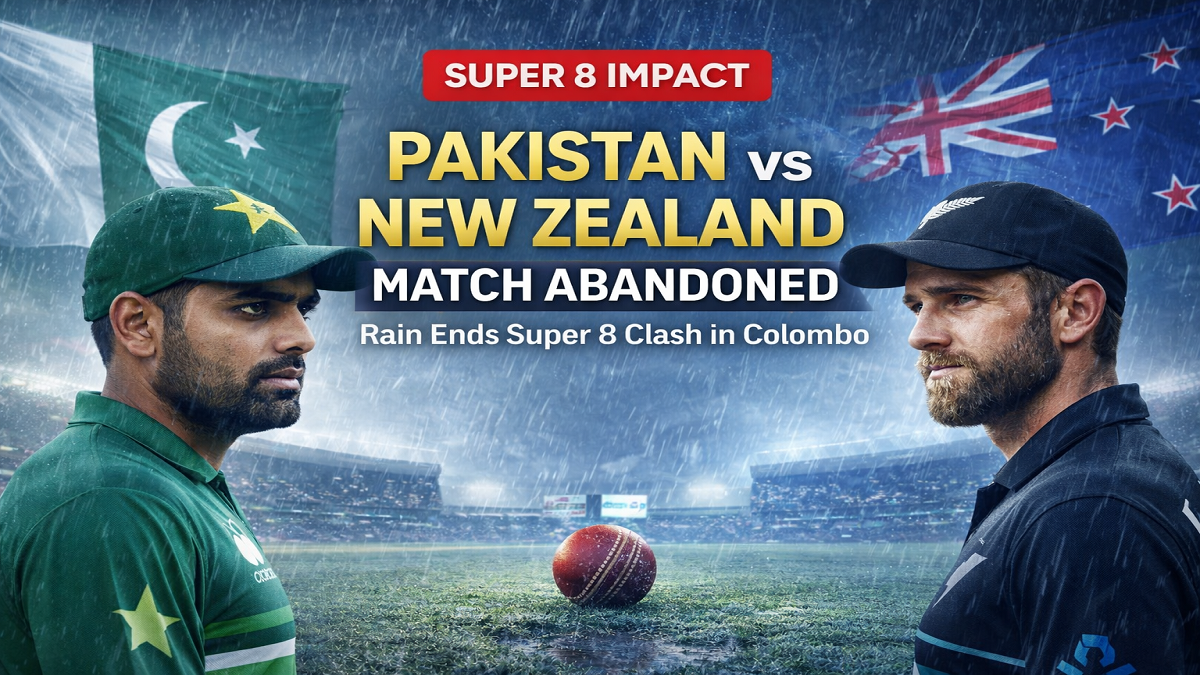
Pakistan vs New Zealand match abandoned in Colombo as rain won. Here’s the full Super 8 impact, points pressure, and what both teams must do next.
Pakistan vs New Zealand Match Abandoned: The Rain That Changed a Super 8 Day
A match can end without a ball being bowled, but it still creates a result in the only way that matters in tournament cricket: it changes the pressure.
The Pakistan vs New Zealand Super 8 opener at R. Premadasa Stadium, Colombo was abandoned due to persistent rain, with no play possible. Pakistan won the toss and chose to bat, but the weather never allowed the contest to start, and both teams had to settle for one point each.
On the surface, “one point each” looks fair. In reality, a washout is never neutral. It shifts qualification math, it steals a potential net run rate opportunity, and it forces teams into a narrower path where one bad night can end the campaign.
This is the kind of game that doesn’t happen, but still becomes a turning point.
What Happened in Colombo (And Why It Was Inevitable)
The key detail is simple: rain stayed long enough to kill the game. Reports from match coverage confirmed the toss happened (Pakistan chose to bat), delays continued, and officials eventually abandoned the match without a single delivery.
Colombo is not new to weather interruptions, but this one hurt more because it arrived at the worst time: Super 8 is where every game is a qualifier in disguise.
Pakistan vs New Zealand: The Ground Reality
When a Super 8 match is abandoned before a single ball is bowled, the impact goes far beyond the scoreboard. In this case, there were no overs, no DLS calculations, and no shortened chase to rescue the contest. As a result, neither side had the opportunity to control the narrative of the game.
More importantly, both teams were denied strategic flexibility. A side often looks to “win small” by defending 120 or calmly chasing 110 in tricky conditions. On the other hand, a dominant team may aim to “win big” and significantly boost net run rate. However, with persistent rain wiping out the fixture entirely, those possibilities disappeared.
Therefore, what appears to be a neutral one-point outcome is rarely neutral in tournament cricket. Instead, it quietly increases pressure on the remaining matches and reduces the margin for error in the Super 8 stage.
Why Abandoned Matches Matter More in Super 8 Than Group Stage
In a long league, one no-result feels like noise. In Super 8, it’s often destiny.
Super 8 formats compress the margin for error. You don’t have time to “settle into the tournament.” If you lose early, the calculations get brutal. If you win early, you can manage risk. A washout takes away that control.
1) A washout steals a winnable point swing
A win is two points. A washout is one. That means:
- The team that would have won loses a point.
- The team that might have lost gains a lifesaving point.
So the washout doesn’t just remove a match. It redistributes the tournament advantage.
2) Net Run Rate damage is silent but deadly
NRR is where teams build separation:
- A 9-wicket chase in 10 overs can become a qualification shield.
- A 20-run win becomes a pressure release.
But when there’s no game:
- You can’t repair NRR.
- You can’t create NRR distance.
- Your remaining matches become “must-win” more quickly.
3) Pakistan vs New Zealand: It Forces Both Teams Into Higher-Risk Cricket Next
After a washout, teams rarely stay balanced. Instead, they tend to overcorrect in the following match because the points table suddenly feels tighter than expected.
For example, chasing sides often attack bigger totals with unnecessary urgency, especially when they believe net run rate must now be repaired. As a result, calculated aggression turns into rushed stroke play.
Similarly, captains may gamble with bowling matchups earlier than planned. Rather than allowing the game to settle naturally, they search for breakthroughs through aggressive field placements or unexpected bowling changes.
In addition, team selection can shift toward extremes. Depending on conditions, management might add an extra power-hitter to lengthen the batting order or introduce additional pace to hunt early wickets.
Consequently, a washout does more than split points evenly. It subtly reshapes mindset. That is how abandoned matches create chaos: pressure pushes teams toward decisions driven by fear rather than clear strategy.
Pakistan’s Real Loss: Not Just Points, But Momentum
For Pakistan, the pain is specific: they are a team that thrives when rhythm builds across phases—powerplay intent, middle overs control, and late acceleration. When a match is washed out, Pakistan lose the one thing that can’t be coached mid-tournament: flow.
And in a Super 8, flow matters because every game becomes an emotional final.
Pakistan vs New Zealand: Pakistan’s “Missed Opportunity” Explained
Although Pakistan collected one point from the abandoned fixture, the deeper loss was competitive preparation. Super 8 cricket does not allow time for experimentation, which makes every outing a live rehearsal under pressure.
First, the team was denied the opportunity to assess batting order stability in a high-intensity environment. A match like this could have clarified whether the current top and middle-order combinations can absorb early setbacks or accelerate when required.
Furthermore, bowlers missed a valuable chance to understand ideal lengths and variations in Colombo conditions. Every surface behaves differently under lights and humidity, and real-time feedback often shapes tactical adjustments for future matches.
Finally, management could not confirm their best XI based on live match evidence. Tournament cricket rewards clarity, and without game data, selection decisions remain theoretical rather than proven.
Therefore, even though the points were shared, Pakistan effectively lost something more valuable: a competitive rehearsal that could have strengthened their Super 8 blueprint.
New Zealand’s View: One Point Can Be Gold (But It Also Adds Pressure)
New Zealand are often the tournament team that turns tight games into calm wins. They love clarity: defined targets, controlled pace, and smart matchups.
A washout gives them a point, yes—but it also removes their chance to:
- take early control of the group,
- build NRR advantage with a disciplined win,
- force rivals into catch-up mode.
So for New Zealand, this is a mixed outcome:
- Good: you didn’t lose.
- Bad: you didn’t gain dominance.
In Super 8, dominance is what buys you flexibility later.
The Toss Detail That Still Matters (Pakistan Chose to Bat)
Even though the match never started, the toss decision tells us what Pakistan expected from the surface and conditions.
Coverage reported Pakistan won the toss and opted to bat first.
That choice suggests at least one of these strategic beliefs:
- Pakistan trusted their batting depth to set a competitive total.
- They wanted scoreboard pressure in a big game.
- They assumed conditions could worsen later (typical in rain-threat matches).
Ironically, in rain-hit games, captains often prefer chasing because DLS can simplify the target. But in some venues, captains bat first to avoid a damp ball and unpredictable grip later. In Colombo, that logic isn’t crazy—it just never got tested.
Colombo Conditions: Why Rain Can Make the Whole Day Unplayable
People often ask: “Why couldn’t they play even 5 overs each?”
The answer is that in heavy, persistent rain:
- the outfield remains too wet,
- the ball becomes unsafe,
- fielders risk injury,
- and the match can’t start without meeting minimum playing conditions.
ESPNcricinfo’s match report confirmed the washout after waiting through the delays.
Shortened games still require:
- a safe outfield,
- enough time for minimum overs,
- and conditions that don’t endanger players.
When rain doesn’t stop long enough, there’s no window to even begin.
Pakistan vs New Zealand: The Points Impact
Officially, both teams take one point each.
But value depends on what each team needed from this match.
If Pakistan needed a statement win
Then the washout feels like a robbery, because it removes the chance to take control. It also increases “must-win” pressure in the remaining fixtures.
If New Zealand wanted a safe start
Then the washout feels like protection. Not perfect—but safe.
This is why fans can watch the same abandoned match and feel opposite emotions.
What Pakistan Must Do Next: A Practical Super 8 Blueprint
In a compressed stage, Pakistan should treat the washout as a warning siren: you cannot wait for the tournament to open up. You must attack your next game like it’s a semi-final.
1) Batting: Win the powerplay without losing your shape
Pakistan’s best Super 8 path comes from balanced powerplay aggression:
- Don’t aim for 70/0 if the pitch is sticky.
- Aim for 45–55 with wickets in hand.
That gives freedom later.
2) Middle overs: Create one “batting partnership block”
Pakistan often oscillate between bursts and collapses. The fix is simple:
- Identify the two best “rotation + boundary” batters for overs 7–15.
- Keep them together long enough to break the choke.
3) Bowling: First six overs must be wicket-hunting, not defensive
Super 8 doesn’t reward “safe 45/0 in the powerplay.”
It rewards 2 wickets early because that kills the opponent’s launchpad.
4) Fielding: Treat singles as wickets
When pressure is high, teams try to steal momentum through singles.
Pakistan must shut that down:
- hit the stumps,
- force two-risk runs,
- turn basic rotation into stress.
This is how you replace the momentum you lost from the washout.
In their previous match against India, Pakistan struggled.
What New Zealand Must Do Next: Stay Calm, But Be Ruthless
New Zealand don’t need to reinvent themselves. They need to do what they do best: control the match tempo.
1) Build totals with structure
New Zealand’s safest path is:
- stable powerplay,
- acceleration from overs 12–17,
- and a final push with set batters.
2) Use matchups like a chessboard
Against Pakistan, matchups decide everything:
- bowlers who drag shots to long boundaries,
- variations that remove slog zones,
- and field settings that punish risk.
3) Don’t rely on “one point” comfort
A washout can trick a team into thinking they’re “not behind.”
But Super 8 punishes complacency fast.
In their previous match against South Africa, New Zealand struggled.
Pakistan vs New Zealand: The Hidden Story
Tournaments are supposed to reward quality. Weather introduces randomness. When randomness increases:
- teams lean on experience,
- pressure handling decides outcomes,
- and squads with clarity win more often.
A washout increases the number of “do or die” matches. Do-or-die cricket is rarely about talent alone. It’s about:
- decision quality under stress,
- execution of basics,
- and avoiding panic.
This is why abandoned matches can shape the eventual champion more than people admit.
FAQs: Pakistan vs New Zealand
Why was Pakistan vs New Zealand abandoned?
The match was abandoned because persistent rain prevented any play and conditions never improved enough to start the game.
Was a single ball bowled in Pakistan vs New Zealand?
No. Reports confirmed the match ended as a washout without a ball being bowled.
What points did Pakistan and New Zealand get?
Both teams received one point each after the abandoned match.
Pakistan vs New Zealand: Where was the match scheduled?
The game was scheduled at R. Premadasa Stadium, Colombo.
Pakistan vs New Zealand: Who won the toss?
Coverage reported Pakistan captain Salman Ali Agha won the toss and chose to bat.
What This Means for the Rest of the Super 8 Group
When a Super 8 match ends in a washout, the table becomes more fragile than it appears. The margin between qualification and elimination shrinks immediately, even though the standings may look balanced on paper.
For instance, a single dominant win in the next round could suddenly create separation at the top. Conversely, one heavy defeat might push a contender dangerously close to elimination. Because both Pakistan and New Zealand were denied the opportunity to build early momentum, their remaining fixtures now carry significantly greater weight.
The implications become clearer when looking ahead. A defeat in the next outing would transform this abandoned match into a missed opportunity. On the other hand, a convincing win would neutralize the damage and restore control over qualification scenarios. Meanwhile, if New Zealand secure victory in their following match, the shared point could quietly turn into a strategic advantage.
Ultimately, that is how Super 8 cricket operates. Results rarely exist in isolation; instead, their true meaning emerges from what follows.
Key Takeaways: The Match Didn’t Happen, But The Tournament Moved
- The match was abandoned due to rain with no play possible.
- Both teams took one point, but the value of that point isn’t equal emotionally or strategically.
- Pakistan lose rhythm and an NRR opportunity; New Zealand lose a chance to dominate early.
- The next game for both teams now carries extra pressure, because Super 8 does not forgive slow starts.
Play Live Cricket
For Super 8 match previews, playing XI updates, pitch reports, and post-match analysis, keep following Play Live Cricket. We track every key moment that shapes the tournament—especially the moments that don’t show up on the scoreboard.
Disclaimer
This article is written for news analysis and fan education. Match details are based on official coverage and reputable reports available at the time of publishing. Tournament standings and qualification scenarios can change quickly with each result, so always check the latest official updates during the event.