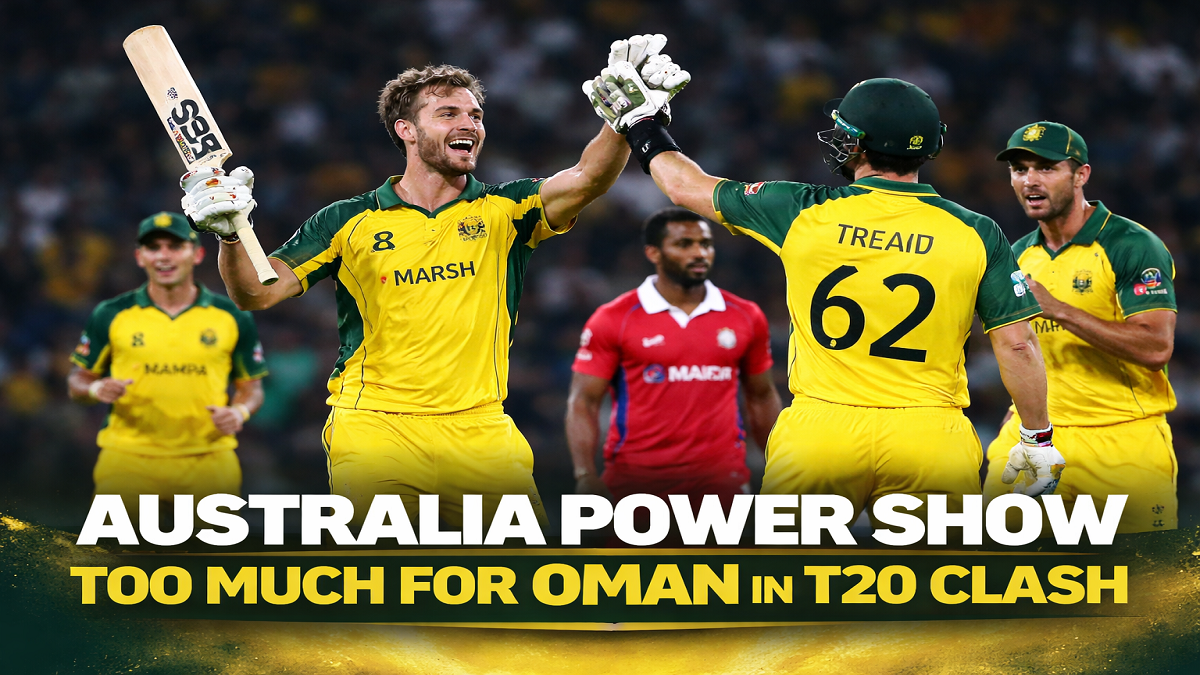
Australia Power Show Too Much for Oman in T20 Clash
Australia Power Show in Kandy as Australia bowl Oman out for 104, then chase 105 in 9.4 overs to win by 9 wickets in Group B.

Australia Power Show: Too Much for Oman in T20 Clash
The Australia Power Show arrived in full force at Pallekele. From the start, Australia followed a clear plan. They won the toss, bowled Oman out cheaply, and then chased the target in style. First, Australia dismissed Oman for 104 in 16.2 overs. After that, they reached 108/1 in just 9.4 overs. As a result, they won by nine wickets with 62 balls left. Therefore, the result became clear long before the final over.
This match mattered for more than the margin. In fact, it showed how well Australia execute simple plans. With the ball, they attacked the stumps and forced mistakes. Because they kept tight lines, Oman never built a partnership. Meanwhile, with the bat, Australia started fast but stayed calm. At the same time, they avoided reckless shots. Consequently, the chase never became tense.
For Play Live Cricket readers, this game shows what a perfect T20 night looks like. First, take early wickets. Next, control the middle overs. Then, maintain pressure. Finally, finish the chase without panic. In the end, the Australia Power Show reflected clarity, control, and confidence.
Match Summary
- Oman: 104 all out (16.2 overs)
- Australia: 108/1 (9.4 overs)
- Result: Australia won by 9 wickets (62 balls remaining)
- Player of the Match: Adam Zampa (4/21)
- Venue: Pallekele International Cricket Stadium (Kandy)
- Toss: Australia chose to field
On paper, it reads like a mismatch. In reality, it was Australia executing a simple plan with full discipline. Oman never recovered after they lost wickets in clusters, and Australia chased so quickly that Oman barely adjusted their field settings before Australia finished the game.
Why This Australia Power Show Felt So One-Sided
In T20 cricket, the difference between a “good win” and a “statement win” is how quickly one team removes uncertainty. Australia removed uncertainty in two steps.
First, they turned Oman’s innings into a constant rebuild. Wickets arrived often enough that Oman could not set a base, and their total never reached the “defendable” zone. Second, Australia’s openers treated the chase like a sprint with guardrails—fast enough to finish early, but controlled enough to avoid gifting wickets.
That is why the win feels heavy. Chasing 105 in 9.4 overs means Australia didn’t merely win; they dominated time as well as runs.
Australia Power Show: Pitch and Conditions in Kandy
Pallekele is a venue where the ball can come on nicely under lights, and short bursts of momentum often decide the match. Australia’s decision to bowl first suggests they trusted their attack to exploit early movement and then use variation once Oman started forcing shots.
Once Oman’s total stayed low, the chase became tailor-made for a powerplay assault. Australia didn’t need to “bat long.” They needed to bat clean. When the target is small, the hardest mistake is over-attacking early and gifting the opponent a window. Australia avoided that trap.
Oman’s Innings: 104 All Out and No Time to Settle
Oman’s innings ended at 104 in 16.2 overs, and that “all out” detail matters. It means Australia didn’t merely contain Oman; they finished them.
In a low total, you usually see one of two patterns:
- a slow start that forces risky acceleration, or
- early wickets that prevent partnerships from forming.
Oman appeared to suffer from both. As wickets fell, the next batter walked into pressure immediately. That pressure creates the most common T20 dismissal type: the forced hit to a safe boundary rider, or the rushed shot that misses the stumps by inches. Australia’s bowlers didn’t need magic balls. They needed repeatable lengths and smart changes of pace. The result shows they delivered exactly that.
Adam Zampa’s Spell: The Control Point
The headline bowling performance came from Adam Zampa, who took 4/21 and earned Player of the Match.
In T20 cricket, leg-spin is often the wicket-taking weapon that turns a shaky innings into a collapse. Zampa’s success typically comes from two things:
- He attacks stumps with a shape that invites the big shot, and
- He varies pace enough to disrupt timing.
Against Oman, that combination was devastating. Once a chasing side knows “104 is on the board,” every wicket becomes even more valuable because it crushes the opponent’s chance to reach 130–140—totals that at least create a question in the chase. Zampa ensured Oman never reached that questioning zone.
Australia Power Show: Maxwell and Bartlett Apply the Squeeze
Australia’s control was not only spin-based. The support spells mattered.
- Glenn Maxwell: 2/13
- Xavier Bartlett: 2 wickets (reported as 2-27 in Cricinfo match blog)
These numbers show a wider point: Australia didn’t allow “easy overs.” In T20s, smaller teams survive when they steal two overs—one 16-run over, one 14-run over—then patch the rest with singles. Oman never got those momentum overs, and once momentum is denied, wickets arrive because batters try to manufacture power.
Maxwell’s economy suggests he forced batters to hit into the longest parts of the ground. Bartlett’s wickets indicate Australia kept threatening at the other end too. Together, they ensured Oman’s innings had no breathing space.
Oman’s Key Resistance Was Not Enough
Even in collapses, there is usually one batter who tries to hold the innings together. This match had that moment too, but the scoreboard pressure made survival feel like surrender. As wickets kept falling, Oman’s best chance—building a late push—disappeared quickly.
That is the trap of being 6 down before 100: the lower order must swing, and swinging against smart bowling usually ends in catches or bowled dismissals. Oman reached 104, but they never built a platform that could have threatened 140.
Australia’s Chase: 105 in 9.4 Overs
If the bowling set the win up, the chase turned it into a highlight. Australia chased 105 by reaching 108/1 in 9.4 overs, winning by 9 wickets with 62 balls remaining.
A chase this quick is not just “fast scoring.” It’s a sign of clarity:
- the openers know which balls to attack,
- singles are taken automatically to keep strike moving, and
- risk is controlled because the required rate is always in check.
The chase ended so early because Australia treated the powerplay like an opportunity rather than a danger zone.
Mitchell Marsh Leads the Australia Power Show
The chase was anchored by Mitchell Marsh’s 64 off 33 balls*.
That innings is the definition of controlled dominance. A batter who scores at that rate while staying not out is doing two things at once:
- removing pressure from the other end, and
- shrinking the target so quickly that bowlers abandon plans.
Marsh’s role here was clear: finish it, don’t complicate it. When the chase is small, the captain-batter who stays till the end eliminates the only realistic comeback path: a mini-collapse.
Travis Head’s Burst Makes the Chase Shorter
At the other end, Travis Head made 32 (reported as 32 off 19 in the match blog / scorecard summary).
That contribution mattered because it meant Australia didn’t depend on one player doing all the work. When both openers score freely, the chase becomes impossible to defend, since bowlers cannot “hide” from the aggressive batter.
Even when Head got out, the target was already nearly finished. That is what a dominant chase looks like: the wicket arrives after the game’s outcome is already decided.
Why This Chase Was So Efficient
Australia’s chase was efficient for three reasons.
First, they didn’t chase boundaries every ball. They chose boundary balls.
Second, they kept their shape—no wild swings that invite top edges.
Third, they never let the required rate rise, which meant Oman could not build a pressure over.
In short, the Australia Power Show was built on method, not just muscle.
Tactical Breakdown: Where the Match Was Won
1) Australia Won the “Wickets” Battle
Oman being bowled out at 104 shows Australia never let partnerships grow.
In T20, partnerships are oxygen. Remove them and the innings collapses.
2) Australia Won the “Time” Battle
Chasing in 9.4 overs is a domination of time as much as runs.
It tells you the chase was never under stress.
3) Australia Won the “Matchups” Battle
Zampa’s four-for, Maxwell’s tight spell, and wickets at the other end suggest Australia consistently found favorable matchups and attacked them.
Oman never found a matchup they could exploit.
What This Result Means for Group B Narrative
This match was widely described as a dead rubber, with Australia already eliminated before the game.
That context matters, because it explains the “too little too late” feeling: Australia looked sharp here, but tournament outcomes are shaped by earlier games.
Still, even as a dead rubber, the performance matters. Teams carry patterns forward. A dominant win reinforces role clarity and confidence. It also provides a blueprint for how Australia want to play: aggressive with control, not aggressive with chaos.
For Oman, the match is a harsh lesson in what happens when you lose wickets early and cannot manufacture a stable middle. Against top attacks, survival alone is not enough—you need at least one partnership that flips the run rate.
Player of the Match: Why Zampa’s 4/21 Was the Game Changer
A chase of 105 can always contain danger if the chasing side loses early wickets. That danger disappears if the bowling side keeps the target low. Zampa did exactly that.
His 4/21 didn’t just reduce runs; it reduced options for Oman. It forced them into lower-order hitting sooner than planned. That is why the innings ended in 16.2 overs, not 20.
Key Takeaways for Play Live Cricket Readers
- The Australia Power Show was built on wicket-taking, not containment.
- A total of 104 all out gives the chasing side freedom to play without fear.
- A chase completed in 9.4 overs signals complete control and strong intent.
- Leg-spin remains a match-turning weapon when batters are under scoreboard pressure.
Final Word: Australia Power Show Ends Oman’s Resistance Early
Australia’s win over Oman was decisive because it had no weak phase. The bowlers struck consistently, with Zampa’s 4/21 leading the way, and Oman were dismissed for 104. Then the batters, led by Marsh’s 64*, chased 105 in 9.4 overs to win by 9 wickets with 62 balls remaining.
That is a complete T20 performance: low target created, target crushed quickly, and pressure never allowed to enter the game.
Play Live Cricket
Stay tuned to Play Live Cricket for more T20 World Cup match reports, tactical breakdowns, and high-CTR coverage built for cricket fans who want the full story behind the scorecard.
Disclaimer: This article is for informational and editorial purposes only. Match data (scores, result, and key figures) is based on publicly available scorecards and reports. We are not affiliated with the ICC, ESPNcricinfo, or any official broadcaster. All team names and tournament references belong to their respective owners.