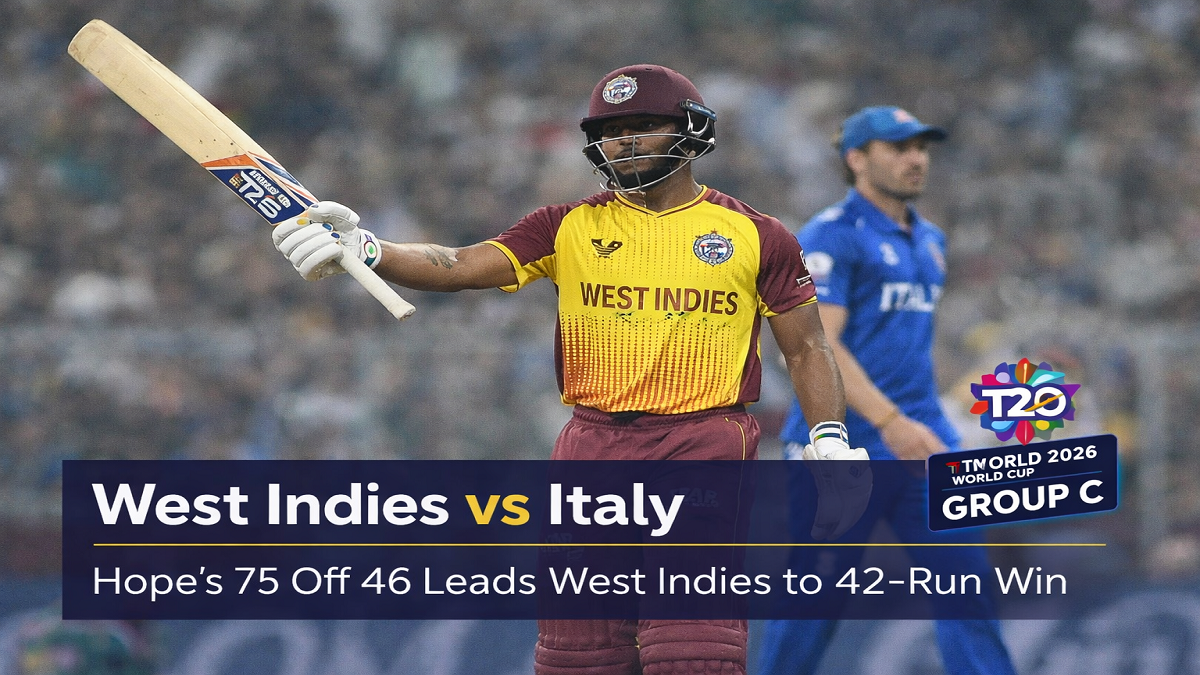
West Indies vs Italy: Shai Hope’s 75 Seals 42-Run Victory
West Indies vs Italy: Shai Hope’s 75 set up 165/6, then WI’s bowlers crushed Italy for 123 to win by 42 runs at Eden Gardens.
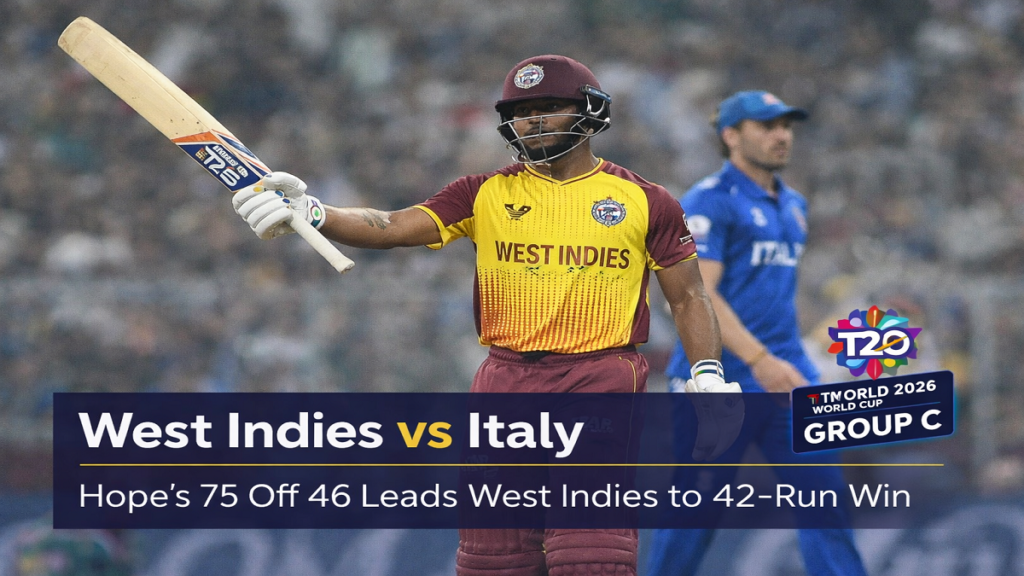
West Indies vs Italy: Match Report
A commanding 42-run victory over Italy at Eden Gardens kept the Caribbean side firmly on track in their T20 World Cup campaign. Put in to bat, West Indies posted 165/6, built around a classy, high-tempo knock from Shai Hope (75 off 46). Italy’s chase never truly settled, and they finished on 123—well short of the 166 target.
This game had a clear storyline: West Indies didn’t blast 200, but they built a defendable total the smart way—absorbing early wickets, accelerating through the middle, and finishing with boundary bursts. Then, with the ball, they attacked Italy’s top order, forced mistakes, and controlled the chase with pressure rather than panic.
What follows is a deep, human-style breakdown of how West Indies shaped the match—and what Italy will take away from another tough day against elite T20 execution.
West Indies vs Italy: Toss, venue, and the early feel of the pitch
Italy won the toss and opted to field first at Eden Gardens, Kolkata. Usually, this ground rewards clean timing and fearless stroke play, so chasing can feel straightforward. However, conditions here can shift quickly. When the pitch offers even slight grip, patience becomes vital. As a result, captains push boundary riders back, singles turn harder to steal, and the scoreboard begins to apply quiet pressure—especially as the required rate starts to climb.
At first glance, bowling first also looked like the practical choice. After all, chasing provides structure and clear targets in T20 cricket. In addition, potential dew later can make the ball skid on, which often helps batters. Nevertheless, that advantage comes with a risk. If a team like West Indies survives the early threat, they can accelerate in bursts and turn a middling start into a strong finish. Consequently, a score around 165 might not appear imposing, yet it becomes demanding once dot balls pile up and the asking rate rises.
Early on, Italy followed a clear plan with real intent. They bowled tight lines, hunted wickets, and aimed to funnel the middle order toward the longer boundaries. Initially, those breakthroughs gave them control. But then, West Indies absorbed the pressure, rotated strike more consistently, and slowly flipped the momentum. From that point onward, Italy struggled to pull the game back.
West Indies vs Italy: Early wickets, but the innings doesn’t collapse
West Indies lost wickets early, including Brandon King, and for a brief moment Italy had exactly what they wanted: a powerplay where the batting side can’t fully open up.
However, this phase revealed the Caribbean side’s maturity. Rather than attempting to “win back” the powerplay with reckless strokes, they rebuilt through disciplined shot selection and steady rotation. In tournament cricket, that balance carries enormous value. Group matches rarely demand constant fireworks; instead, they reward awareness and point accumulation. The batters read the situation carefully and chose control over spectacle.
Importantly, that rebuild did not drain momentum. It simply removed the risk of a collapse that can shrink 165 into 135 within a few overs. Once the danger passed, the innings developed with clarity—a stable platform first, followed by a calculated acceleration that lifted the total into a defendable range.
West Indies vs Italy: Shai Hope’s innings
If you want one name to define this match, it’s Shai Hope.
Hope’s 75 off 46 wasn’t just a “top score.” It was the kind of innings that keeps every phase alive:
- In the powerplay, he ensured West Indies didn’t lose direction after early wickets.
- In the middle overs, he kept the run rate healthy without forcing low-percentage shots.
- When it was time to accelerate, he had wickets in hand and rhythm in place.
He combined clean boundary hitting with smart rotation, and more importantly, he maintained that balance throughout his stay. Consequently, the strike rate reflects sustained pressure rather than brief bursts of aggression. Even though the scoring rate never looked explosive, his tempo ensured Italy never felt fully in control.
The most impressive part was how he managed risk. He didn’t need miracle shots. He relied on clean hitting when the ball was in his zone, and he kept finding singles when Italy protected the boundary. That constantly reset the field and made Italy bowl “one more good over” again and again. In T20s, that is exhausting for the fielding side.
Even when he eventually fell, the innings had already been shaped in West Indies’ favor.
West Indies vs Italy: why 165/6 became a strong total
West Indies didn’t rely on one batter only. They had enough contributions around Hope to keep the innings complete.
- Roston Chase (24) helped bridge the innings through the middle.
- Sherfane Rutherford (24 off 15)* gave West Indies that late push that changes the psychology of the chase.
- Matthew Forde (16 off 8)* delivered high-impact runs at the end—exactly the kind of cameo that can be the difference between “chaseable” and “uncomfortable.”
Italy’s bowlers did pick up wickets and had moments of control, including a phase where West Indies lost a couple in clusters. But even that didn’t derail the innings because West Indies maintained a simple rule: don’t waste deliveries.
They kept nudging ones, turning pressure back onto the bowler, and ensuring the final overs were played with intent. That’s how teams reach 165 despite losing wickets.
The innings ended at 165/6 in 20 overs, which looked like a balanced total—but at Eden Gardens, with a quality attack and a target that forces risk, it was a very defendable score.
West Indies vs Italy: Italy’s bowling
Italy’s bowling wasn’t without positives. They found early breakthroughs and tried multiple options. But in T20s, “plans” only work when execution is consistent.
Against a batter like Hope, a few specific errors tend to get punished:
- Missing lengths: Short or over-pitched deliveries become boundary balls.
- Predictability: If the batter can sit on a pace/length pattern, they can play late and still score.
- Over-correcting: After a boundary, bowlers often chase the perfect ball. That leads to wides, free hits, or an easy single that keeps the batter relaxed.
Italy did fight, but West Indies kept finding those tiny openings that add up: a boundary here, a two there, a misfield that turns into another run. Over 20 overs, these margins become 15–20 runs. And that’s exactly the kind of difference that decides games like this.
West Indies vs Italy: The chase begins — and the pressure arrives early
Chasing 166 is not impossible. But it requires at least one strong partnership and a powerplay that doesn’t gift wickets. Italy couldn’t get that stable start, and once early wickets fell, the chase shifted from “planned” to “reaction.”
In a chase, early wickets do two damaging things:
- They increase the number of “new batters” who must adjust to pace, bounce, and field settings.
- They reduce your freedom to attack the best bowlers.
Italy’s top order struggled to create that clean launchpad. They had moments where boundaries came, but wickets interrupted the flow. Once you lose rhythm in a chase, the required rate becomes a silent opponent. It keeps rising even when you feel you’re “not far behind.”
That pressure forces the next mistake—usually a big shot against the wrong ball.
The middle overs problem: why Italy couldn’t build a chase
Chases often unravel in a familiar pattern. A boundary sparks momentum, only for a wicket to halt it. Two cautious overs then slow the tempo as batters attempt to rebuild. Meanwhile, the required rate surges beyond eleven per over, allowing bowlers to attack with confidence. Italy found themselves caught in that repeating spiral.
Even if you find a partnership, the required rate shapes your shot selection. Singles stop feeling valuable, even though they are essential. Dot balls become panic triggers. And when the boundary doesn’t come, batters start swinging at balls that aren’t meant to be hit.
Against West Indies, that is dangerous because they don’t need to take big risks with the field. They can protect boundaries, bowl into safe zones, and wait for the batter to overreach.
That’s how many T20 chases die—not with one dramatic collapse, but with a slow squeeze.
West Indies bowling: attack first, then control
West Indies bowled this match like a team that trusted its total. They didn’t look desperate for miracle deliveries. They looked committed to a plan: take early wickets, then make the chase feel longer than the overs remaining.
A disciplined T20 defense usually includes:
- New ball discipline: hit hard lengths, don’t over-feed swing, make batters earn runs.
- Middle overs control: protect boundaries, force singles, and attack with a wicket ball every over.
- Death clarity: yorkers or wide lines, and no easy pace on the stumps.
West Indies’ key success was simple: they didn’t allow Italy to score freely without risk. Every boundary felt like it had to be forced. That increases the chance of mistimed shots, and mistimed shots create wickets.
Once wickets fall, the chase becomes a rescue mission. And rescue missions rarely win World Cup matches against top teams.
The turning point: when the chase stopped being realistic
Every T20 match has a “door open” moment—the window where the chasing team can still believe. In this game, that window closed when Italy couldn’t carry momentum after brief scoring bursts.
Chases need continuity. If you hit 12 in an over, you must follow with 7–8 at minimum, even without boundaries. If the next over is 3 runs and a wicket, the previous over becomes irrelevant.
Italy never sustained the pressure long enough to make West Indies change their bowling order or panic with field placements. That tells you West Indies remained in control for most of the chase.
And when you’re chasing 166, “control” matters more than anything. The chasing team must control the narrative. Italy couldn’t do that.
Final result: West Indies vs Italy ends with a 42-run margin
West Indies finished with 165/6, Italy replied with 123, and West Indies won by 42 runs at Eden Gardens.
A 42-run win in a T20 is not a close finish. It reflects control across both innings:
- A top-order innings that didn’t collapse.
- A middle phase that didn’t stall.
- A finish that added crucial extra runs.
- A bowling effort that attacked early and squeezed late.
This is exactly how strong teams build tournament momentum: not by depending on one miracle over, but by winning multiple small phases.
What this win means for West Indies
For West Indies, this match was a tournament-style victory.
They showed:
- Game awareness (rebuilding after early wickets)
- Tempo control (Hope’s innings guided the rate)
- Finishing power (Rutherford and Forde raised the total)
- Bowling clarity (wickets + pressure in the chase)
These are the traits that travel well in a World Cup. Big totals are nice, but repeatable execution wins tournaments.
Just as important, a 42-run win also helps the overall campaign because big margins strengthen confidence and often matter in group-stage calculations.
What Italy can learn from West Indies vs Italy
Italy will take lessons from this game, even in defeat.
The biggest learning points:
- Powerplay batting must stabilize
Even if you don’t explode, you cannot lose early wickets while chasing a strong side. A 45/1 powerplay keeps you alive. A 30/3 powerplay makes everything harder. - Partnerships are oxygen
One 60-run stand changes a chase. Without partnerships, you keep resetting, and the required rate keeps climbing. - Singles are not “small”
When boundaries are protected, the single is the pressure release. It prevents dot-ball pressure and keeps batters calm. - Bowling needs fewer freebies
Early wickets are great, but against top teams, you must reduce release deliveries and wides. One loose over can be the difference between 150 and 165.
Italy have shown across this World Cup that they can compete in patches. The next step is sustaining those patches across full innings—especially against teams that punish every error.
West Indies vs Italy: Key takeaways in one glance
West Indies won because they were better in the key T20 fundamentals:
- One batter batted deep (Hope)
- Finishing runs were added (late cameos)
- Wickets arrived early in the chase
- Italy were forced to take risks too soon
- Pressure stayed constant for 20 overs
That’s the blueprint of a professional T20 win.
Play Live Cricket
For more ICC Men’s T20 World Cup 2026 match reports, points table updates, and team-by-team analysis, stay tuned with Play Live Cricket.
Disclaimer
This match report is written for news and analysis purposes only. All team names, match details, and scores are referenced from publicly available match coverage and score sources.