USA vs Namibia: Krishnamurthi Fireworks Seal 31 Run Win
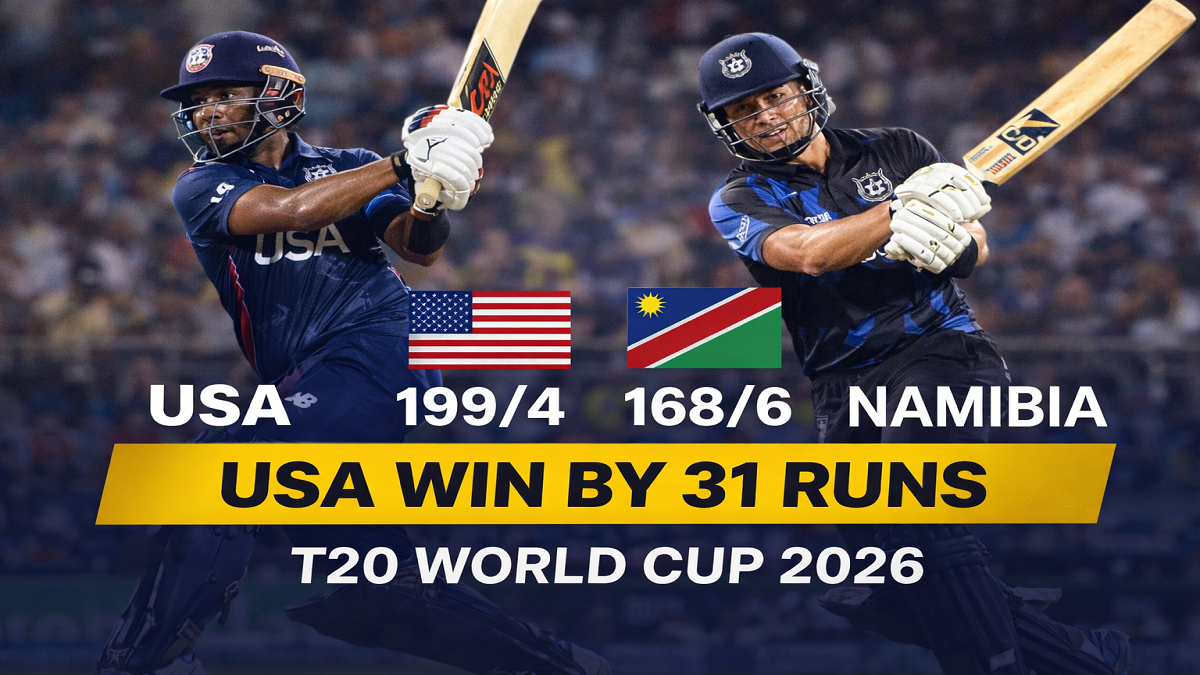
USA vs Namibia match report: USA defend 199/4 in Chennai to beat Namibia by 31 runs in a crucial T20 World Cup 2026 Group A clash.
USA vs Namibia, Chennai: A 31-Run Statement in Group A
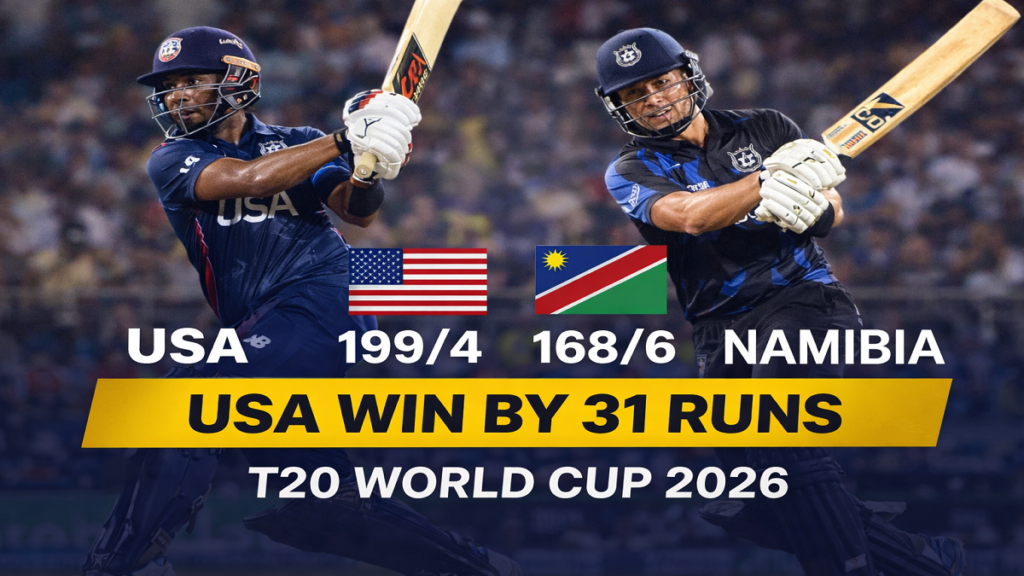
Some wins feel like survival. This one felt like a message. At Chepauk in Chennai, the United States of America put up 199/4 and then defended it with enough control to beat Namibia by 31 runs. The scoreline tells you the margin, but not the shape of the match. This game turned on two things: USA’s powerplay authority with the bat, and a late-innings burst that pushed a good total into a genuinely hard chase.
Namibia did not collapse. They fought. They even looked in the chase for long phases. But they kept losing wickets at the moments when momentum should have become pressure. When you chase 200, you don’t just need boundaries. You need uninterrupted partnerships, because every wicket adds two extra problems: new batters and new field plans.
USA won the toss and chose to bat first. That choice mattered. Chennai can reward teams that bat with clarity up front and then bowl with smart pace changes later. USA did both.
USA vs Namibia: Match Context and Why This Result Matters
Group matches are not only about points. They are about net run rate, confidence, and belief. USA came in knowing they needed to stay alive in the qualification conversation. Namibia came in still searching for a first win. You could see that difference in the intent.
For USA, this was a performance built on intent without chaos. They did not swing wildly from ball one. They attacked the right bowlers, respected the tough overs, and still got to a near-200 total.
For Namibia, the chase had moments where it looked like a thriller could be built. But the innings kept resetting. Each reset made the required rate climb just enough to force risk.
USA vs Namibia: USA Innings
USA’s innings was not one long slog. It was two clear phases.
First came the platform. Then came the finish.
They ended at 199/4 in 20 overs. The base of that total was laid by the captain, and the final push was delivered by a finishing knock that flipped the match.
USA vs Namibia: Powerplay Authority
USA’s openers ensured the early overs belonged to them. Even when Namibia hit a decent length, the USA batters found ways to score. That is often the difference between an “okay” powerplay and a match-winning one.
The scoreboard pressure began early and it never truly went away for Namibia’s bowlers.
USA vs Namibia: Monank Patel’s Knock
Monank Patel played the innings you want from a captain in a high-pressure group match. He scored 52 off 30 balls, striking at 173.33, with 3 fours and 3 sixes.
What made his knock valuable was not only the boundary count. It was his timing. He hit the acceleration gears at the exact point when Namibia were trying to settle after the first wicket. He understood the moment: keep the run rate moving so that the middle overs don’t become a trap.
Patel’s dismissal came when he tried to continue the same aggressive pattern. He was caught at long-on off Myburgh, leaving USA 89/2. But by then, the platform was already strong.
USA vs Namibia: Support Around Him
While Patel led the scoring, the other batters did enough to keep the innings from stalling.
- Shayan Jahangir added 22 off 18 with a boundary and a six.
- Saiteja Mukkamalla scored 17 off 18, which looks quiet, but it helped bridge a phase where Namibia were trying to slow the game.
- Milind Kumar chipped in with 28 off 20 to keep the total moving into the last overs.
This is what good T20 batting often looks like. Not every innings needs three players at strike rates above 180. Sometimes it needs one player to dominate, and the rest to avoid creating dead overs.
USA vs Namibia: Sanjay Krishnamurthi’s Finish
Then came the innings that turned 175 into 199.
Sanjay Krishnamurthi finished unbeaten on 68 off 33 balls, striking at 206.06, with 4 fours and 6 sixes.
That is not simply a cameo. That is a match-defining finish.
The most important part was how quickly he got into the innings. Some finishers need ten balls to find timing. Krishnamurthi found his range and immediately forced Namibia to defend the boundary with deeper fields. Once the boundary riders go back, singles open up. Once singles open up, bowlers have fewer “safe” lines. Then the bad balls appear.
That is exactly how a late-overs innings becomes unstoppable.
USA’s last few overs were decisive because they were not just hitting. They were also rotating enough to ensure Namibia could not settle on one plan.
USA vs Namibia: Namibia’s Best With the Ball
Namibia did have bright spells.
WP Myburgh took 2/22 in four overs. Those wickets were crucial because they arrived when USA were building a big total.
Captain Gerhard Erasmus also took 2/27. His overs mattered, but the key issue for Namibia was the expensive overs around them, including a tough night for Trumpelmann, who conceded heavily.
In a chase, you can hide one expensive over. In a first-innings defence, one expensive over can turn into the difference between 180 and 200.
USA ensured Namibia felt that difference.
USA vs Namibia: Namibia Chase
Namibia finished on 168/6, falling short by 31 runs.
A chase of 200 needs a near-perfect innings or at least one truly big partnership in the middle. Namibia had flashes. They had a strong start. But the innings was repeatedly interrupted.
Steenkamp Leads the Fight: 58 Off 39
Louren Steenkamp was Namibia’s best batter on the day. He made 58 off 39, with 5 fours and 3 sixes, striking at 148.71.
His innings was the engine of Namibia’s chase. It had power, but it also had shape. He kept the required rate within reach through the first half. When you chase a big score, that’s the job of the top order: don’t let the chase become impossible before the final five overs.
Steenkamp did his part. The issue was that he could not find a long enough partner to convert his start into a match-winning partnership.
He fell at 112/3. That wicket was a major turning point because Namibia were still in the chase at that moment. Losing him forced the next batters to either rebuild or swing. Both options were risky.
Loftie-Eaton’s Quick 28 and Namibia’s Early Momentum
Jan Nicol Loftie-Eaton gave Namibia momentum with 28 off 17. His scoring rate was valuable because it matched the chase’s demand. But he was dismissed at 99/2, and that dismissal again prevented Namibia from carrying a set batter deep.
That became the theme.
Middle Overs: The Chase Keeps Resetting
After Loftie-Eaton, Namibia lost rhythm. The captain Erasmus managed only 6 off 10 and was dismissed at 123/4.
This is where large chases often break. A chase can survive one slow innings if another batter is exploding at the other end. But if the chase slows and wickets fall, the required rate jumps into a zone where boundary-or-bust becomes the only plan.
From there, Namibia needed late hitting plus stability. They got some hitting. They did not get enough stability.
JJ Smit’s 31 and the Late Push
JJ Smit made 31 off 23. He tried to keep the chase alive. But when he fell at 19.5 overs, Namibia were already short of the target by a distance.
There was also an unusual moment: Zane Green retired out on 18 off 13. Retire-outs in high chases usually signal urgency — a team trying to maximize boundary potential. It shows Namibia were aware time was slipping.
Even with that move, the target stayed out of reach.
USA Bowling: Enough Discipline, Smart Matchups
USA’s defence was not perfect. Conceding 168 suggests Namibia had scoring opportunities. But the USA bowlers did two things well:
- They took wickets at the key moments.
- They avoided a full collapse of control in the last five overs.
Standout Impact: van Schalkwyk’s 2/30
SC van Schalkwyk delivered one of the most impactful spells: 2/30 in four overs. His wickets came at moments that mattered, including removing Frylinck and then later Erasmus.
In a chase, those wickets are double value. They don’t just remove runs. They remove momentum and force new batters to start against a rising required rate.
Netravalkar’s Control: 1/27 in Four
Saurabh Netravalkar was economical for this kind of chase, finishing with 1/27 in four overs.
When you defend 199, you need at least one bowler to create a “quiet lane” in the innings. Those overs reduce the amount of damage the other bowlers must absorb.
Ranjane’s Key Moment: 1/6
Shubham Ranjane produced a key wicket and finished with 1/6. Even if it was only a short spell, it mattered. Removing Steenkamp at the moment Namibia were still in the chase was massive.
Ali Khan’s 1/43: Expensive, But the Wicket Was Important
Ali Khan went for runs (1/43) but took a late wicket as well. In a chase where batters are forced to swing, expensive overs can happen. The key is whether you also claim a wicket or force a mistake. USA managed enough of those moments to keep control.
Key Turning Points That Decided the Match
1) Krishnamurthi Turning 175 Into 199
The finish changed the match. USA’s total was not just “above par.” It became a chase that demanded a near-perfect innings. Krishnamurthi’s six-hitting ensured Namibia started behind the game.
2) Steenkamp’s Dismissal at 112/3
Steenkamp was set. He was the batter most capable of chasing 200 if he batted deep. Once he fell, Namibia’s chase shifted from “possible” to “needs a miracle.”
3) Wickets Interrupting Partnerships
Namibia’s fall of wickets tells the story: 54, 99, 112, 123, 149, 168. They never produced the long partnership needed to chase 200.
What This Means for Group A
USA took the points, Namibia stayed winless. And beyond points, this win helps USA’s campaign because a 31-run margin matters for net run rate.
From the group table shown with this match coverage, USA’s record and standing improved while Namibia remained at the bottom. In tournaments like this, a single strong win can become the difference later when teams finish level.
For Namibia, the concern is not effort. It’s conversion. They have had competitive phases but not enough full-match execution. They need either a big batting innings from one player who stays to the end, or a bowling performance that keeps opposition totals closer to 160–170.
Final Word
USA earned this win through structure and timing. They batted with intent early, absorbed the middle overs without losing shape, and then exploded at the death through Krishnamurthi’s 68*. Namibia responded with a brave chase led by Steenkamp, but the constant wickets prevented them from building the one thing every big chase demands: continuity.
At the end, 199/4 was simply too much, and USA’s 31-run victory in Chennai became one of those group-stage results that can define a tournament path.
Play Live Cricket
Stay tuned to Play Live Cricket for complete T20 World Cup 2026 coverage, match reports, cricket news, team updates, expert analysis, and breaking cricket news from around the world. We bring you fast, accurate, and detailed cricket insights to keep you ahead of the game.
Disclaimer
This article is based on officially available match data and public scorecards. Statistics and match details are sourced from recognized cricket platforms. Play Live Cricket does not claim ownership of any third-party statistics or broadcast material. All rights belong to their respective owners.