
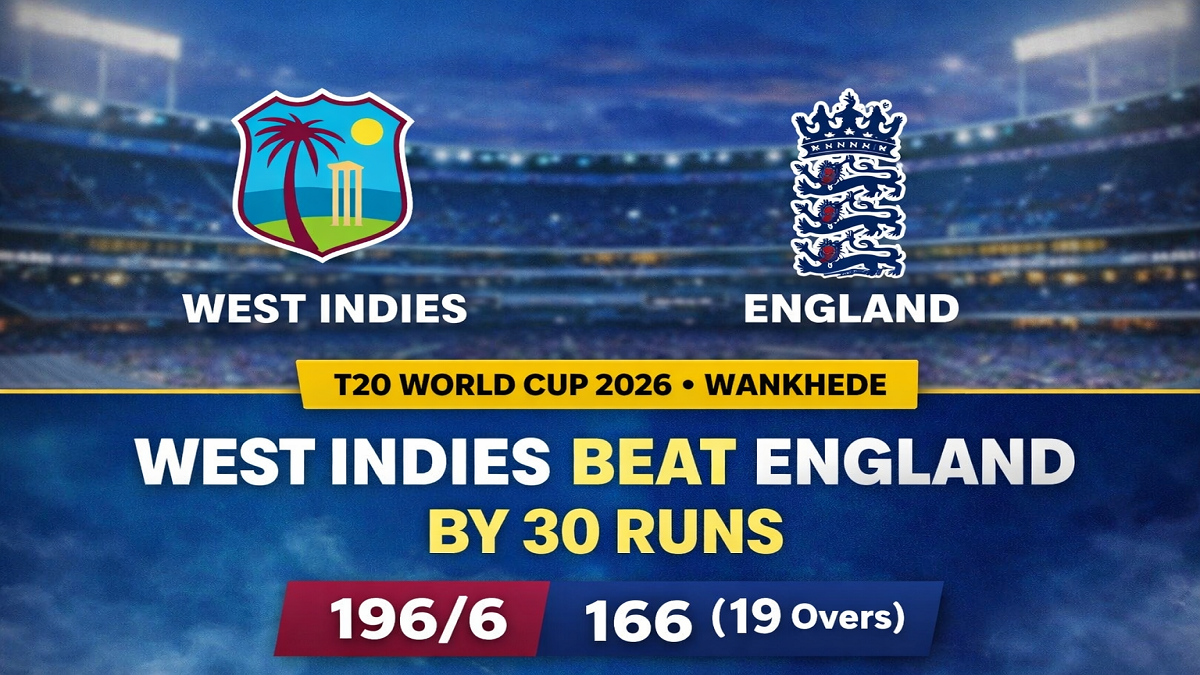
West Indies Beat England by 30 Runs at Wankhede
West Indies Beat England by 30 runs at Wankhede in the T20 World Cup 2026 after 196/6, then bowled England out for 166 in 19 overs.
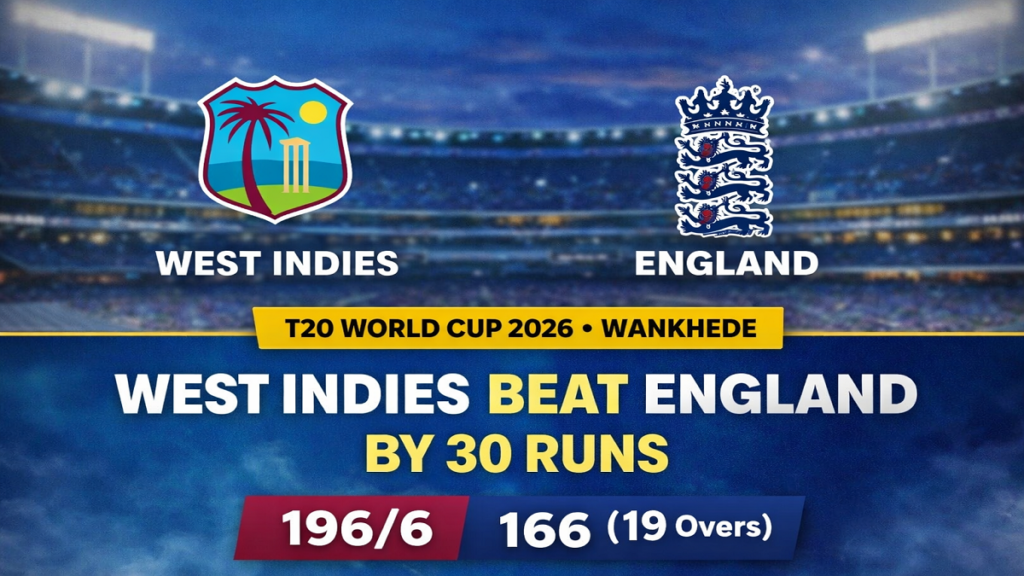
West Indies Beat England by 30 Runs at Wankhede in a Statement Win
Wankhede Stadium has a reputation for turning cricket into a sprint. The boundaries feel close, the outfield feels fast, and the ball often flies when batters commit. On this night in the T20 World Cup 2026, West Indies used those conditions like a home advantage, even though they were the visiting side in every sense. They set the tone with power, supported it with smart rotation, and then defended it with disciplined spin and calm death bowling. When the last wicket fell and the chase ended at 166 in 19 overs, the story became official: West Indies Beat England by 30 runs in a match that swung the Group C conversation.
The scoreboard alone tells you it was a high-scoring contest. West Indies posted 196/6, a total that demands relentless intent from the chasing side. England, for their part, began with the belief you would expect from a team packed with aggressive batters. However, belief is not enough when the required rate starts high and then climbs even higher. West Indies understood that the chase would break if they took wickets in the right overs, and they executed that plan with clarity.
At Play Live Cricket, we look for the “why” behind the result. This win was not an accident. It was built through phases, and each phase carried its own meaning.
Match Context and Why It Mattered
Group-stage matches can sometimes feel routine until the table tightens. This one did not feel routine at any point. West Indies arrived with momentum, and this victory made it two wins in a row, putting them in a strong position in the group. England, meanwhile, felt immediate pressure after the defeat, because tournament math becomes harsh very quickly. In fact, match reports noted England’s margin for error had effectively vanished after this result.
That is why the performance mattered beyond the points. West Indies did not just win. They won with authority, and they did it against a high-profile opponent whose brand is built on fearless chasing. When a team beats England while defending a big total, it sends a message to the rest of the competition: you can’t rely on reputation alone in this World Cup.
West Indies Beat England by 30 Runs After Turning 196/6 into Real Pressure
A total of 196/6 at Wankhede is strong, but it becomes truly dangerous when it is built in a way that forces the chasing side to take risks early. West Indies did exactly that. Rather than wasting overs, the batters kept the tempo high from the start. They also prevented England’s bowlers from settling into repeatable lines, which kept pressure on the fielding side. Even the so-called “quiet” overs moved the scoreboard forward, and that matters in T20 cricket because it stops the bowling unit from gaining a sense of control.
The innings had two clear ideas: keep wickets in hand, and keep the run rate healthy. West Indies managed both. They lost wickets, but they did not lose shape. That difference is crucial. Many teams score 190 by throwing everything at the last five overs. West Indies built their platform in a way that made the finish feel natural rather than forced.
West Indies Beat England by 30 Runs: Rutherford’s Role as the Backbone of the Innings
Every big total needs one innings that gives the scoreboard stability. On this night, that innings came from Sherfane Rutherford, who played a match-defining knock, finishing unbeaten on 76 from 42 balls. The value of such an innings is not only the boundaries. It is the way it organizes everyone else around it.
When a batter stays in deep, the rest of the lineup can play their roles with clarity. One player can take calculated risks. Another can focus on strike rotation. The finishing hitters can wait for the exact moment to explode. Rutherford’s innings created that comfort. It also created fear, because England knew that removing him would not rewind the damage already done.
Crucially, his six-hitting changed the psychological balance. Reports highlighted that he struck seven sixes, which is the kind of impact that forces captains to protect boundaries instead of attacking stumps. Once a bowling side starts protecting boundaries too early, singles become easy. Then, overs that should cost seven start costing nine. That is how 175 becomes 196.
The Late Surge That Took the Total Beyond “Chaseable”
One of the cleanest indicators of a dominant T20 batting display is what happens between overs 16 and 20. If a team finishes with control, the total often jumps by 40 to 60 runs in that window. West Indies did exactly that, and a key late contribution came from Jason Holder, who hammered 33 from 17 balls.
That cameo mattered because it changed the target from “very hard” to “borderline brutal.” Chasing 180 at Wankhede is a challenge. Chasing 197 forces constant aggression. Constant aggression invites wickets. Wickets create new batters under pressure. Pressure creates mistakes. West Indies understood that chain perfectly, and their finishing overs were designed to start it.
West Indies Beat England by 30 Runs: England’s Bowling Story and the ‘‘One Bright Over’’ Problem
When a team concedes 196, it is usually because multiple bowlers have expensive spells. England did have one standout performance with the ball: Adil Rashid delivered a high-class spell, giving away just 16 runs and taking two wickets. However, one brilliant spell cannot fully control a T20 innings if support around it leaks runs.
That’s the hard reality of this format. A team needs at least two bowlers to apply pressure at the same time. Without that, batters simply wait out the tight overs and attack everyone else. West Indies played that game well. They absorbed Rashid, then punished the overs around him. That is how you beat good bowling without needing to dominate every single ball.
England’s Chase and the Weight of a High Required Rate
Chasing 197 changes how you bat. You cannot “start steady.” Even a normal over of six or seven feels like a loss. That mental weight pushes batters into boundary hunting earlier than they would like. England began with intent, yet intent alone does not guarantee control.
Here is the corrected version with improved flow and no consecutive “They” sentence starters:
As the chase progressed, West Indies kept England in a state of discomfort. Boundaries became slightly harder to find, which increased scoreboard pressure. The bowlers kept the stumps in play consistently, forcing batters to think twice before committing to big shots. In addition, subtle variations in pace prevented England from lining up predictable deliveries. Although scoring opportunities appeared at times, sustained partnerships never truly developed, and that ultimately made the chase feel unstable.
When chases fail from big targets, it is often because of a simple pattern: the required rate rises while wickets fall. England fell into that pattern. Once the chase became a series of short bursts instead of a stable climb, West Indies gained control.
Why Spin Was the Real Control Lever
Wankhede is often described as a pace-friendly batting venue, yet spin can still dominate if it is used correctly. The key is not turn. The key is pace change, angle, and field discipline. West Indies used their spinners in exactly that way, and match coverage pointed to Gudakesh Motie as a major turning point with figures of 3/33.
Motie’s spell mattered because it arrived at the moment when England needed stability. Even more importantly, he removed England’s captain Harry Brook, a wicket that shifted leadership pressure onto the remaining batters. In T20 chases, the captain’s wicket often changes the tone. It signals that the chase has moved from confident to uncertain.
Roston Chase also played a key role in the middle overs, taking important wickets and keeping scoring zones tight. The combined effect was clear: England did not lose because they stopped trying. They lost because West Indies repeatedly broke momentum.
West Indies Beat England: The Wickets That Changed the Chase Shape
Big chases are rarely lost in one over. They are usually lost through a sequence of “mini losses.” A batter gets out just as they begin timing the ball. A partnership ends before it can grow. A quiet over follows a boundary over. Then the required rate spikes again.
England suffered from those mini losses. Reports noted key wickets including Jos Buttler and Will Jacks, which meant the side kept losing power at moments when calm aggression was required. Every dismissal forced the innings to reset, disrupting rhythm and momentum. As partnerships broke, valuable time slipped away. With each lost over, the target began to feel heavier and increasingly out of reach.
Even when one batter tried to hold the chase together, the support around them was not enough. That is the hidden danger of chasing 197: one good innings still needs partners, because the total demands multiple contributors, not just one.
Sam Curran’s Resistance and Why It Was Not Enough
England did have fight. Sam Curran finished unbeaten on 43, providing some resistance as wickets fell around him. Still, T20 chases do not reward resistance unless it comes with sustained boundary flow. Once partners kept falling, Curran’s job became impossible. He had to protect his wicket and attack at the same time.
That is the cruel equation of a steep chase. If you play too safely, the required rate becomes absurd. If you attack too early, you risk getting out and ending the chase immediately. West Indies forced England into that exact trap, and once England fell into it, the chase stopped feeling in control.
Death Overs and Why England Folded at 166 All Out
England ended all out for 166 in 19 overs. That detail matters because it shows the chase did not simply “finish short.” It collapsed while trying to catch up. When teams go all out in chases, it usually means they reached a stage where they had no choice but to swing.
West Indies handled those final overs with discipline. Rather than searching for magic deliveries, they stuck to high-percentage plans: bowl into the pitch, protect the straight boundary, force big hits to the longer side, and keep the stumps in play. Those plans do not always look flashy, but they win matches consistently.
A 30-run margin in a high-scoring match is significant. It indicates that West Indies had control for more of the game, even if the chase had exciting moments.
Tactical Lessons from the West Indies Batting Blueprint
This match offered a clean batting lesson for tournament cricket.
West Indies did not build 196/6 through chaos. They built it through a controlled template:
- Start with purpose, not panic.
- Keep the run rate alive with rotation.
- Save the biggest swings for the last five overs.
- Protect wickets just enough to ensure a powerful finish.
Rutherford’s anchoring role and Holder’s late impact fit that template perfectly. England’s best bowling spell came from Rashid, yet West Indies still reached 196 because the template spreads scoring responsibility across phases.
That is how strong T20 teams bat. They do not rely on miracle overs. They manufacture pressure.
West Indies Beat England: Tactical Lessons from the West Indies Bowling Plan
The bowling lesson was just as clear. When defending a big total, you don’t need wickets every over. You need wickets at the right times. West Indies targeted England’s momentum overs and broke them. Motie’s 3/33 did exactly that, and the wicket of Brook added weight to the chase.
Another key point was fielding discipline. When defending nearly 200, you must save singles early so that batters feel pressure to attack. If you allow easy ones, the chase becomes smooth. West Indies were sharper, and sharpness matters because it creates extra dot balls without needing a perfect delivery.
West Indies Beat England: What It Means for West Indies Going Forward
This win strengthened West Indies’ tournament position, not only through points but also through confidence. Match reports described it as their second straight victory, which matters because momentum in World Cups often builds quickly.
Additionally, the result reinforced the team’s overall balance. The batting unit proved it can reach 196 without reckless aggression, while the bowling attack demonstrated it can defend that total effectively with spin playing a central role. Late-order hitters once again showed their ability to push scores beyond par. Together, those qualities create a dangerous combination in knockout phases, where even one loose over can decide a campaign.
West Indies Beat England: What It Means for England and Their Next Steps
From England’s perspective, this defeat created urgency. Coverage emphasized that England had little or no margin for error after losing this game. That kind of pressure can either sharpen a team or break rhythm.
Tactically, England will likely focus on two areas after this match. They need better containment around their best bowler, because Rashid’s excellence did not translate into overall control. They also need more stability in big chases, because losing wickets while chasing 197 makes even Wankhede feel massive.
The positive for England is that T20 tournaments move fast. One strong win can change a group narrative. Yet they will need to respond immediately, because the table does not wait for teams to “find form.”
Final Verdict: West Indies Beat England by 30 Runs with Power, Planning, and Poise
This match was not decided by luck. West Indies earned it. They built 196/6 with smart aggression, then defended it by breaking England’s chase at key moments. Rutherford’s unbeaten 76 gave the innings its spine, Holder’s 33 gave it its late punch, Motie’s 3/33 gave the chase its turning point, and Rashid’s 2-for-16 stood out as England’s best resistance with the ball.
Wankhede demanded fearless cricket, and West Indies delivered it with structure. That is why West Indies Beat England by 30 runs—and why the rest of Group C will take notice.
Play Live Cricket
Stay connected with Play Live Cricket for match summaries, series updates, and women’s cricket coverage with clean, reader-friendly analysis.
Disclaimer: This match report is based on publicly available score information and is written for news and informational purposes.